|
Sunday, February 8, 1–4pm
Alameda 6, San Antonio
free
Español abajo
The Beauty of Black
Black is an ancient color, the first color, the first charcoal drawing dated 35,000 BCE.
Black is serious as in clerical robes and funeral attire.
Black is elegant as in the little black dress and the black tie affair.
Black is dark as in pitch, ink, paint.
Black is deep as in the sea, the night, outer space.
Black has two opposite definitions. It is the lack of all colors of light, or a combination of multiple colors of pigment. The latter definition applies to the arts.
Black is pervasive in the art world. It appears in Chavaux cave drawings, in Greek black figure pottery, in Renaissance portraiture, and in Chinese pottery. The ultimate expression of blackness is the Rothko Chapel housing fourteen massive dark paintings. The work has no subject matter. It has been documented these paintings have evoked the most tears shed by people in front of a work of art.
Artists Shahastra Levy and Kathleen Cammarata explore the beauty of black both in drawings and paintings.
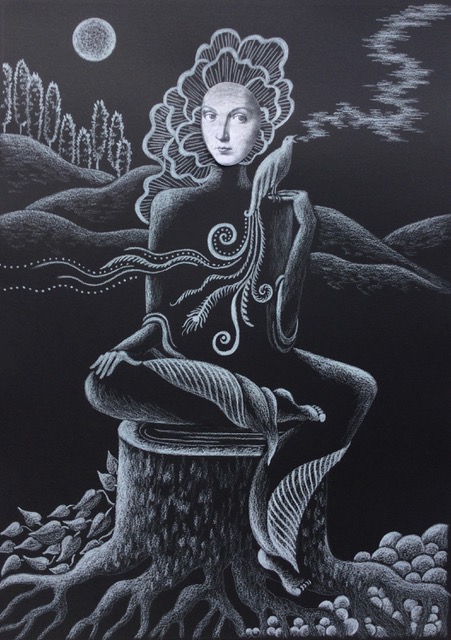
In Levy’s drawings black is perceived as the color of the Great Mystery, out of which all life is born. The “womanBEING” series—where the word BEING is both a noun and a verb—are white pencil on black paper portraying sovereign women holding potent aspects of the Feminine Principle. Deeply connected to the elemental earth as well as the vast galaxy, these iconic women stand in places of intuition, wisdom and strength imparting subtle messages to the soul. In her drawing “Abiding” we see a woman with a raised hand encircled by a halo against a night sky. She stands connected to earth and sky, her hand a shining symbol of her innately wise self.
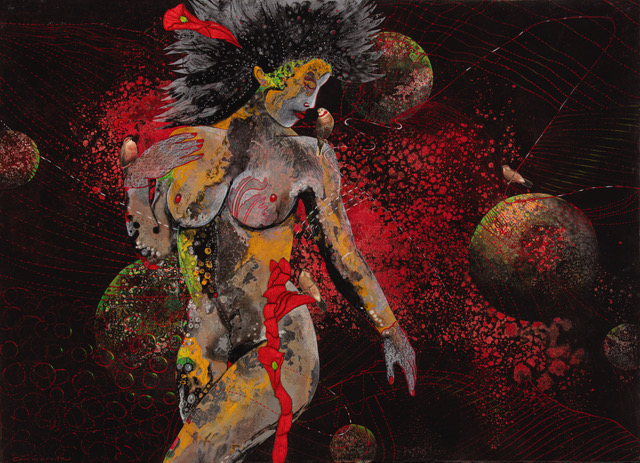
In Cammarata’s work she employs black as deep space. Black is both dense and void. It allows form into being, forms that rise, fall, float, and fade. There is a collapse of distinction between representative and non-representative. The blackness defines the relationships of the forms and enhances the colors giving them luminosity. In the painting “Eloquent Spin” we can see the deep space and the glow of the yellows and reds.
Cammarata has been painting for 45 years. She taught in two museums and at the University of Massachusetts Lowell. She has received numerous grants and awards. Her work is collected in the USA, Canada, and Mexico. She lives and works in San Miguel.
Levy is an author/illustrator, designer and painter. Drawn to the transformational soul qualities of art making, she works to transfer that essence into images and forms that inspire and provoke. Her series of 50 white on black drawings express this transformation. Her work can be found in both private and corporate settings.
La belleza del negro
El negro es un color antiguo, el primer color, el primer dibujo en carbón fechado en el 35,000 a. C.
El negro es serio, como en las túnicas clericales y la vestimenta funeraria.
El negro es elegante, como en el pequeño vestido negro y los eventos de etiqueta.
El negro es oscuro, como el alquitrán, la tinta, la pintura.
El negro es profundo, como el mar, la noche, el espacio exterior.
El negro tiene dos definiciones opuestas. Es la ausencia de todos los colores de la luz, o la combinación de múltiples colores de pigmento. Esta última definición se aplica a las artes.
El negro es omnipresente en el mundo del arte. Aparece en los dibujos de la cueva de Chauvet, en la cerámica griega de figuras negras, en el retrato renacentista y en la cerámica china. La máxima expresión de la negrura es la Capilla Rothko, que alberga catorce enormes pinturas oscuras. La obra no tiene tema. Se ha documentado que estas pinturas han provocado la mayor cantidad de lágrimas derramadas por personas frente a una obra de arte.
Las artistas Shahastra Levy y Kathleen Cammarata exploran la belleza del negro tanto en dibujos como en pinturas.
En los dibujos de Levy, el negro se percibe como el color del Gran Misterio, del cual nace toda la vida. La serie “womanBEING”—donde la palabra BEING es a la vez sustantivo y verbo—son dibujos a lápiz blanco sobre papel negro que representan mujeres soberanas portadoras de potentes aspectos del Principio Femenino. Profundamente conectadas con la tierra elemental así como con la vasta galaxia, estas mujeres icónicas se sitúan en lugares de intuición, sabiduría y fuerza, impartiendo sutiles mensajes al alma. En su dibujo “Abiding”, vemos a una mujer con la mano levantada, rodeada por un halo contra un cielo nocturno. Ella permanece conectada a la tierra y al cielo, su mano un símbolo radiante de su sabiduría innata.
En la obra de Cammarata, ella emplea el negro como espacio profundo. El negro es tanto denso como vacío. Permite que la forma llegue a ser, formas que ascienden, caen, flotan y se desvanecen. Hay un colapso de la distinción entre lo representativo y lo no representativo. La negrura define las relaciones entre las formas y realza los colores dándoles luminosidad. En la pintura “Eloquent Spin” podemos ver el espacio profundo y el resplandor de los amarillos y rojos.
Cammarata ha pintado durante 45 años. Ha enseñado en dos museos y en la Universidad de Massachusetts Lowell. Ha recibido numerosas becas y premios. Su obra se encuentra en colecciones de Estados Unidos, Canadá y México. Vive y trabaja en San Miguel.
Levy es autora/ilustradora, diseñadora y pintora. Atraída por las cualidades transformadoras del alma en la creación artística, trabaja para transferir esa esencia a imágenes y formas que inspiran y provocan. Su serie de 50 dibujos en blanco sobre negro expresa esta transformación. Su obra se encuentra tanto en espacios privados como corporativos.
******
***
Please contribute to Lokkal,
SMA's non-profit community publication:

|
|