|
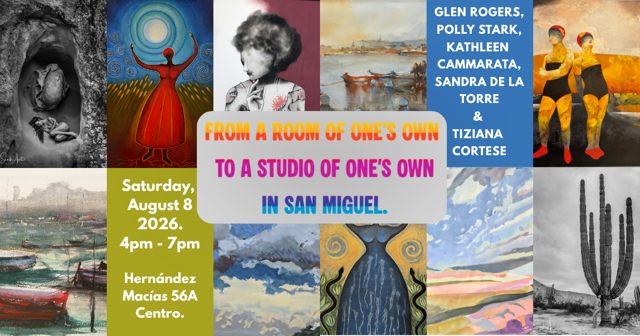
Saturday, August 8, 4-7pm
TINTA&tiempo, Hernández Macías 56a
free
Español abajo
From A Room of One's Own to a Studio of One's Own
in San Miguel de Allende
In 1929, when Virginia Woolf wrote her celebrated essay A Room of One's Own, she articulated
a profound argument for women's emancipation within the sphere of art, exposing what was
then an unmistakably male-dominated social and cultural order. As is well known, she illustrates
her thesis through literature by imagining the life of Judith, William Shakespeare's gifted sister.
With her extraordinary command of language—so capable of drawing readers into richly
detailed descriptions and evocative atmospheres—Woolf immerses us in a reality that exalts
and privileges men while, by contrast, questioning and obstructing women. In 1928, one year
before this landmark essay was published, British women had finally secured the right to vote
on equal terms with men. Across the Atlantic, women in the United States had obtained this
right in 1920; in Mexico, however, another thirty-three years would pass before women achieved
this same milestone, gaining a fundamental political, economic, and social freedom.
There are many ways to approach women's artistic production, though I personally prefer to
speak of creation rather than production. The term is closely linked to the idea of gestation,
which, in this context, becomes an ontological concept—a key word because of its direct
connection to the Self. To create, in its deepest sense, is to gestate. It is to give visible form to
something that previously existed only as intuition.
From this perspective of gestation, one hundred years after Woolf's reflections, and following
decades of activism and meaningful cultural change, women artists in England, the United
States, and Mexico—the countries referenced in these pages—continue to confront challenges
while practicing their art with freedom. Economic independence, freedom of action, technical
mastery, and the confidence to cultivate an authentic voice are the foundations upon which this
exhibition stands. The five artists gathered here—Glen Rogers, Polly Stark, Tiziana Cortese,
Kathleen Cammarata, and [artist's name]—belong to a generation of women for whom the
studio no longer represents an exceptional privilege but rather a hard-won territory from which
to imagine, investigate, and create.
If Virginia Woolf argued that a room of one's own was a necessary condition for writing, these
artists remind us that a studio of one's own is far more than a place to work. It is where
imagination finds refuge, where craft becomes language, and where the inner world takes form.
Self: In Jungian psychology, the Self represents the totality of the psyche, integrating both the conscious and the
unconscious. It is the central archetype of the personality, and the process of individuation consists precisely in the
gradual movement of the ego toward the Self.
San Miguel de Allende, Summer 2026
ALEJANDRA BUSTAMANTE
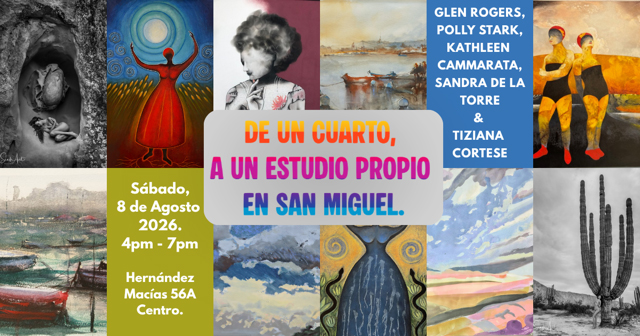
De Un cuarto propio a un estudio propio en San Miguel de Allende
En 1929, cuando Virginia Woolf escribió su celebrado ensayo Un cuarto propio, articuló un argumento profundo a favor de la emancipación de las mujeres dentro de la esfera del arte, exponiendo lo que era entonces un orden social y cultural inequívocamente dominado por los hombres. Como es bien sabido, ilustra su tesis a través de la literatura al imaginar la vida de Judith, la hermana dotada de William Shakespeare. Con su extraordinario dominio del lenguaje—tan capaz de sumergir al lector en descripciones ricamente detalladas y atmósferas evocadoras—Woolf nos sumerge en una realidad que exalta y privilegia a los hombres mientras que, por contraste, cuestiona y obstaculiza a las mujeres. En 1928, un año antes de que se publicara este ensayo emblemático, las mujeres británicas habían finalmente conseguido el derecho al voto en igualdad de condiciones con los hombres. Del otro lado del Atlántico, las mujeres en Estados Unidos habían obtenido este derecho en 1920; en México, sin embargo, pasarían otros treinta y tres años antes de que las mujeres alcanzaran este mismo hito, ganando una libertad política, económica y social fundamental. Existen muchas maneras de abordar la producción artística de las mujeres, aunque personalmente prefiero hablar de creación en lugar de producción. El término está estrechamente vinculado a la idea de gestación, la cual, en este contexto, se convierte en un concepto ontológico—una palabra clave por su conexión directa con el Sí Mismo. Crear, en su sentido más profundo, es gestar. Es dar forma visible a algo que anteriormente existía solo como intuición.
Desde esta perspectiva de la gestación, cien años después de las reflexiones de Woolf, y tras décadas de activismo y de un cambio cultural significativo, las mujeres artistas en Inglaterra, Estados Unidos y México—los países referidos en estas páginas—siguen enfrentando desafíos mientras practican su arte con libertad. La independencia económica, la libertad de acción, el dominio técnico y la confianza para cultivar una voz auténtica son los cimientos sobre los que se sostiene esta exposición. Las cinco artistas reunidas aquí—Glen Rogers, Polly Stark, Tiziana Cortese, Kathleen Cammarata y [nombre de la artista]—pertenecen a una generación de mujeres para quienes el estudio ya no representa un privilegio excepcional sino más bien un territorio arduamente ganado desde el cual imaginar, investigar y crear.
Si Virginia Woolf argumentó que un cuarto propio era una condición necesaria para escribir, estas artistas nos recuerdan que un estudio propio es mucho más que un lugar de trabajo. Es donde la imaginación encuentra refugio, donde el oficio se convierte en lenguaje, y donde el mundo interior toma forma. Sí Mismo: En la psicología jungiana, el Sí Mismo representa la totalidad de la psique, integrando tanto lo consciente como lo inconsciente. Es el arquetipo central de la personalidad, y el proceso de individuación consiste precisamente en el movimiento gradual del ego hacia el Sí Mismo.
San Miguel de Allende, Verano de 2026 ALEJANDRA BUSTAMANTE
******
***
Please contribute to Lokkal,
SMA's non-profit community publication:

|
|