 Español
December 7, 2025
by Dr. David Fialkoff, Editor / Publisher
A new guy in town stands alone each week, behind a pair of sunglasses, in the shade on the edge of the Saturday Market observing the crowd. The first week, we exchanged hellos. The next Saturday I went up, briefly welcoming him to our fair city. Last Saturday, we were both more talkative. A professional poker player, he holds his cards close to his chest, observing the room. But he's friendly enough, and I'm in no rush.
While we were speaking, and much to my advantage in presenting myself, a woman, who was also a stranger to me, came up and asked if I were the author of these Sunday articles. When I acknowledged that to be the case, she thanked me warmly, telling me how much she enjoys reading each one. I thanked her in turn and tried to engage her in conversation, but she scooted off to buy her vegetables.
When she took her leave, I said to the card-player, "I write to be read. But I also write because I have to." Let me explain:
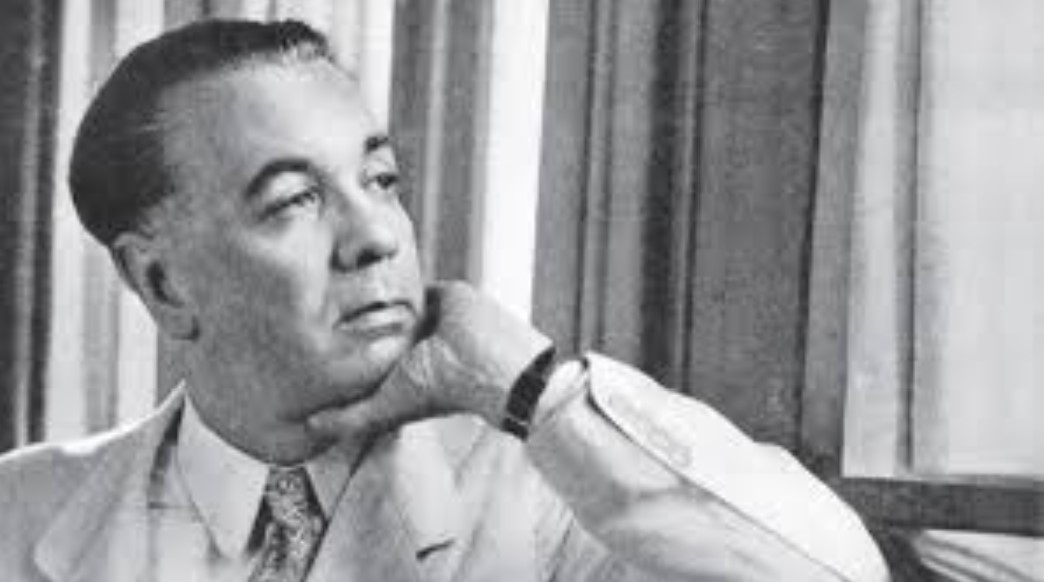
Borges
In his short story "The Circular Ruins," Jorge Luis Borges tells the tale of a man who arrives at an ancient ruin determined to dream another human being into existence, detail by detail, with the goal of giving that person a real life in the physical world. Through intense dreaming and ritual concentration, he gradually succeeds, only to then discover that he himself is the product of another's dream. Writing for me is like that, dreaming and ritual concentration; if not creating my life in the physical world, at least weaving the strands together.
Dylan
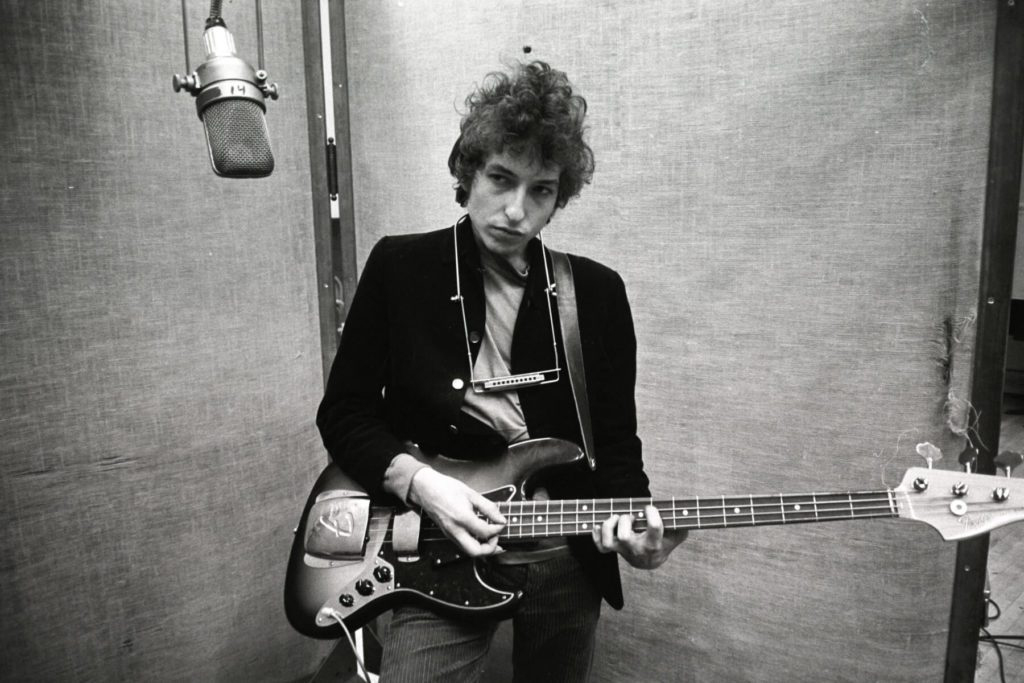
In Bob Dylan's 60 Minutes interview (2004, Ed Bradley), Dylan explained that many of his early songs didn't feel consciously authored in the normal sense. They seemed to arrive already formed, rather than being composed line-by-line; given, not engineered. He said he couldn't explain where they came from. They emerged intuitively rather than intentionally.
Dylan's sense of creative transmission rather than deliberate composition parallels Borges's theme. The dreamer/author doesn't "invent" so much as channel. Creation doesn't always feel like an act of will. Often it is mysterious even to the creator. Authorship loops back on itself: who is making whom?
Escher
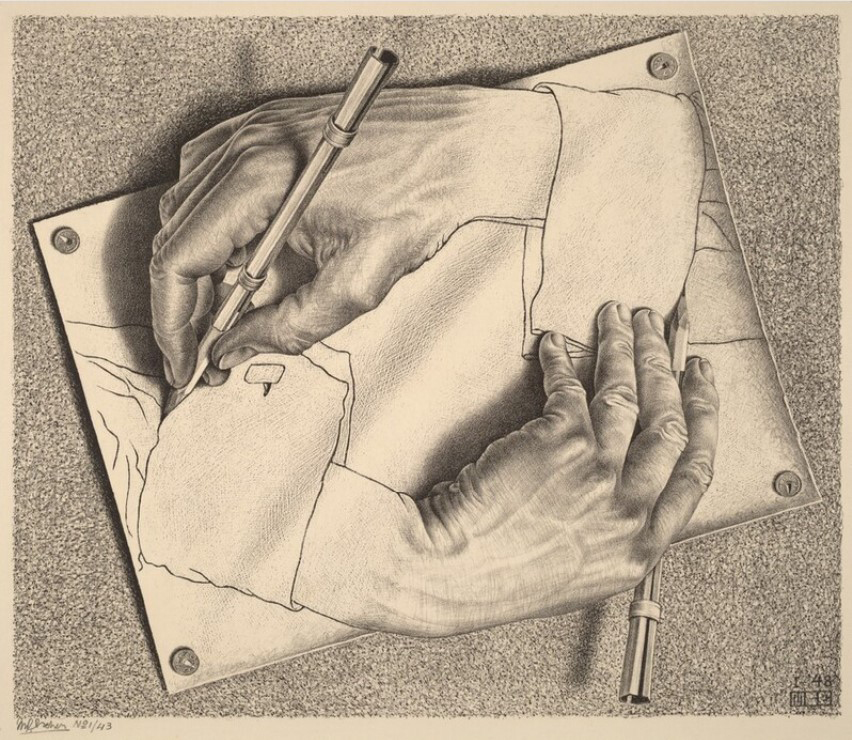
My writing process regularly puts me in mind of Escher's Drawing Hands (1948). The famous lithograph of two hands drawing each other is a metaphor for self-creation, circular causality. It explores the very problem Dylan gestures toward when he says he didn't know where his songs came from, and the same theme that Borges addresses in stories where the creator is created by his creation.
In Drawing Hands each hand is both cause and effect. There is no "first mover." The image creates a closed loop, a creative Möbius strip. Origin cannot be localized. It is autopoiesis, systems creating and sustaining themselves. It is recursive, outputs becoming inputs. Creation is not linear. It is circular. The maker is made by what they make.
Science
Neuroscience confirms this poetic, mystical worldview. Creative insights often come from the "default mode network," a brain network active during mind-wandering, reverie, and associative thinking. When the conscious "author" loosens control, the brain recombines memories, fragments, emotions, and symbols into something new... often suddenly. Conscious authorship comes after the fact. We experience the result first and then claim ownership. This is why creativity often feels impersonal and intimate at once. It arises from you, but not from the deliberate you, who plans the steps involved.
According to science, there is an instability of authorship, the illusion of a single origin point. But there is no single author in the brain. What we call "I" emerges from distributed neural processes, including recursive feedback loops and the predictive modeling of the body and world. The brain doesn't just perceive reality. It predicts, receives sensory feedback, revises the prediction and feels ownership of the result. But consciousness itself is constructed; the brain models itself by modeling the world. Creation doesn't flow one way. Creator and created co-generate each other.

Zen
Zen goes even deeper. It asks: Who thinks the thought? Who hears the sound? Who creates the poem? And then Zen answers that there is no independent "who" which can be found. Zen doesn't deny experience. It denies the separate author standing behind and outside of experience. There is hearing, but the hearer is conceptual. There is thinking, but the thinker is inferred. There is writing, but the author is an afterthought. The brain feels ownership, but the best of life is not something that I do, but something that happens through me, when I am not. "The painter is the painting." "Wind moves, not the flag."
Levin
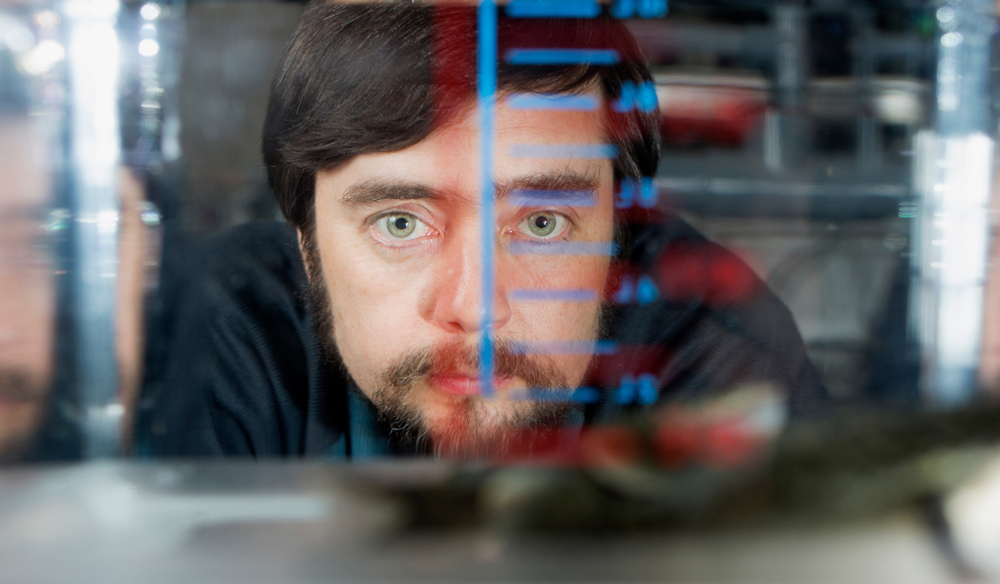
Leading consciousness researcher, Michael Levin of Tufts University flirts with animism, the ancient and formerly universal idea that consciousness is ubiquitous. What Levin has actually shown is that primary aspects of consciousness: goal-directed behavior, problem-solving, and memory, exist far below the level of brains or neurons, in cell collectives, tissues, and even single cells.
Living systems: cell collectives, tissues, and even single cells, operate within what Levin calls a "cognitive light cone." Each system within its cognitive light cone has a local perspective and acts to maintain or achieve internal goals related to what it can sense and influence. This implies that mind or cognition is continuous in nature, rather than something that suddenly turns on once neurons appear.
I Ching and AI
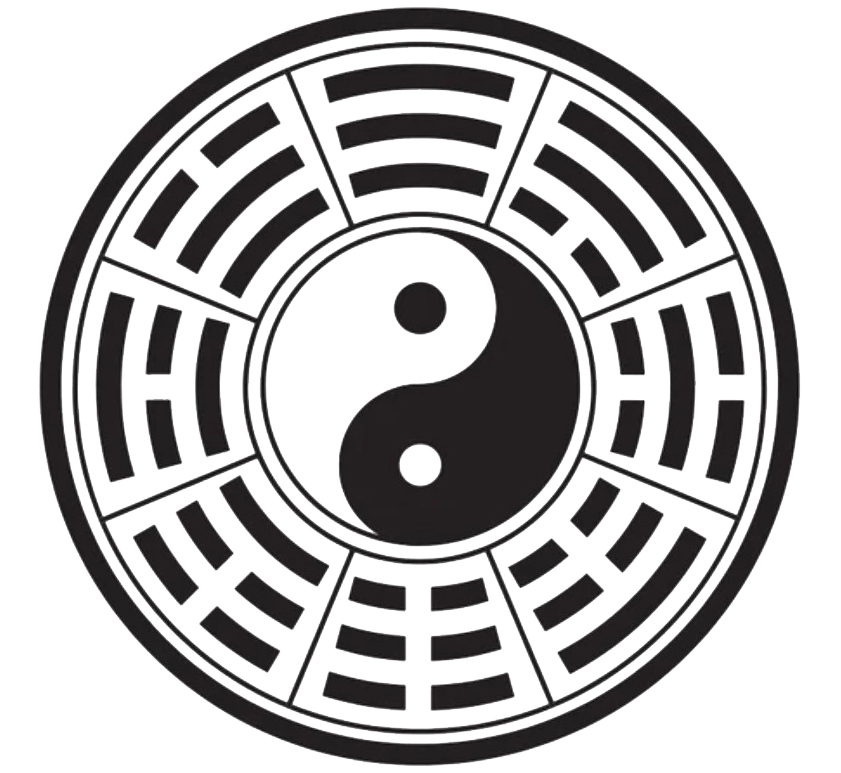
The I Ching is a Chinese fortune-telling system involving 64 hexagrams, each with its own interpretation, recorded in commentary in a book. A question is asked. Then coins are tossed, or yarrow sticks are employed to determine which hexagram should be consulted to answer that question. This ancient Chinese oracular system and our modern artificial intelligence have a lot in common.
The I Ching and AI are both "question mirrors." Neither system possesses consciousness in the ordinary sense. Neither has subjective experience, intrinsic goals, emotions, nor awareness of being asked questions. But both do something psychologically profound. They act as participatory meaning generators.
Their intelligence emerges not from the system alone, but from the interaction loop: human intention → structured randomness → patterned output → human interpretation → further questioning. This is a cognitive feedback loop, very similar to reading poetry or interpreting dreams.
Zen makes heavy use of these mechanisms. Koans are not meant to give answers. They are meant to reshape how the questioner thinks. The answer isn't in the text. It is in the mind that wrestles with it. As with the I Ching, so with AI, at least as important as the answer is how we ask the question. In Zen an improperly framed question produces confusion; a deeply penetrating question dissolves the questioner.
In Levin's work, this principle appears in that the scale of the question determines the scale of the intelligence: cells reorganize differently depending on how problems are posed to them; larger-scale integration yields smarter problem-solving. In quantum physics observation is participatory; outcomes depend on how the system is interrogated.
The I Ching and AI are not conscious in the experiential sense. They do not feel or know themselves. But they function as cognitive mirrors, idea attractors. They become consciousness-amplifying tools, scaffolding for introspection. In Buddhist terms, they are upaya, skillful means: techniques that evoke insight without themselves being aware.

Last Saturday, while the music played, and the poker player was telling me about himself, he asked, "Do you play cards?" Now everybody has played cards. What he wanted to know was if I were a card-player, that is, would I get his metaphor, could I understand his attitude towards the game. I replied by singing (a verse from The House of the Rising Sun), "My father was a gambling man," which happens to be the truth. He told me, "Ninety percent of all hands in poker are crap. It's how you play the other players."
When all you have is a hammer, everything looks like a nail. When you publish a magazine, everything sounds like an article. Standing there in the shade I was sure that my new acquaintance has some stories to tell. But while everybody can put words on a page, but not everyone is a writer. Not everyone likes to write. Maybe next Saturday I'll ask him.
Me? I like to write, and I have to — I want to see how the story turns out.
**************

Dr. David Fialkoff presents Lokkal, public internet, building community, strengthening the local economy. If you can, please do contribute content, or your hard-earned cash, to support Lokkal, SMA's Voice. Use the orange, Paypal donate button below. Thank you.
**************
*****
Please contribute to Lokkal,
SMA's online collective:
 ***
***
Discover Lokkal:
Scroll down SMA's Community Wall below.
Mission

Visit SMA's Social Network
Contact / Contactar