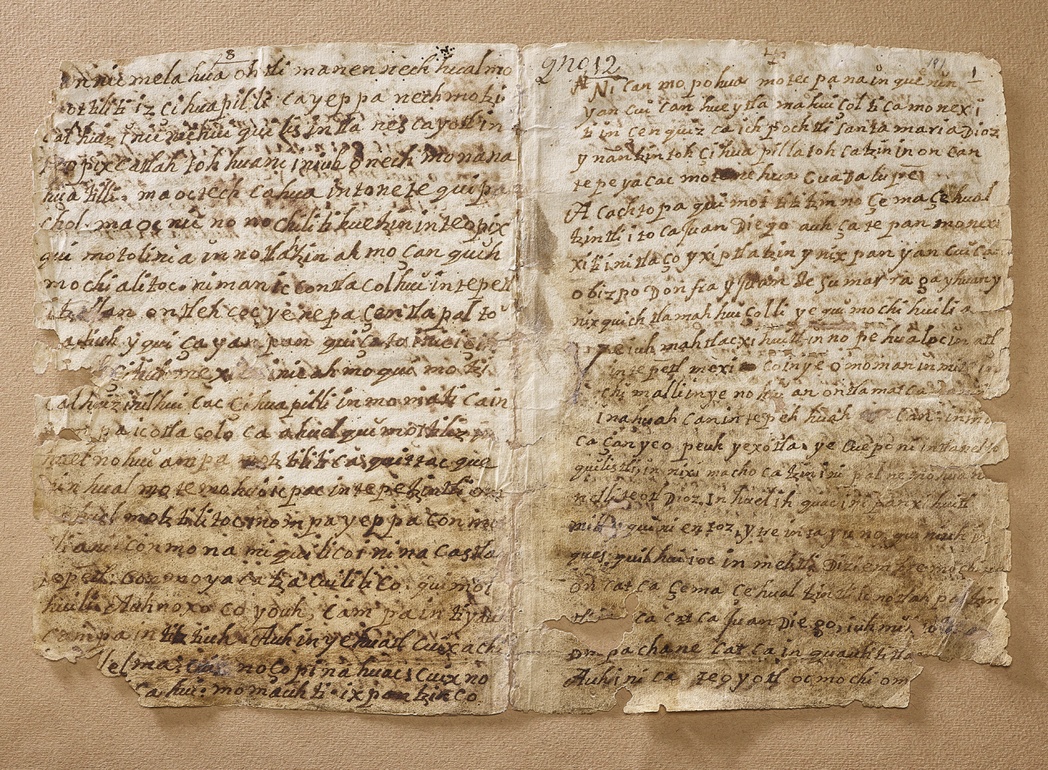
Nican Mopohua (manuscript)
Español
December 14, 2025
by Philip Gambone
December 12 is the day set aside to honor the Virgin of Guadalupe, the patron saint of Mexico. The fervent devotion she inspires among Mexican Catholics as a symbol of God's love for the poor and oppressed is very much alive today. To a certain extent, she has also been secularized, a symbol of some of the best Mexican values in general—the Mexico of gentility, faithfulness, patience, and tranquilidad, the Mexico beneath the surface of gleaming skyscrapers, cartel violence, and beach-resort tourism. Her image is inescapable. The story of her miraculous appearance in December 1531 to a lowly Indian peasant named Juan Diego is perhaps less well known.
In the December 25, 1948 edition of Collier's magazine, the American writer John Steinbeck published his version of the story, entitling it "The Miracle of Tepayac." In the plainspoken style that characterized Steinbeck's two Mexican novels—The Pearl and Tortilla Flat—he began the magazine piece with Juan Diego's sorrow at the death of his wife, a bereavement that sent him "wandering over the hills, spending his strength the way a grieving man does."
One December day, Juan Diego "arose before dawn and walked through the frost of the harsh and stony land" to the hill of Tepayac. Climbing the hill at the break of day, he was surrounded by the singing of many birds, a music that seemed to come from everywhere. Steinbeck writes, "He looked up the hill and the dawn light was brighter than any he had ever seen; the music swelled and echoed about him." He went toward the light that was shining from the hilltop and heard a voice that said, "Juan Diego, come here."
Suddenly, his grief was gone "and the fullness of beauty was in him." Running up to the brow of the rocky hill, he saw the Queen of Heaven surrounded by light. The stones on the hill "glittered like jewels." Juan Diego gazed at her for a moment, and then backed away in shyness and fear. The vision spoke to him: "I am Mary, the Mother of Jesus. And I wish that on this bleak hill a temple may be built in witness of my love for your people. I have seen the suffering of your people and I have come to them through you."
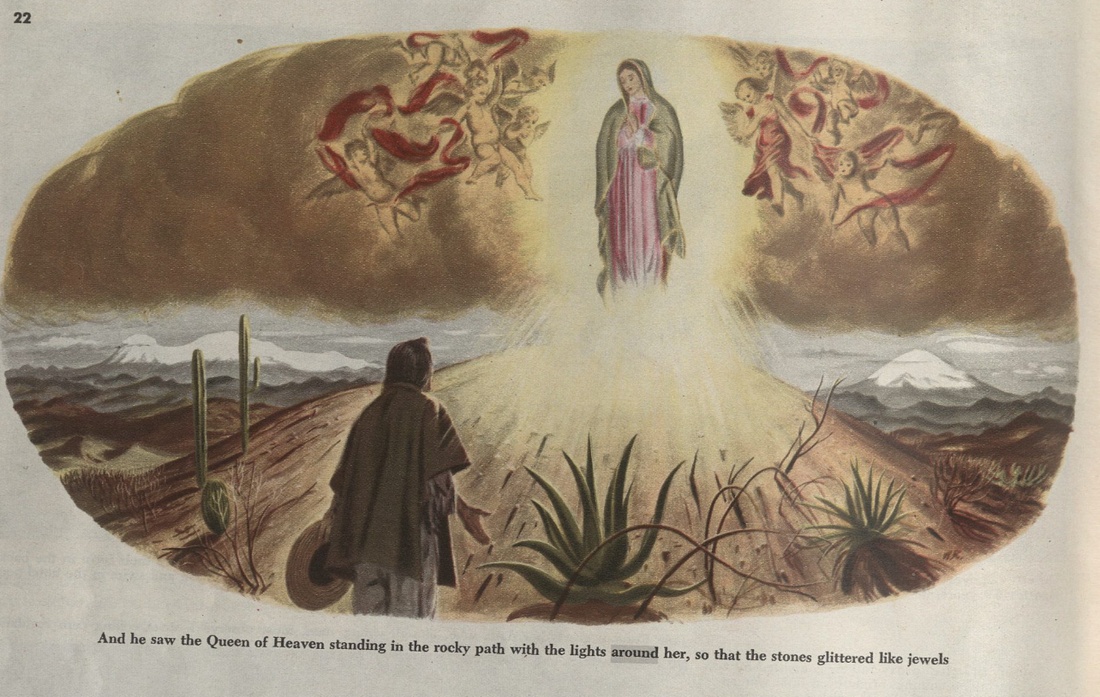
Illustration in Collier's magazine
*
She told him to go to the bishop in Mexico City with the message that the temple should be built on the hill. Juan Diego bowed and told The Lady that he would do her bidding. As he spoke, "the light faded into ordinary day and the stones were stones and the mesquite black. The Lady was gone." The humble Indian made his way to the new city of Mexico, in awe at the buildings and churches. "He asked his directions many times before he came to the palace of the bishop, a lordly building, magnificent, new."
Many of these details are Steinbeck's own imaginative interpolations. The first written account of what became known as the "great miracle" or "great event" does not mention the light fading, or Juan Diego's awe at the city, or that he had to ask for directions. That version, called the Nican Mopohua, was most likely written by an Indigenous scholar named Antonio Valeriano (1521-1604), who knew Juan Diego, and wrote his story down in their native language, Nahuatl, shortly before Juan Diego died. One complete copy of the Nican Mopohua, which means "Here it is set down," is in Centro de Estudios de Historia de México Carso. Another copy, rather astonishingly, is housed in the New York Public Library.
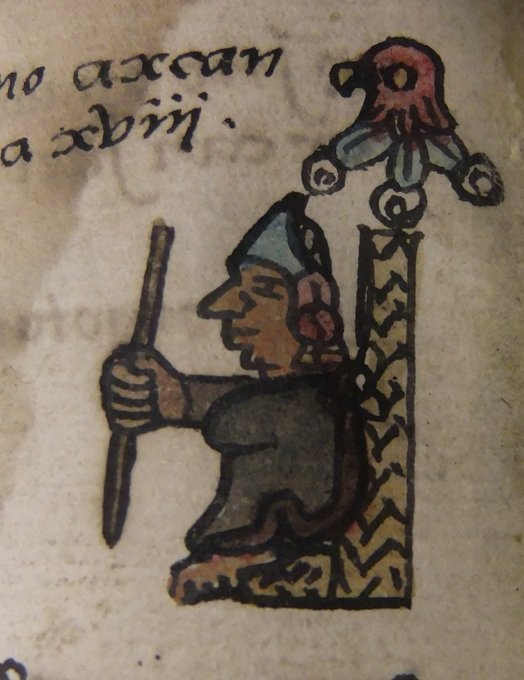
Antonio Valeriano author of Nican Mopohua
*
It's not clear whether Steinbeck consulted the Nican Mopohua when he set about to write the Guadalupe story for Collier's. The first printed version, in Nahuatl, appeared in Mexico in 1649. A Spanish translation did not appear until 1929. English translations existed by the time of Steinbeck's Collier's piece, but whether he was aware of them is not known.
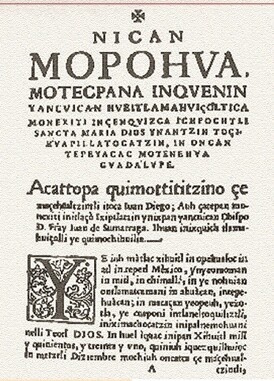
Nican Mopohua (first printed edition, 1649)
*
Juan Diego's initial audience with the bishop did not go well. In Steinbeck's telling, when he reported to the bishop that he had seen the Queen of Heaven in a pool of light on the hill of Tepayac, and that she wanted the prelate to build a temple to Her on the hill, the bishop smiled wearily. "Why there?" he asked. "To be a sign to our people," Juan Diego cried in triumph. "She is ours—our own Mother." The bishop frowned. "You are excited, my son. Go reflect and come back when you are calm. Go with God!"
Steinbeck writes: "His heart heavy with failure, Juan Diego went blindly in the evening to the hill of Tepayac, for his vision was fading and he was afraid the bishop had spoken the truth, and that his grieving had turned his mind to dreams. As he came to the hilltop the night was falling. The light sprang up and the Lady was before him again."
Again, it's interesting to compare Steinbeck's version with an English translation of the Nican Mopohua, which says: "He left sad because the errand entrusted to him was not immediately accepted. Then he returned, at the end of the day, he went straight from there to the top of the little hill, and he arrived before Her, the Queen of Heaven: there, exactly where she had appeared to him the first time, she was waiting for him." No mention of the self-doubt Steinbeck attributes to Juan Diego; no self-psychologizing about Juan Diego's mind given over to dreams.
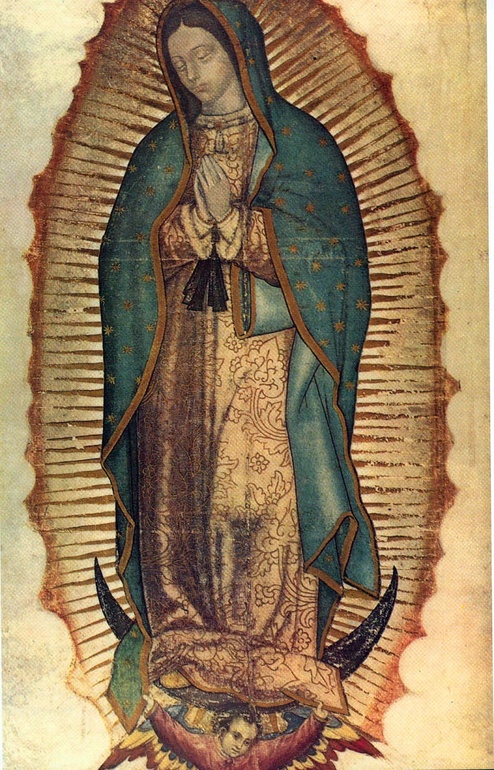
Virgin of Guadalupe
*
Juan Diego begs the Holy Mother—in the Nican Mopohua, he sweetly addresses her as "my Lady, my Queen, my little Girl"—to send someone of importance. Steinbeck gives him this speech: "Send some lord, or better, shed your light on the bishop himself." (In the original telling, he abases himself in effusive detail: "I am really just a man from the country, I'm the porter's rope, I'm a back frame, just a tail, a wing; I myself need to be led, carried on someone's back.") But the Queen of Heaven tells him that he and no other is to be Her messenger. Steinbeck writes: "The light about Her flared and the whole valley glowed and sparkled, and then it was dark, and Juan Diego was alone on the desert hill of Tepayac."
Before dawn, Juan Diego makes his way back to the city. This time, he addresses the bishop more plangently, falling to the floor before the episcopal throne. "Our Lady says you must build the temple! She says it is Her wish. Do you hear? She orders the temple to be built in the valley by Tepayac." The bishop sternly tells him, "You are ill. You are unbalanced. I will tell you … words are empty, and men sometimes see things that are untrue. Ask for a sign beyond words. Then we will know beyond doubt. Now go." (Again, the original version does not emphasize Juan Diego's possible mental imbalance, only that the bishop needs more proof.)
Back Juan Diego goes up the hill, secretly followed by two of the bishop's minions, who mysteriously lose track of him. When Juan Diego reports the bishop's message, The Holy Mother tells him to go and rest, "and in the morning come again and I will give you a sign." On the way home, Juan Diego hears that his uncle is dying of a fever. He goes to find medical help. "His promise to the Holy Mother worried him, but it seemed good to him to have a humble duty to do, for Her mission had frightened him. The emotion of it had wearied him, for one must bring something to great beauty"—and here Steinbeck's language seems right out of his novel The Pearl—"and it is a burden on a man to be a great man."
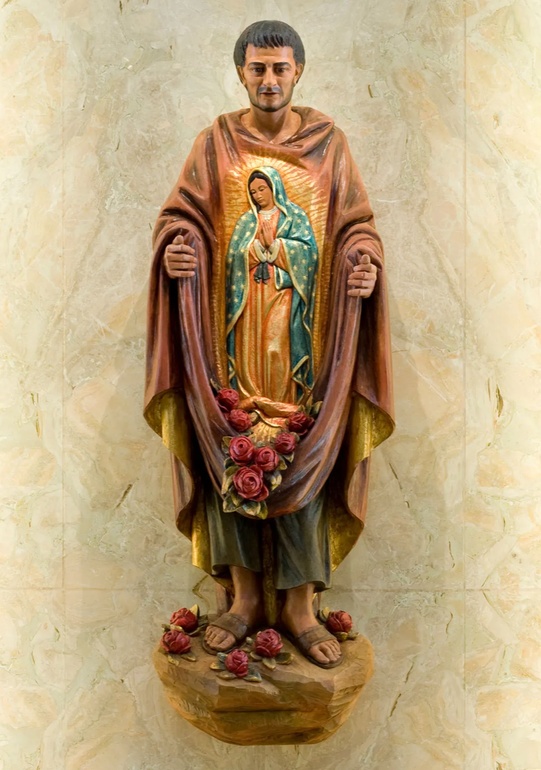
Juan Diego
*
He takes a path where he hopes to avoid the Holy Mother, but she meets him on the way. "Forget your uncle. He is well now. I have made him well. Go now to the right path over the hill of Tepayac and gather what you find there." Juan Diego goes back up the hill "and in that desolate place he saw roses of Castile fresh and lovely growing in a place where roses could not grow and blooming in a frosty month when roses do not bloom. In the dawn he gathered the flowers and then the Virgin was beside him, and she took the blooms from him and laid them in his cloak. 'This is my sign,' she said." Here is one of Steinbeck's most interesting departures from the original version, which never mentions roses, but instead says that he found "flowers of every kind, lovely and beautiful."
Juan Diego returns to the palace once more, carrying the roses wrapped in his cloak. Steinbeck writes, "The servants in the hall jeered at him, and they struck him and pulled at him to put him out of the hall…. As they pushed him, a corner of his cloak came free and they saw the roses and they were silent. One man put his hand to the flowers and he could not touch them. And then he went quietly to the door of the bishop's chamber and opened it, and Juan Diego entered."
The bishop is annoyed, but Juan Diego, now unafraid, declares "Here is the sign." As he releases the corners of his cloak, the roses, "uncrushed and unwilted," fall to the floor. The bishop falls to his knees. And then another miracle: on the rough cactus fiber of Juan Diego's cloak they find the image of the Mother of God.
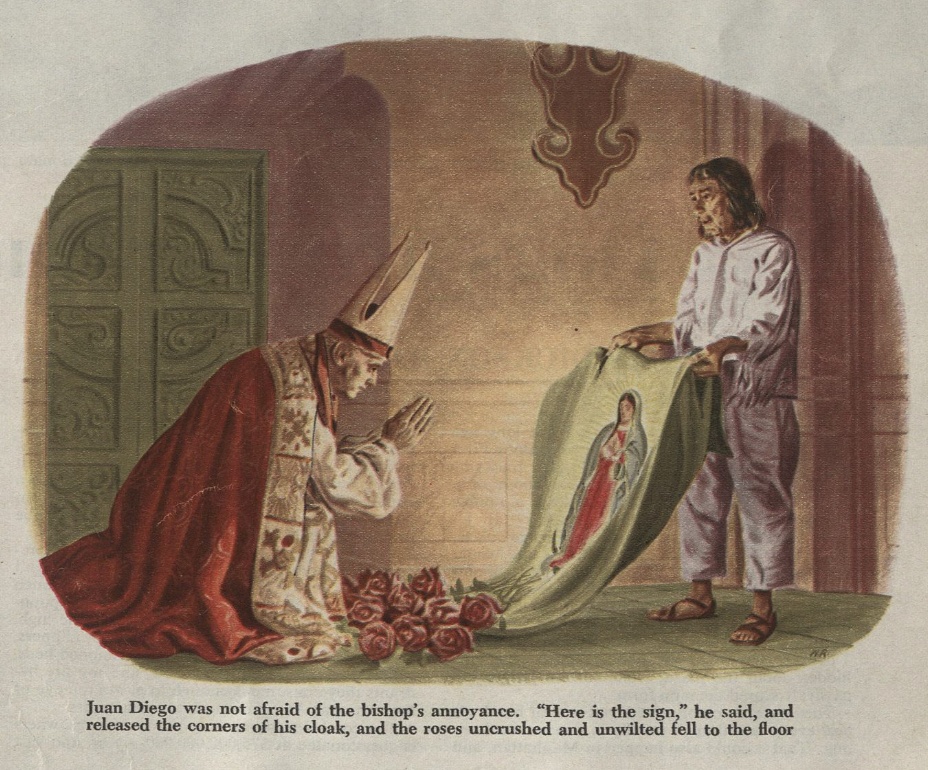
Illustration in Collier's
*
The account in the Nican Mopohua goes on for several more verses, relating how the bishop took the cloak and put it in his private chapel; how he ordered the temple to be built; how Juan Diego's uncle testified that he had been cured of the fever at just the moment the Virgin said he would be; how the bishop exhibited the cloak to the entire city; and how the image, now named The Perfect Virgin, Saint Mary of Guadalupe, came to be acknowledged as something divine.
In contrast, Steinbeck wraps things up in a paragraph, adding some imaginative details about how Juan Diego built a new mud house near the temple and planted a garden. "He swept out the chapel and cared for it until he died. He was very happy. And it is possible he did not know that through his heart Our Lady of Guadalupe had become the Holy Mother of his people."
What did the Guadalupe story mean to Steinbeck? In an essay titled "Steinbeck's View of God," Alec Gilmore writes that though he was raised Episcopalian, by his early teens Steinbeck, "began to question the idea of God and the place of religion. Organised and institutional religion played little part in his life thereafter and he could never be described as 'a religious man.'"
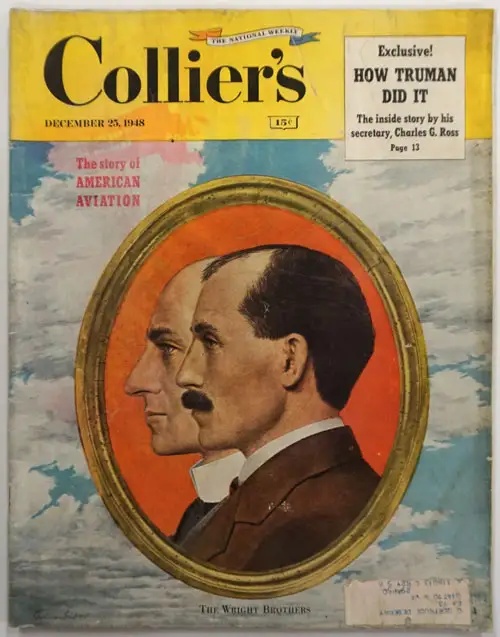
Collier's magazine (December 25, 1948)
*
With that in mind, it might be tempting to dismiss "The Miracle at Tepayac" as just a piece of hackwork, commissioned by Collier's for the attention (and magazine sales) that the name Steinbeck would produce. But Steinbeck's several visits to Mexico and his attraction to biblical themes throughout his writing career, suggest that the Guadalupe story meant something important to this writer who called himself "a lumbering soul but trying to fly." Perhaps the words Steinbeck gave to the Holy Mother when she first spoke to a reluctant Juan Diego, explain it best: "Juan Diego, I have chosen you for a reason to be understood only gradually, but it will be stronger, because everyone will find the reason for himself."
Whether we are conventional believers or lumbering souls, the Guadalupe story, now almost 500 years old, invites each of us to find a meaning in a simple Indian's humble faithfulness to a vision of universal compassion and hope.
**************

Philip Gambone, a retired high school English teacher, also taught creative and expository writing at Harvard for twenty-eight years. For over a decade, his book reviews appeared regularly in The New York Times. Phil is the author of seven books. His memoir, As Far As I Can Tell: Finding My Father in World War II, was named one of the Best Books of 2020 by the Boston Globe. His new collection of short stories, Zigzag, was published last year by Rattling Good Yarns Press. His books are available through Amazon and at "Tesoros," the bookshop at the Biblioteca.
**************
*****
Please contribute to Lokkal,
SMA's online collective:
 ***
***
Discover Lokkal:
Scroll SMA's Community Wall below.
Mission

Visit SMA's Social Network
Contact / Contactar