 Español
August 9, 2026
Previous chapters
by Jan Baross
CHAPTER THIRTY-THREE
Wild wind and moonlit spray whip my hair in a frantic dance. Below us, the dark waves thunder against volcanic spears. Currents cut at the ragged edges and spin into white foam that once carried Gabito's blood.
We shield our eyes from blinding gusts, squint through the mist. There it is, José's Blessed Virgin. I am awed by his monster of architecture. She is as tall as a lighthouse. Long curved shins and thighs pillar skyward. Her hands are lifted, a prayer that begins at the elbows and goes to the stars.
The body, made of hard bricks, has been plastered and sanded to look like skin, hair, fabric. José has carved the wind into the light weave of her fragile gown. The cloth clings to the molding of her body, one naked breast exposed to the lungs of the sea.
I cling to a stunted pine, and can barely contain my admiration. And then, my throat turns raw as I look up into the woman's face. My face! My pinched frown! My overbite like a canopy!
A sudden sickness retches up my throat. No wonder Mamá and Papá shut me out. José has built an abomination.
"What kind of boy does this to his mother?" yells Gabito over the wind. "You appear naked in front of God and man!"
The great statue looks out at the waves with hollowed eyes.
"Have I been such a terrible mother, Gabito?" I yell back.
He avoids my eyes, but his silent expression tells me, yes.
A faint scent of kerosene is carried on a downward draft. Among the thin folds stretched across the Virgin's stomach, there is a flickering of orange from a hole, as though her bellybutton were on fire.
"José!" The wind tears his name from my lips.
"I will see if he is there," says Gabito.
Gabito's sandals rise past my eyes and up to navel height. I can only climb as high as the Virgin's adobe toenail, as big as a plate, her foot as large as José's single bed. Around the base of the Virgin's feet, bamboo scaffolding and a wooden ladder have been deliberately hacked to pieces.
Gabito descends so fast he almost misses the toe where I am sitting.
"Tortugina, hurry! He is sealing himself inside the Virgin!"
Gabito climbs behind me and wraps his arms around my waist.
"What are you doing?" I say.
My feet are suddenly off the ground.
"You have to get him out of there!" says Gabito.
Gabito's arms are as tight as rope. I try to settle comfortably into the hard nest of his muscles. It is not at all like being weightless in the sea. The wind tries to flatten us against the statue's solid shins. Cold air drafts up my dress. Gabito inches us up past the roundness of the Virgin's strong knees.
When we are eye-level with the square navel, I can see the orange flickering of a kerosene lamp inside. Gabito's heavy ghost breathing against my ear comes from so many holes in his head that it sounds like harmony.
"Hurry," Gabito says. "I cannot keep us both up forever!"
My fingers touch cold adobe, sanded to the imperfection of skin. I crawl into the small entrance that has not yet been sealed, jagged like crone's teeth, but wide enough for my hips. The short tunnel of bricks forms a tight girdle. Gabito nudges me from behind. I smell old tortillas, man-sweat, and the sharp, musty odor of mortar. My fingers touch freshly set bricks on the floor at the entrance to the womb. I climb over the bricks into a room rounded like a small cave by darkness and light from a lantern.
José's back is turned to me and his shadow is a giant spider on the curved wall. In a dusty pile around the base of a brick wall and crude planked floor are the basic items for such a life: a sleeping mat, a big skin of wine, a large tin of water, canned food, empty beer bottles and tins, building tools, a metal miner's hat, and curled ropes. A bucket of dirty water tilts next to a trough, and nearby are piles of brick, lye, and sand.
Unearthed in the deepest of all lairs, José hears my breathing and turns. He holds the kerosene lamp toward me and stares troubled, out of focus, perhaps drunk. José is a shirtless adobe statue, covered in brick dust and unshaven. His once shining curls are matted against his head. So many changes have passed beneath his skin in one hard year. I want to place my fingers over his tired, red eyes and help him sleep.
"José," I say softly, "look at you."
"Mamá," he cries. "Can I never escape you, even in death?"
José's body has put on muscle from the heavy labor of building a woman. Molded by deep light, he looks as if he were made to hold up the world. What do I say to my son in the womb of his creation? I pull the crumpled envelope out of my pocket, an offering in the palm of my hand.
"José, it is Pilar's letter. She loves you and begs you to forgive her. She will be here soon. There is no reason to shut yourself away."
He frowns as he takes the pink envelope and runs his finger along the unglued edge. His face turns as red as his eyes.
"You opened it?" he asks in disbelief.
"A mother's love made me do it," I say.
José stuffs the letter in his waistband and reaches for the leather wine bag.
"I never want to see the face of love again," he says. "Now please, go away."
He shoots a line of wine into his mouth. It streaks down the sides of his dusty face and chest. What can I say to delay leaving him?
"But we have much to discuss," I say.
José shakes his head. "No."
"Then give me some wine."
He seems startled, but hands me the wine skin. I lower my bottom onto the pile of curled rope and aim the wine into my mouth.
Gabito is inches from my ear.
"You are drinking?" he asks me silently. "While he is making a suicide?"
"I will get him so drunk he passes out," I say only to Gabito. "Then you can float him to earth. Do you have a better idea?"
I give the wine skin back to José. He takes another long mouthful. His eyes look bruised from the inside.
"If I had been a man with Pilar," he says, "I would have had the strength to shut you out, as I shut the world out when I carve. I should have focused on nothing but the body of my wife."
He drinks again, with pursed, wet lips that remind me of the harsh tug of his baby hunger.
"Get out, Mamá!"
Will I always be the culprit, the betrayer, to my son?
He turns away. With a perfectionist's eye, José pours lye, sand, and water into the trough and stirs.
"Entomb me for my sins, José," I say. "I will make the journey to hell with you."
He looks up at me with the wound of his wedding night still sharp in his eyes.
"I wanted to die as an old man in Pilar's arms, surrounded by my children and grandchildren."
José weighs the balance of the trowel in his hand as though he might strike me.
"Now I will die inside this womb with my mother!"
The word "mother" sounds like a curse.
"I thought I escaped you when I left, Mamá. But even my greatest creation looks more like you than like Pilar."
It looks exactly like me, I want to say. But I am silent as I watch José lather the brick and set it in the entrance to the womb. With the tapping of his wooden handle, the bricks slip perfectly into place. Gabito's whisper is harsh in my ear. "Tortugina, make him drink more, before the bricks set!"
"José," I say quickly. "Let us drink to the last sky we will see."
José squirts the wine into his mouth. Between each brick that he picks up with slower and slower deliberation, I propose a toast.
"To your statue, to your talents, to carpenters everywhere!"
He does not seem to notice that he is getting sloppy.
He holds the last brick, feels the weight as though it were precious. Wedging it into place, he shuts out the stars. José has built a woman, my nightmare woman, who is as complete as a destiny can be.
The wind is gone except for a small overhead draft.
We drink in silence.
We drink again.
Gabito hisses behind me, "The bricks are hardening!"
José leans back against the wall of the womb and lets his hand drop to Pilar's letter in his waistband.
"Mamá, you see where love has taken us." His words trail into the dust. "Why is there no happiness?"
The long muscles of his body slacken as he closes his eyes and passes out. With small snores, his purple-stained chest moves up and down.
"Quick, Tortugina," says Gabito. "Pull down the wall!"
Red chips fly as I beat the bricks with a hammer. The wall pocks but is unmoved. José snores in his coma-drunk sleep, curled around Pilar's letter.
"Hurry, Tortugina," says Gabito.
Desperate, I begin to throw unused bricks at the entrance. I gasp for air in the red dust. Panic settles deep in my chest. Gabito tries a little magic, but a purple haze and a few hand movements do nothing. I shake José, the first time I have touched my son in a year.
"José! Wake up!" I say.
He cannot hold up his head from the burden of wine. José shivers from a cool draft somewhere above us.
"Gabito, do you feel cold air from the outside?"
Without a word, Gabito shoots upward out of the lantern light and into the darkness.
I throw water from the bucket over José's head. He wakes up with his face wet, as though it has been cut from fruit.
José sits up. "Mama," he moans, "leave me alone!"
He shakes water off his head like a puppy.
"José," I say, "you are no longer my insatiable infant. You are a man hungry to know his manhood. Your heart is full enough. Your wife loves you for reasons beyond your chico gigante. And if you do not learn from my words, you deserve to die in a sealed womb. Now get me out of here!"
When I turn up the orange light of the lamp, it burns higher into the darkness. José's cheekbones are defined by ancient shadows. But his eyes look new, as though he opened them for the first time. These are the eyes of a boy who would not let his mother die.
José leans forward until his brow touches mine. His head is fever-hot. He cries wine tears. Our minds are so close we smell each other's thoughts.
"Mamá," whispers José, "I will help you."
He places my palm flat against his chest. José's hands are weighted with such beauty.
"José," I whisper, "I love you, perhaps not well, but with my whole heart."
We hold each other in the drafty stillness of the womb. When I raise my hand off his chest, I have left my handprint in dust and wine.
Read more chapters
**************
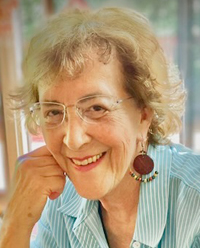
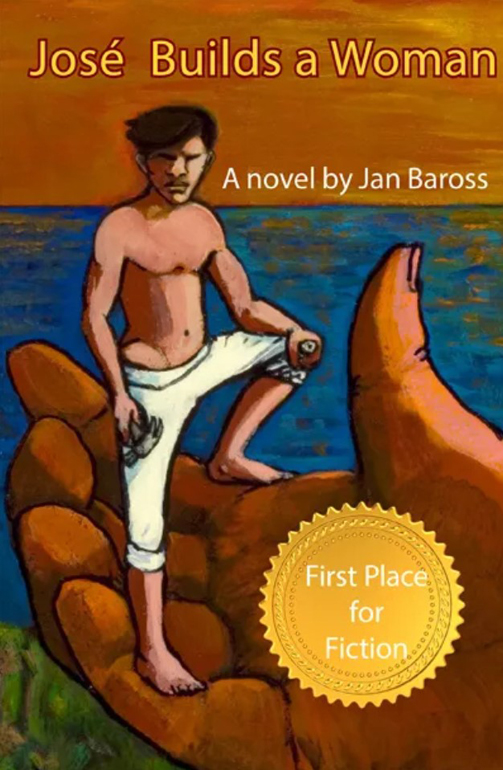
Jan Baross is an award-winning novelist, documentary filmmaker, photographer, screenwriter, librettist, film critic and taught filmmaking at Oregon State University. "Jose Builds a Woman," her debut novel published by Ooligan Press twenty years ago, in 2006, received first place for fiction. Ursula Le Guin gave it a thumbs up.
Baross lives six months a year in Portland, Oregon and SMA where loves designing posters for the Annual San Miguel Playwrights Winter Showcase. Books and Audible on Amazon. Films on YouTube.
www.janbaross.com
**************
*****
Please contribute to Lokkal,
SMA's online collective:
 ***
***
Discover Lokkal: Mission

Visit SMA's Social Network
Contact / Contactar