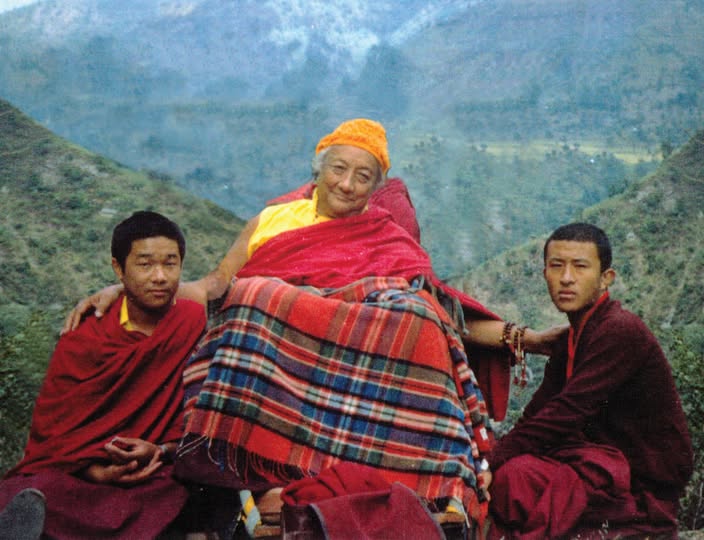
Dilgo Khyentse Rinpoche
Español
February 15, 2026
by Alan Goldfarb
Whenever I hear someone claim to have seen a UFO, I immediately suspect they aren't completely right in the head. Here's a story I've never told because it's maybe something like that, and I don't want to be suspect. But 40 years have passed now, and I like to recount experiences from my life. So I'm going to spit it out.
From the mid 80's to the mid 90's, while running my glassblowing studio, nights and weekends I used to study Tibetan Buddhism at the Vajradhatu in Burlington, Vermont and the Karme Choling Meditation Center in the Northeast Kingdom.
It is obvious to anyone who knows me that very little of it stuck! But I was a dedicated student and energetically practiced meditation with the sangha and studied many English translations of the biographies and songs of the Kagyu gurus.
Chogyam Trungpa Rinpoche died in 1987, ostensibly from taking on the karma of tens of thousands of Western students, although it is more likely that he succumbed to alcoholism and cocaine addiction. At his family's request, the state of Vermont granted the first permit in the United States to hold a public cremation.
It was held in a pastoral natural setting in the hills. Three thousand people attended as did many senior monks from the Kagyu and Nyingma lineages. Among them were some of the last of the generation of cave dwelling monks to escape the 1959 Chinese invasion and occupation, as well as some of the first generation of monks born in exile in India, Nepal, or Bhutan (or reincarnated in Tibet but snuck out as infants to be trained in exile).
The ceremony was presided over by the venerated tantric master Dilgo Khyentse Rinpoche. He had been a senior tutor to the child who became the 14th Dalai Lama. In the assembly of monks, he appeared androgynous, as a combination of the great grandmother and great grandfather .
Dilgo Khyentse had been born in 1910 in Kham, eastern Tibet and was built like the Kham warriors, well over 6'6" tall. He is shown in the center of this photo. His translator was his young student Dzongsar Jamyang Khyentse Rinpoche, who was said to be the reincarnation of Dilgo Kyentse's own guru. He is shown on the right in this photo.
Much of the time Dilgo Khyentse looked as though he were in a trance state of continuous meditation and recitation of mantra. During the cremation ceremony and through his cycle of teachings in the days afterwards, he always had his ritual objects, the damaru or hand drum, made from a pair of large human skullcaps and covered with python skin, his dorje or scepter, and his dribul or bell.
I first heard Dilgo Khyentse play the damaru during the cremation itself. Its sound was immense, thunderous, almost terrifying. As he continued it appeared to bring about visible phenomena in the sky. He would play it and rainbow spots would appear in the sky. He would cease and they would vanish. He would play it and an image of Trungpa's dream flag would appear in the clouds. He would stop and it would vanish. He would play it and a cloud would form in the shape of Trungpa's ashe calligraphy stroke. He would stop and it would vanish.
I was not on drugs. This was going on while Trungpa's body was being incinerated inside of a hollow clay stupa- shaped crematorium called a purkhang, and flames were shooting out the top. At one point Trungpa's skull exploded and a large fragment of the cranium flew out the portal on the front of the purkhang. This later became a relic that was enshrined.
I was standing talking with Allen Ginsburg and a female reporter from the New York Times who was covering the event. Allen asked her if she could see what was happening in the sky. She replied, "Yes, absolutely." He asked her if she was going to write about it. She replied "Absolutely not."
I had a number of experiences over those few days. Two days after the cremation, on May 28th, right before my birthday, Dilgo Khyentse Rinpoche gave a 3-hour talk and transmission for 250 people on the Yogachara mind- only teaching. The setting was incredible, it took place in a large tent in a meadow by a pine forest and a rocky stream below a small mountain under the clear blue sky of northern Vermont.
At the peak of the teaching he started playing his damaru and reciting a long repetition of a mantra while playing his damaru. The 250 students in attendance joined in on the mantra. A ferocious rain and hailstorm formed, with high winds and thunder and lightning (and some flooding in the tent). The recitation lasted twenty minutes or half an hour. During that time he maintained the thunderous drumming and sonorous mantra. With a combination of humility, nobility, and absolute confidence, he emitted something atmospheric that permeated us and the space around us. I think some people were stung by the kiss of unobstructed mind that he was manifesting
As he finished the teaching, the hailstorm stopped, the sky cleared up, and more rainbow spots appeared. Closing the ceremony, his translator Dzongsar quipped, "He always does that during this teaching."
Postscript:
If you wrote this and I read it I would think you were a touch goofy. On the other hand, the Dalai Lama does employ a man whose title is the weather controller, to split storms around his audiences when he does outdoor teachings in McLeodganj.
To my dismay, this story got me removed from Facebook as soon as I published it last week.
A few years after this, the great and venerable Khyentse passed away after a lifetime of ceaseless practice and teaching. Young Dzongsar got hip to the modern world and went on to make a number of movies, one a charming film that he wrote and directed called "The Cup," about a charismatic and enterprising young monk in a Tibetan resettlement community in northern India uniting the cranky and eccentric inhabitants of the monastery and surrounding town around his quest to obtain a borrowed television so that they can view the World Cup soccer final.
**************
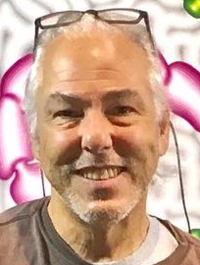
Alan Goldfarb, a native New Yorker, began studying ceramics as a boy. During high school he was introduced to glassblowing. He attended college at the School For American Craftsmen. In 1983 he opened a glassblowing studio in Burlington Vermont, which he ran until 2006.
In the course of that time he continued to study under noted international artists like Dale Chihuly, Italian maestros Lino Tagliapietra and Pino Signoretto, and Swedish designer Bertil Vallien. He also taught workshops at various colleges, museums, and craft schools.
He received awards, grants, and scholarships for his studio work, and a number of his pieces are in private and public collections, including the Corning Museum of Glass, The Museum of Fine Arts Boston, and The Smithsonian Institution. A studio notebook of his drawings is also preserved in the Rakow Research Library.
He closed his glass studio in 2006 and moved to San Miguel de Allende. Following a hiatus he opened a woodworking and art studio creating handcrafted furniture, sculptural objects, and paintings. From 2021 to the present he has worked with local albañiles building a handcrafted adobe house in the countryside.
His short stories have been published in the Gihon River Review, Lokkal Magazine, and the anthology, "Craftspeople; In Their Own Words."
Comments or feedback? Please practice kindness. Contact Alan at:
goldfarb.alan@gmail.com
Please contribute to Lokkal,
SMA's online collective:
 ***
***
Discover Lokkal: Mission
Visit SMA's Social Network
Contact / Contactar