Why Noel Coward Matters
Blithe Spirit, theater, Wed, Thur, Sun, Feb 11, 12, 15
|
|
 Español
February 8, 2026
by Fredric Dannen
Fredric Dannen is executive director of La Troupe México, the only dedicated Spanish/English bilingual theater company in Mexico, and possibly the only one in Latin America. This is the first of a regular series of theater columns that Dannen will be writing for Lokkal.
Some time in the 1950s – the exact date is unknown – a young British actor and aspiring playwright attended a performance of Private Lives, a three-act comedy by Noel Coward. Private Lives concerns a divorced couple, Amanda and Elyot, who inadvertently wind up in adjoining rooms at a hotel in Deauville, France, while each is honeymooning with a new spouse. Despite the rough-weather relationship that had doomed their marriage, Amanda and Elyot find they are still passionately drawn to one another. Early in the play, they stand on their respective balconies and exchange what on the surface appears to be small talk.
|
|
|
|
AMANDA: What have you been doing lately? During these last years?
ELYOT: Travelling about. I went round the world, you know, after –
AMANDA: Yes, yes, I know. How was it?
ELYOT: The world?
AMANDA: Yes.
ELYOT: Highly enjoyable.
AMANDA: China must be very interesting.
ELYOT: Very big, China.
AMANDA: And Japan –
ELYOT: Very small.
AMANDA: Did you eat sharks' fins, and take your shoes off, and use chopsticks and everything?
ELYOT: Practically everything.
AMANDA: And India, the burning Ghars, or Ghats, or whatever they are, and the Taj Mahal. How was the Taj Mahal?
ELYOT: Unbelievable, a sort of dream.
| |
|
|
The young actor and writer attending that performance was Harold Pinter, who would go on to become one of the most admired playwrights of the 20th century. It is not an exaggeration to say that Private Lives – which debuted in London in 1930, the year Pinter was born – changed Pinter's entire approach to playwriting. Coward's influence on Pinter was so pronounced, in fact, that theatergoers coming to Coward for the first time often comment that he is "Pinteresque," whereas the reverse is actually the case. In an interview many years after he saw Private Lives, Pinter said the balcony scene in that play marked "the first time I realized you could put a character on the stage and have him say one thing and the audience knew he meant something entirely different."
Coward's use of wit as an emotional mask—often referred to as his "elliptical" technique—was revolutionary for its time. In the dialog quoted above, the characters use flippancy to mask the raw, irrational feelings they still harbor for one another. What Amanda and Elyot are actually saying beneath the banter is: "I still love you. Do you still love me?" It takes only a few more lines for the mask to slip.
|
|
|
|
AMANDA: How was the Taj Mahal?
ELYOT: Unbelievable, a sort of dream.
AMANDA: That was the moonlight, I expect, you must have seen it in the moonlight.
ELYOT: Yes, moonlight is cruelly deceptive.
AMANDA: And it didn't look like a biscuit box, did it? I've always felt that it might.
ELYOT: Darling, darling, I love you so.
AMANDA: And I do hope you met a sacred Elephant. They're lint white, I believe, and very, very sweet.
ELYOT: I've never loved anyone else for an instant.
AMANDA: No, no, you mustn't – Elyot – stop.
ELYOT: You love me, too, don't you? There's no doubt about it anywhere, is there?
AMANDA: No, no doubt anywhere.
| |
|
|
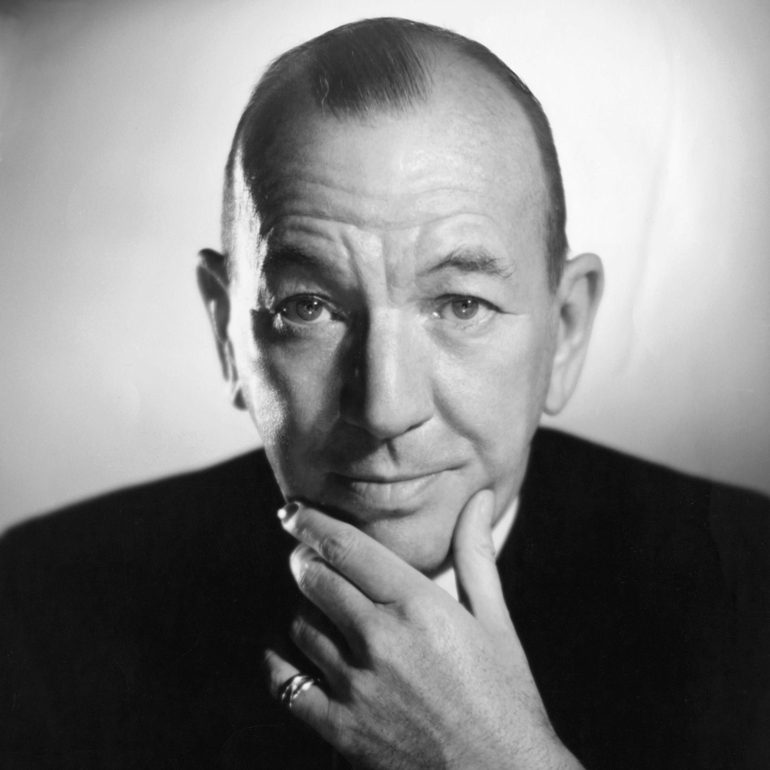
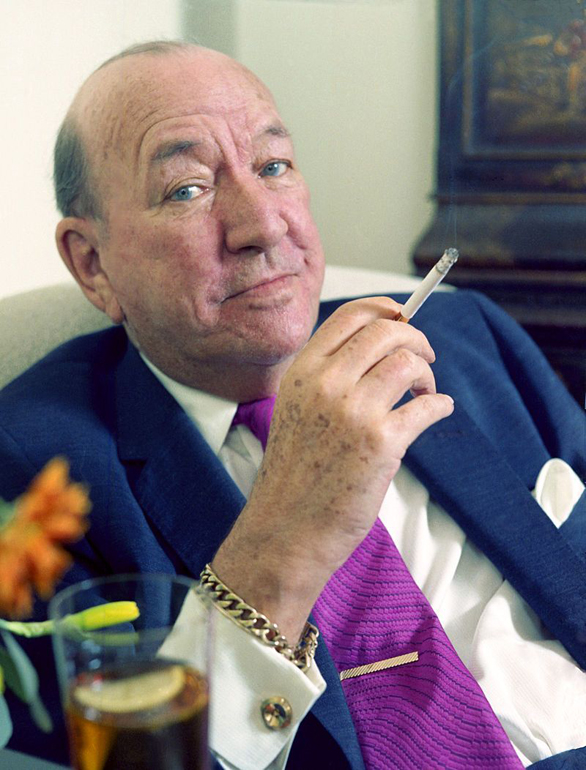
Noel Coward's greatest invention was himself. His drawing-room comedies, such as Present Laughter, in which he played the lead role, presented him as the archetypal witty, sophisticated, upper-class, dressing gown or tuxedo-clad Englishman. That was his public image, but it was a far cry from his upbringing. Coward was born at the near end of the 19th century, on December 16, 1899, in Teddington, England, the son of a piano salesman. His early circumstances, in the words of one biographer, "were of refined suburban poverty." He helped support his family as a child actor and singer. By his late teens, he had begun writing plays.
Coward's breakthrough came in November 1924 with a production of his first hit, The Vortex. It shocked London society, with its portrayal of a sexually predatory older woman and her cocaine-addicted son – taboo subjects that other playwrights avoided. There was even a veiled suggestion of homosexuality, still a criminal offense in England. Coward was himself a closeted gay man.
Coward's productivity was extraordinary. He composed the music and lyrics for hundreds of songs, published fifty plays, and wrote poetry, short stories, a novel, screenplays and three volumes of autobiography. One of his best-loved songs, "If Love Were All," includes the line, "I believe that since my life began, the most I've had is just a talent to amuse." A lot of theater professionals and critics who lack understanding of his work have taken that line as a literal confession, and have dismissed Coward as facile.
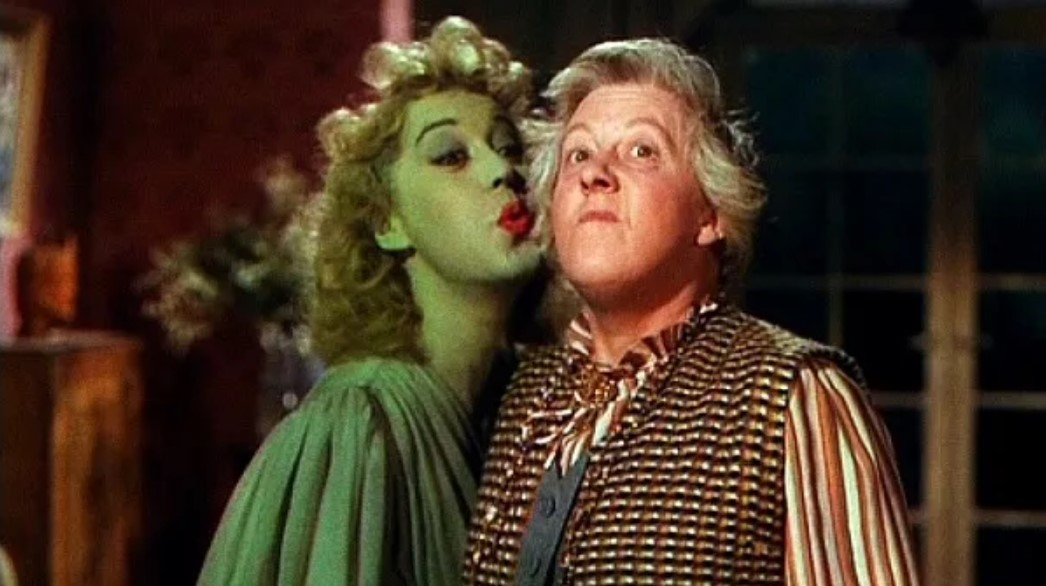
From the 1945 movie version of Blithe Spirit (the 2020 remake is dreadful)
*
Harold Pinter knew better. Coward died in 1973, and three years later Pinter honored him by directing a production of Coward's comedic masterpiece Blithe Spirit at the National Theatre in London. Blithe Spirit tells the story of Charles Condomine, a novelist who invites an eccentric medium, Madame Arcati, to his country home to conduct a séance, hoping to incorporate some of her "tricks of the trade" into his next book. The scheme backfires when Arcati conjures up the ghost of Charles's first wife, the seductive and temperamental Elvira, whom Charles's straightlaced and mature second wife, Ruth, can neither see nor hear. Elvira brings chaos to the Condomine household and to Charles's second marriage.
Blithe Spirit opened in London's West End in 1941, during the Blitz of World War II, a time when Londoners were being driven into air-raid shelters to survive bombing raids of the German Luftwaffe. On opening night, audience members had to carefully navigate their way around a huge crater blown into the pavement in front of the Picadilly Theatre. Coward knew the greatest gift he could bestow on his beleaguered city was laughter. And in Blithe Spirit, he delivered the goods, so successfully that the play ran for nearly 2,000 performances on the West End. George Orwell was among its fans. Blithe Spirit then became a long-running Broadway hit, and has endured to this day as an audience favorite.
Coward's elliptical technique is very much in evidence in Blithe Spirit. As the play unfolds, we discover that Charles, his living wife, Ruth, and his deceased wife, Elvira, are all guarding their true sentiments and protecting themselves with verbal weaponry. When their insupportable ménage à trois finally cracks open, and everything spills out, all three of them are appalled by the truth. "It's discouraging to think how many people are shocked by honesty and how few by deceit," quips Charles, the novelist, in one of his many epigrams.
***
San Miguel de Allende residents and visitors have an opportunity to experience Coward's hilarious play in a new La Troupe México production, directed by the author of this article.
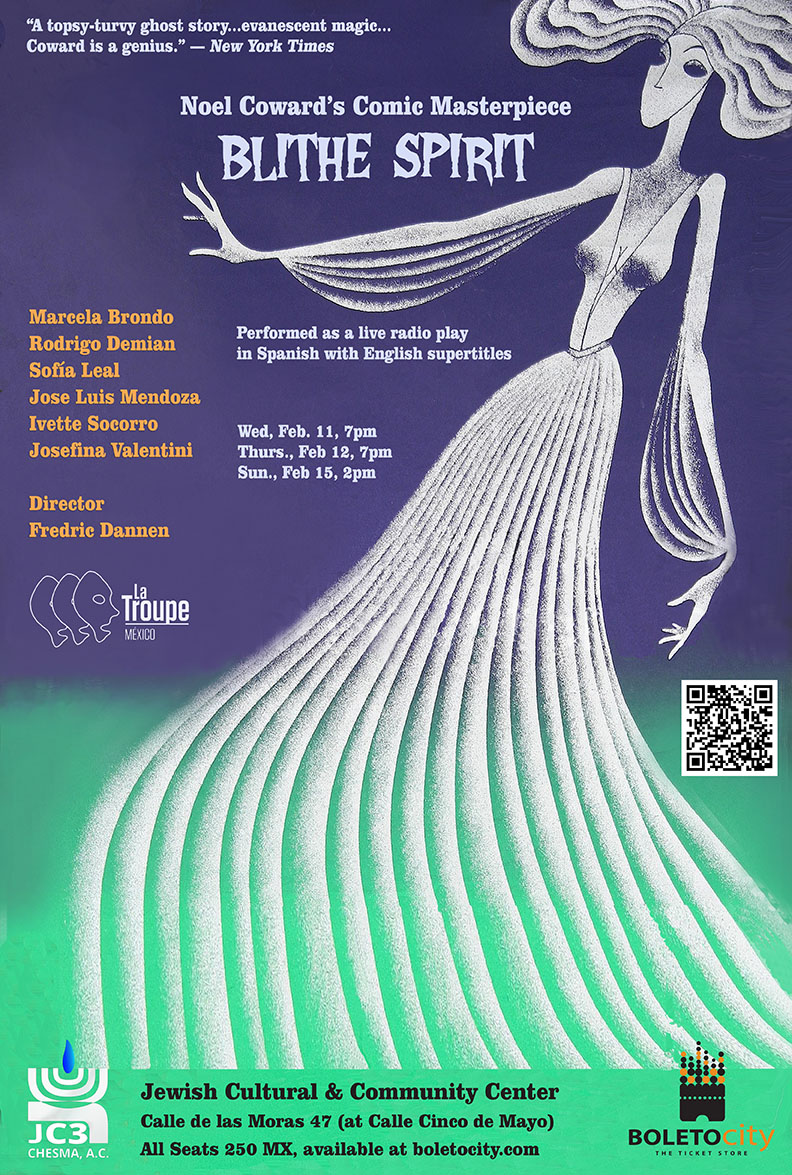 Three performances
JC3, Las Moras 47 (at Cinco de Mayo)
Feb. 11, 12, 15: Thursday, Friday 7pm, Sunday 2pm
presented in Spanish with projected English supertitles
Live radio theater – a reading by actors with music and sound effects before an audience, to be recorded for future podcast.
***
The splendid cast includes six of San Miguel's finest actors: Marcela Brondo, Rodrigo Demian, Sofía Leal, Jose Luis Mendoza, Ivette Socorro, and Josefina Valentini. Four of the cast members appeared in the recent hit production Macario, also at the JC3, and Brondo and Demian were seen in the sold-out run of Testosterona last August at the Skot Foreman Gallery.
All seats are 250 pesos. Tickets may be purchased online by visiting boletocity.com. Or you may buy tickets for cash at The Coffee Society, Sollano 78, open every day from 7:30am to 5:30pm.
www.boletocity.com
**************

Fredric Dannen is a journalist and author with a specialty in criminal justice. He has been a staff writer for the New Yorker and Vanity Fair.
In 1990, Hit Men, his book about the American music industry and the influence of organized crime, spent a month on the New York Times bestseller list. The book is #2 on Billboard's list of 100 Greatest Music Books of All Time. One of his Vanity Fair articles prompted the Sixth Circuit Court of Appeals to rebuke the U.S. Justice Dept. for fraudulently withholding exculpatory evidence in the case of Cleveland auto worker John Demjanjuk, who was extradited, wrongly convicted, and sentenced to hang in Israel as the Nazi war-criminal "Ivan the Terrible." He secured the only interview given by Los Angeles police chief Daryl Gates on the heels of the infamous Rodney King beating, and the only interview ever given by crime boss Lorenzo Nichols, the crack kingpin of New York City.
While conducting research for a forthcoming book, Dannen uncovered lost evidence in the case of Calvin Washington, a Texan wrongly convicted of homicide. As the direct result of Dannen's efforts, Calvin Washington won a full pardon for innocence, the first ever granted by Texas governor Rick Perry under the state's DNA statute.
**************
*****
Please contribute to Lokkal,
SMA's online collective:
 ***
***
Discover Lokkal: Mission
Visit SMA's Social Network
Contact / Contactar

|
|
|
|
| | |
Click ads
Contact / Contactar
copyright 2026
|