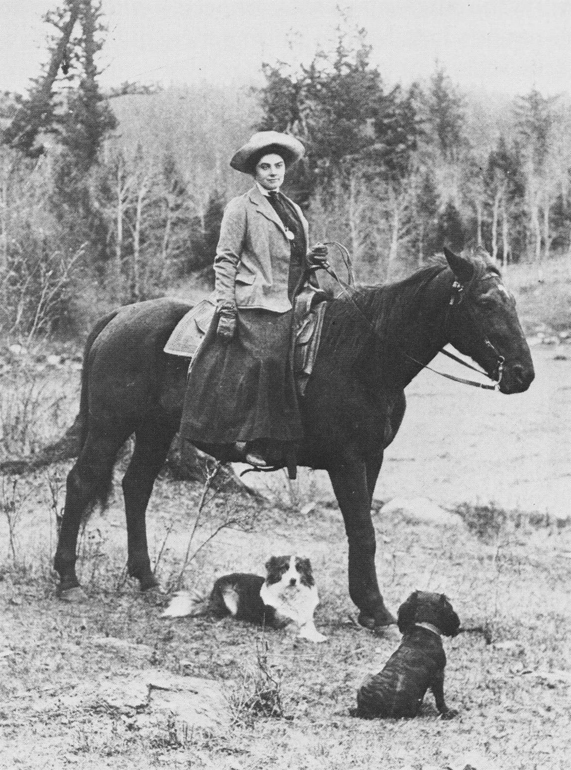
Emily Carr, Cariboo, British Columbia, cerca 1909
Español
February 22, 2026
by Jim Dempsey, librettist
Emily Carr was an exceptional woman. She grew up in a Victorian household in western Canada, lost her parents when young, and found school difficult. But she had the drive of a true artist and was determined to become a painter. Traveling alone, she studied art in San Francisco, England, and France, where she fell in love with the Modernist movement, thinking it the ideal medium for the vast forests and mountains of her native land.
Returning to Canada, her work neglected or spurned, she forged ahead; traveling deep into the forests and First Nations communities to find her subjects; supporting herself any way she could: farming, dog-breeding, keeping a boarding house.
She was discovered, relatively late in her career, and as time has passed she has become one of the best-loved artists of Canada. She was also a writer, a talent that was also discovered relatively late, and her books have become classics. In writing the libretto I wanted to show Emily's journey to success. It was by no means an easy one: struggling with financial difficulties, neglect, a nervous breakdown, anti-provincialism, not to mention that she was a single woman in what was very much a man's world.
Emily felt nature viscerally. Her paintings and writings are a magnificent testament of one artist's view of the world. She sensed a rhythm in the forests of Canada, and her paintings of mountains are utterly breath-taking. She was also a very eccentric person, a lover of animals, and a true seeker. The words of the libretto and Malcolm's music are an attempt to create a portrait of this great woman.
***
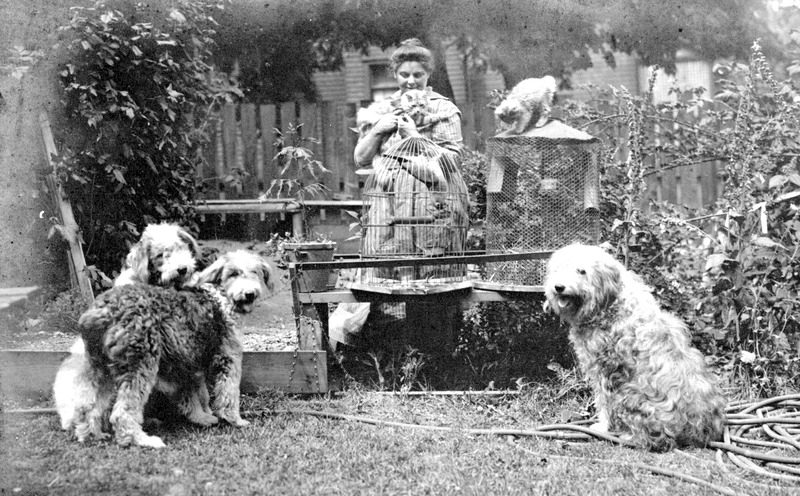
Emily Carr with her pets, in the garden of her home on Simcoe Street in Victoria, 1918
*
by Malcolm Halliday, composer
In early 2017, I composed a cantata about Clara Barton, the extraordinary woman who was instrumental in the founding of the American Red Cross. After the successful premiere of the work at Mechanics Hall in Worcester, MA, I began to think about making the work the first in a trilogy to celebrate three great women of North America.
The cantata "Emily Carr" is the second cantata in this series, representing the great country of Canada. Settling on Emily Carr as the protagonist of this cantata required some thought. Not being Canadian myself, I wasn't sure where to begin, but eventually I was able to consult with the American historian and Canadian Marc Egnal, who kindly produced for me a short list of five of the most significant women of Canadian history. After considering the five proffered names, Jim and I both realized that Emily would be the most captivating and interesting subject for a cantata.
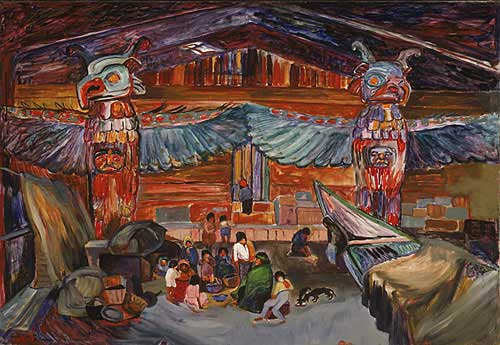
Indian House Interior with Totems, 1912, by Emily Carr
*
For lovers of classical music, the word "cantata" conjures up the magnificent music of a composer such as Bach, who wrote hundreds of "sacred" cantatas. These works were usually intended for use in Lutheran services. However cantatas can also be secular, and the term here applies to the use of a chorus in an extended multi sectional work, often with soloists and employing a variety of instrumental accompaniment.
Largely based on Emily's own words, the cantata's libretto presents a complex woman through various stages of her life, from her birth and childhood through her struggles as an artist to her eventual recognition late in life. The libretto is generally not rhymed or metered but abounds in delightful prose, often with phrases of irregular length but always interesting and at times quite humorous.
The text seemed naturally to divide into various sections, which in the case of this cantata became 13 individual movements. Some lines of text seemed more conjunctive than independent, but were necessary to introduce the next theme or big idea in Emily's evolution. These snippets of text were inspirational in the creation of recitatives, really not far from what one encounters in Handel's Messiah or other choral works of the Baroque era.

Odds and Ends, 1939 by Emily Carr
*
While all the recitatives in the work are scored only for piano and the voice of Emily, the individual movements of the cantata seemed to call for greater instrumental resources. And so, "Emily Carr" was conceived to align perfectly with the resources of Chorale San Miguel, using both the Chorale's historic 1875 Johnson pipe organ and its Yamaha piano, as well as flute and a small string ensemble, in addition to a soprano soloist who portrays Emily Carr. The chorus' role is varied. At turns the chorus encourages, and praises Emily, and at other times it is belligerent, irreverent and even cruel to Emily, especially regarding her dreams to become an artist.
The compelling and interesting libretto proved the catalyst in creating this music. Without the inspiration of the words, it would have been difficult to write even a single note of the cantata.
***
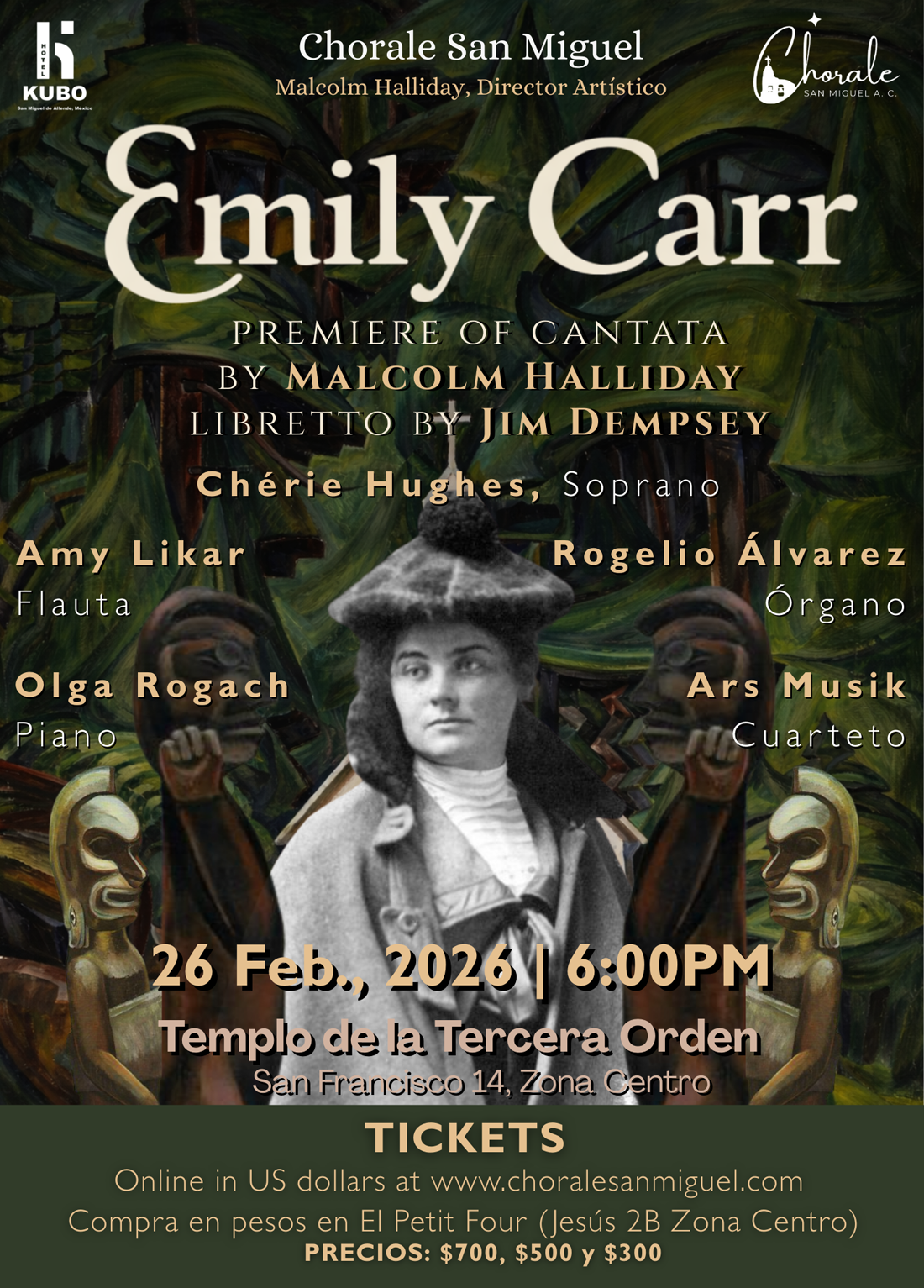 Emily Carr, Cantata
Thursday, Feb 26, 6pm
Chorale San Miguel
Templo de la Tercera Orden
**************
********
******
Please contribute to Lokkal,
SMA's online collective:
 ***
***
Discover Lokkal: Mission
Visit SMA's Social Network
Contact / Contactar