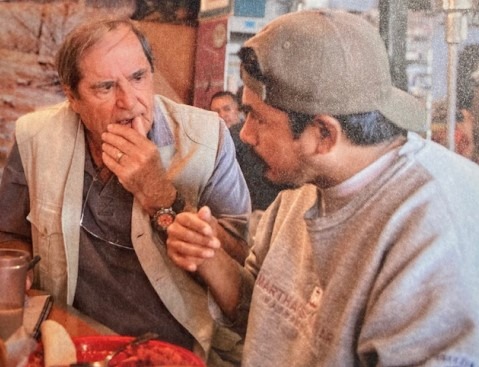
Theroux interviewing migrant worker
Español
February 8, 2026
by Philip Gambone
In a fifty-year career as a wanderer, novelist, and travel writer, Paul Theroux says that he has tried "to see things as they are—not magical at all, but desperate and woeful, illuminated by flashes of hope." Some readers of his work have criticized Theroux for skimping on the flashes of hope while laying on a thick coat of the "desperate and woeful." His reactions to some places he has visited and written about led one critic to say that Theroux finds too many "occasions for mere superior disgust."
It's easy to see that "superior disgust" in Theroux's travel book, The Old Patagonian Express (1979), where the chapters on Mexico abound in adjectives like "dismal," "wretched," "sinister," "disgusting," and "vulgar." (See my "Through Mexico by Train!" in Lokkal, January 25, 2026.) Happily, forty years after that initial sour foray, Theroux decided to revisit Mexico—to "make sense" of the country—spending far more time, meeting more people, exposing himself to a lot more than on his first quick journey aboard a train. The result, On the Plain of Snakes (2019), is a superb book, one that eschews stereotypes and facile conclusions. If anything, this time around, Theroux became a convert to Mexico. In the opening pages of the book, he compares himself to the Ancient Mariner, wanting to "hold the doubters with my skinny hands, fix them with a glittering eye, and say, 'you don't have the slightest idea.'"
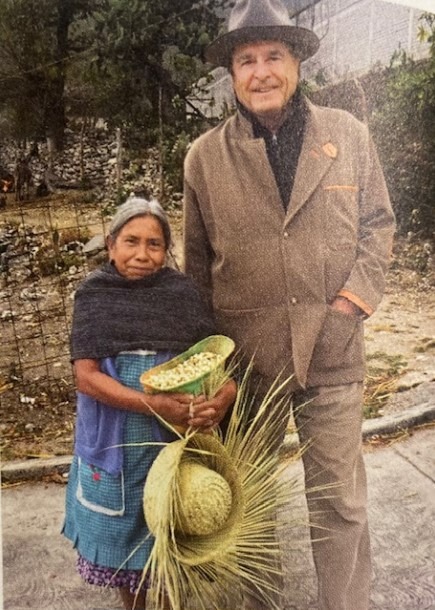
Theroux with Indigenous weaver
*
On the Plain of Snakes is an eminently fair-minded book. A book in which Theroux tries hard to approach his subject without any pre-conceived notions. "Solo mirando," he says at each place he visits. Just looking. He goes out of his way to see Mexico in all its dazzling and bewildering complexity. "Mexico," he acknowledges, "is rich in many tourist-friendly respects—the traditional hospitality, the varieties of food, the elaborate fiestas, the gusto of the language, the consolations of family and faith. These attractive attributes are well known to the vacationer, and are the pride and boast of the Mexican. But there is more, and some of it is not pretty, and all of it is complicated."
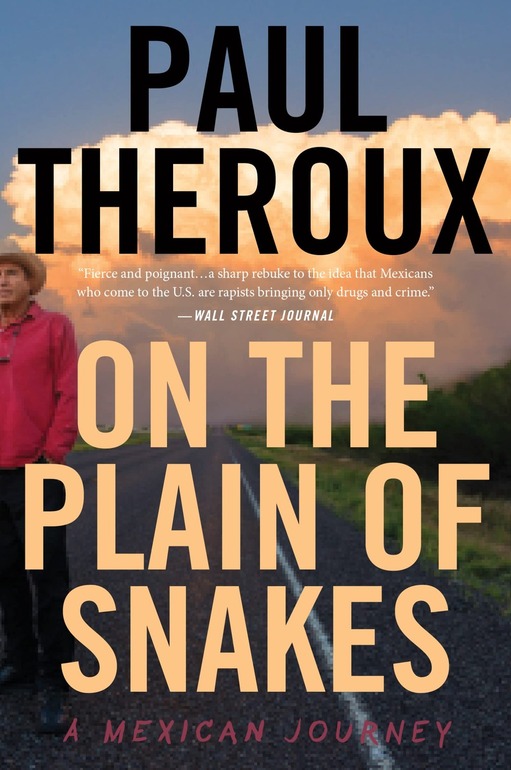
On the Plain of Snakes
*
The complexity of Mexico is at the heart of On the Plain of Snakes: "The country eludes the generalizer and summarizer; it is too big, too complex, too diverse in its geography and culture, too messy and multilingual." Indeed, Theroux courted that very complexity, beginning with his mode of transportation, a car. People told him not to risk it. "If you're lucky, they'll strand you by the side of the road and take your vehicle. If you're unlucky, they'll take your life." He pays them no mind. If anything, Theroux, at the time in his upper 70s, almost welcomed the danger, making few plans in advance and no onward reservations. His method was "to look for a place to stay for the night at around four or five in the afternoon … asking whether they had a room and a safe place to park my car. They always did."
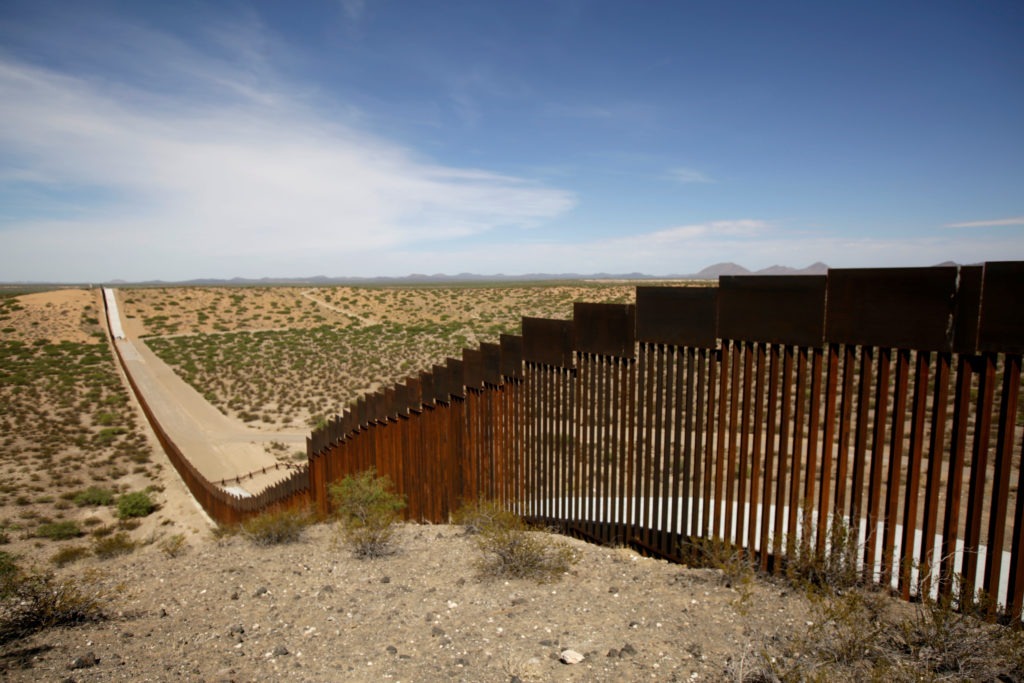
Border Wall
*
The complexity begins as soon as he crosses the border. "Nothing fully prepares you for the strangeness of the border experience," he writes. "Towns don't get much poorer than these blighted communities at the edge of the fence." In his earlier trip through Mexico, the entanglements of border politics hardly merited a mention. This time, Theroux is outraged by the border wall, which he calls "a multimillion-dollar symbol in steel that depicts our national obsession with threat and contagion." He notes that the wall is "more formal than the Berlin Wall, more brutal than the Great Wall of China, yet in its way as much an example of the same folie de grandeur."
The border, the wall, America's folie de grandeur, and the desperate and tragic attempts Mexicans make to cross become a major topic in On the Plain of Snakes. After the Patagonia book came out, Theroux was criticized for his "morally facile" stance. In the later book, he rectifies that stance, frequently expressing moral outrage, which he often aims at the United States government's "barbaric and inhumane violence" toward the families of migrants. He visits a shelter run by American Jesuits, where he interviews more than a dozen migrants, recording their heart-wrenching stories. Thousands of migrants have disappeared en route, murdered or victims of thirst and starvation. The Samaritans of No Más Muertes have set up water stations for desperately thirsty migrants, but these life-saving waystations are frequently vandalized.

No Más Muertes water jugs
*
It comes as no surprise that another major focus of the book is the Mexican drug cartels. Americans are the largest consumer of illicit drugs, a business which nets the narcos enormous profits and leads to enormous corruption. "There is no separation between the police and the narcos," Theroux brazenly claims. "Almost the entire police force is comprised of narcos in police uniforms." Mexican journalists out to expose the trafficking and the corruption become targets of cartel violence. Theroux tells us that Mexico is the deadliest country for journalists, edging out even Syria and Iraq.
Reader be warned: Theroux chooses to see the "underrepresented" Mexico, the places that get short shrift in the guidebooks. What he finds is not always pretty. San Luis Potosí is "a victim of the usual Mexican pattern of the old harmonious colonial city brutally martyred in the cause of modernization." Puebla is magical, but is no longer the compact colonial city is once was. He is acutely attuned to what he calls "Mexican simultaneity," the incongruous juxtaposition of sights: a goatherd by the highway or a fiesta evening in the plaza where "a frantic woman was howling about murders and drug gangs."
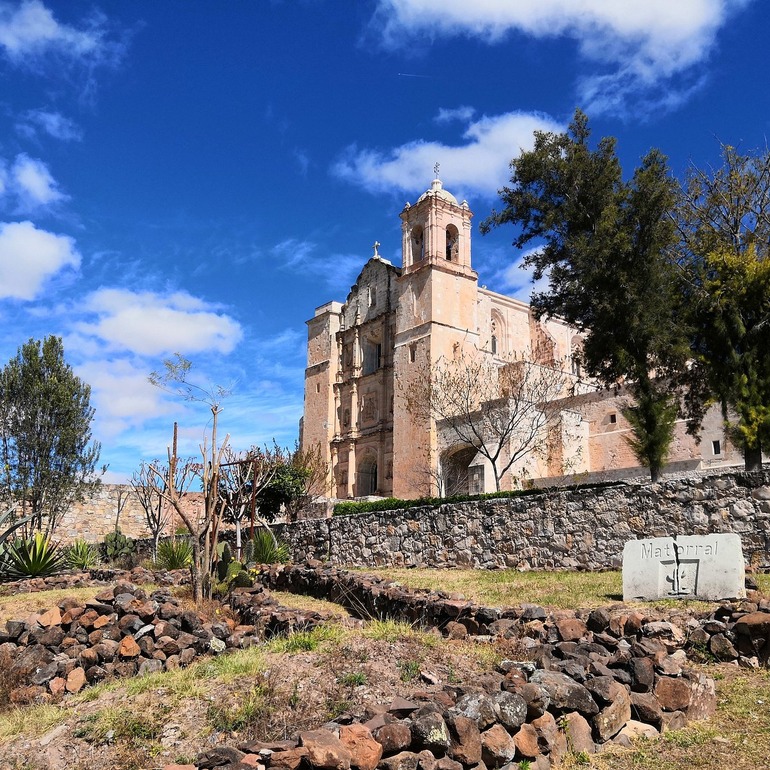
Ex-Convento Yanhuitlan
*
Other places he finds quirky, surprising, engagingly weird. He visits the Shrine of Santa Muerte ("'Keep on sinning!' was the subtext of her theology.") "In promising protection, and perhaps a miracle, instead of heaven, death worship was the perfect faith for Mexico, where half the people lived in poverty." The church of Santo Domingo Yanhuitlán near Oaxaca is "like a frivolous Spanish tea cozy over a sacred Mixtec pot." In San Agustín Yatareni he learns that at any given time a quarter of the village's population is in Poughkeepsie, New York. In Chamula he visits a basilica where the time-honored observance is to splash libations of Coca Cola and ritually burp amid the blaze of hundreds of candles.
Theroux delights in the out-of-the-way and the overlooked. On the Isthmus of Juchitán, he comes across the muxes, Mexico's "third sex": men who dress as women but are physically male. They stroll the streets hand in hand, "beautifully dressed in sequined gowns and high heels" and often work as manicurists or prostitutes. He talks to Amurabi Mendez, an expert of muxes. "The first thing to know," Amurabi tells hm, "is that a muxe is totally woman. A gay man attracted to a muxe—it's somehow not right. The muxe wants to think, 'I'm his girl—whatever he wants … He hit me and it felt like a kiss!'"
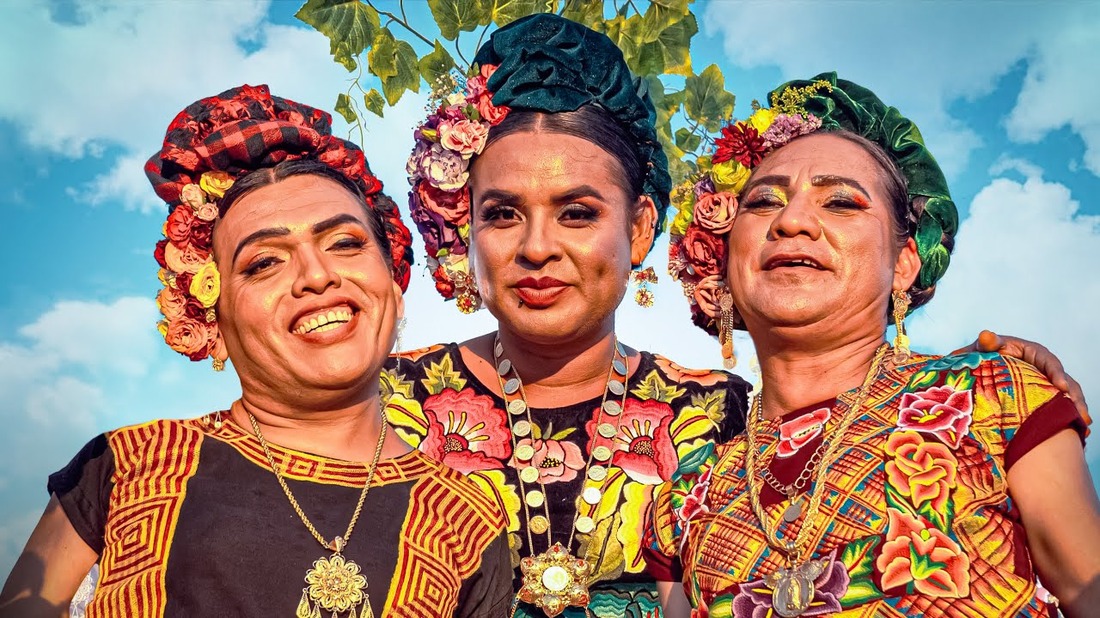
Muxes (Oaxaca)
*
Theroux makes it to San Miguel de Allende, which he calls "fussily picturesque." While he appreciates the "tastefully restored" and "beautifully maintained" architecture and enjoys the "mood of artistic congeniality," he finds other aspects of the town not to his liking. "The sprawl of trophy houses, mansions, condominiums, gated communities, and exclusive townhouses that clutter its margins have given it what seems like an unsustainable urban density and a maddening parking problem that makes being in San Miguel like being trapped in a cyclorama of colonial cuteness."
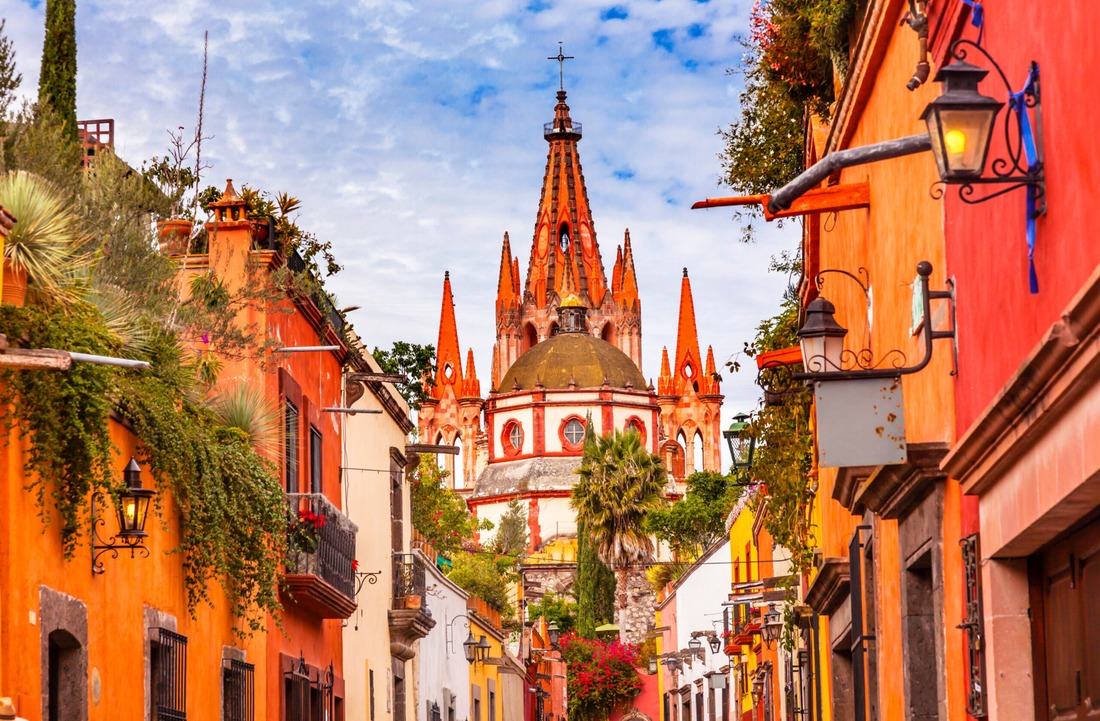
San Miguel - "Fussily picturesque"
*
Rest assured: the book includes its share of happy occasions. In Mexico City, Theroux is invited to teach a writing class and makes many friends. He takes Spanish classes in Oaxaca ("conscious of being elderly and conspicuous"), attends a Day of the Dead fiesta, delights in a village carnaval with its band of overblown trumpets and parade of mascaritas, "men dressed as women, in wigs and gowns, big-breasted, their chests stuffed, their masks depicting coquettes." He is perhaps most moved by a visit to Oventic, a rebel Zapatista caracol or stronghold, dedicated to the principle of building a new and better world—community as sanctuary. "We are here to shout for and demand democracy, liberty, and justice," one of the leaders tells him.
When he embarked on this ambitious road trip, Theroux was feeling depressed: "unguarded, shunned, snubbed, overlooked, taken for granted, belittled, mocked, faintly laughable, stereotypical, no longer interesting, parasitical, invisible to the young." But Mexico, even in its bewildering chaos, ended up not only "making sense" to him but restoring his soul. He concludes that in a lifetime of travel, he had never felt more fully alive than in Mexico, never "more eager to wake each morning and see what the day would bring." Mexico became for him "a world of struggle, of incident, of questioning, of people under threat and prevailing over their humble circumstances, which was a lesson to me, of venerating the past and being true, being determined to live." The "mess" of Mexico coalesced into a rational pattern. "It was all ritual, preordained and obeyed; it calmed me and helped me on my way."

Mascaritas
*
***
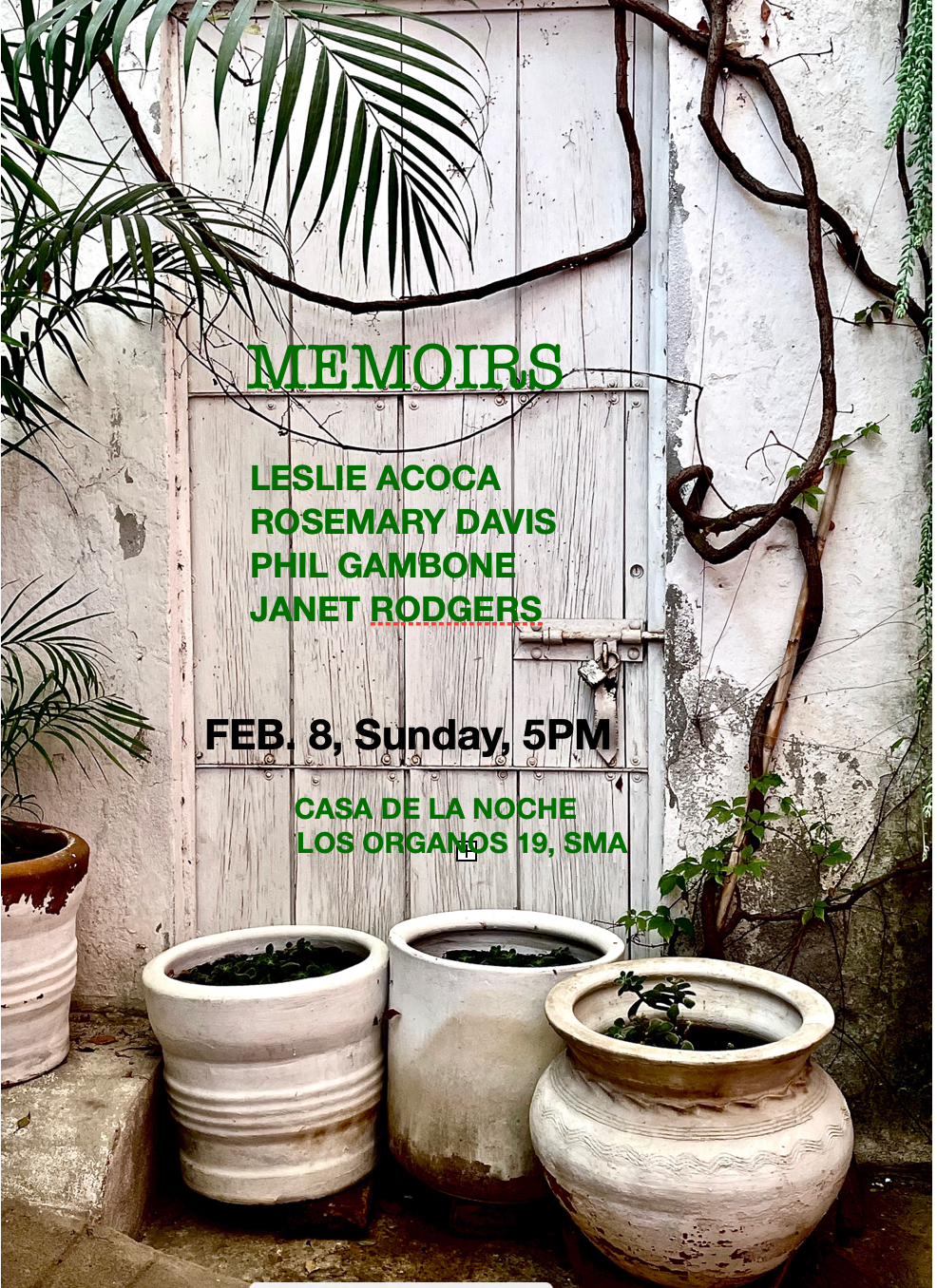
On Sunday, February 8, Philip Gambone will be reading from a new work-in-progress at Casa de la Noche.
See More
 **************

Philip Gambone, a retired high school English teacher, also taught creative and expository writing at Harvard for twenty-eight years. For over a decade, his book reviews appeared regularly in The New York Times. Phil is the author of seven books. His memoir, As Far As I Can Tell: Finding My Father in World War II, was named one of the Best Books of 2020 by the Boston Globe. His new collection of short stories, Zigzag, was published last year by Rattling Good Yarns Press. His books are available through Amazon and at "Tesoros," the bookshop at the Biblioteca.
**************
*****
Please contribute to Lokkal,
SMA's online collective:
 ***
***
Discover Lokkal: Mission
Visit SMA's Social Network
Contact / Contactar