I fall on the empathy side of the sympathy-empathy distinction, actually feeling someone's pain rather than just having compassion for their situation. I adopt the other. Like a garment that I try on, it surrounds me. I regularly burst into tears at stories of hardship overcome, most recently World War Two YouTube videos.
A friend objected when I characterized myself as having "self-doubt." He pointed out that I have great self-confidence. He was right. It's not doubt. It's an un-anchoring, a hyper-flexibility of self. The bullishness of the "great person" eludes me, or, at least, I have to work at it.
My sympathy has, and on occasion still does, limit my freedom. At times I put too much weight on other people's opinions. I'm along the lines of (but not as bad as) my oversensitive (Natrum muriaticum) patients, whom I would counsel: "You wonder why they said it in that tone of voice, the meaning behind it. But there is nothing behind it. They don't mean anything by it. If they had thought about it at all, they never would have said it." I take people's experience to heart, but then I let it go.

A few decades ago, somewhat contrary to that of the CIA interrogator, I had my own revelation into this subject. Wondering why it was that after an unpleasant interaction with someone, although I had intellectual certainty that right was on my side, I still felt bad, I came to understand that most of the time, those negative feelings were those of the other person's, not mine. I was caught in their psychological drama, infected by it as it were. Nor was, or is, it always a question of conflict.
A couple of years ago, I was seeing a woman. Young, attractive, intelligent... for some reason she found me fascinating. I was advocating for a closer relationship. She was interested. But it was going very slowly. Brunches at my house, our chief activity together, infrequent as they were, were always delightful, stretching on for five hours each.
Then, once, I went to her house to resolve some electrical issue for her. Successful in that endeavor, standing there in her now well-lit kitchen, she shared with me her history of abuse, abandonment and trauma. I understood, all at once and all too well, why our relationship was going so slowly.
My reaction, there under the kitchen lights, was physical, a lowering of the blood pressure like going into shock, a draining of life force. Yes, my hopes were deflated, but my personal sadness was only a small part of what I was feeling. I was disappointed, but not that disappointed. Later I understood that the profound sadness that I was feeling was hers. I was trying on her experience. I had asked for it, opening myself up to her. She had shared her perspective. It was horrible.
I went home. My blood pressure rose, and over time my hopes did, too. I took heart, again, in the charming woman whom I knew over brunch. The subject of her emotional difficulties coming up again, she warned me, "I'm not a good bet." But she burst into laughter when I retorted with the Mexican saying, "I buy crooked to make straight." Maybe her never letting me invest was a problem, or maybe it was a favor that she did me.
My hyper-flexibility of outlook does save me from arrogance. Seeing things from multiple perspectives makes it hard to get stuck on any one particular point of view. Mentally and emotionally it gets a bit kaleidoscopic. The changes I go through, morning, noon and night, are probably not that dissimilar from certain types of mental illness. The difference between genius and madness, I say, is that genius pays the bills. And I take heart in that I am putting my psychological imbalance to work.
Philosopher Arnold Zuboff (who was my neighbor when we were young) asserts that consciousness is not fundamentally individual, but numerically one and shared. He says that what we call "separate minds" are appearances generated by different physical perspectives. That is, there is only one subject of experience, consciousness itself, experiencing the world from many physical points of view. We all are the same subject instantiated in different brains at different times.
Zuboff calculates that with many millions of your father's sperm competing to fertilize your mother's egg, the probability of your specific sperm winning was astronomically tiny. (Any other sperm would have produced someone other than you.) The same being true for your parents, grandparents, great-grandparents, etc., over thousands of generations these odds compound into absurd improbability.
Zuboff says that this reveals something wrong about the assumption that consciousness is attached to a particular physical lineage. His conclusion is: consciousness doesn't "belong" to a particular organism; there aren't many separate subjects competing to exist; there is one subject of experience, which always finds itself wherever experience occurs; the "self" is a perspective, not an owner of consciousness; there is one observer appearing as many.
The way I see it, consciousness does not arise from a physical being; it comes to rest on a physical being; like a crown sits upon a head or a soul comes into a body.
My inclusivity, my sympathy, my feeling others as myself, takes part in Zuboff's collective self. It also has something in common with the universalism of the saints. "Oneness reflecting Oneness," as the kabbalists observe, uniting with another mirrors the essential unity of experience. And that is my/our work.
Lokkal, our local internet project, reflecting the collective nature of consciousness, unites the local community online. Yes, I feel like a prophet crying in the wilderness. But you might lift up your voice as well if you believed that coming together as a community, aided by the magic of the internet, will enrich the local economy, solve most social ills, foster togetherness and usher in the singularity. Lokkal puts the unity in community. Ask me, at the email below, how you can help.
Website

xxx
*
**************
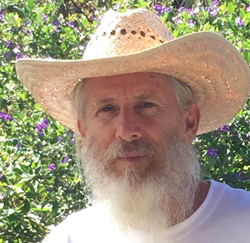
Dr. David Fialkoff presents Lokkal, public internet, building community, strengthening the local economy. If you can, please do contribute content, or your hard-earned cash, to support Lokkal, SMA's Voice. Use the orange, Paypal donate button below. Thank you.
**************
*****
Please contribute to Lokkal,
SMA's online collective:
 ***
***
Discover Lokkal: Mission
Visit SMA's Social Network
Contact / Contactar