
Paul Theroux
Español
January 25, 2026
by Philip Gambone
Paul Theroux's first travel book, The Great Railway Bazaar: By Train Through Asia (1975) was an enormous success, selling a million and a half copies. An account of the author's four-month-long journey across Europe, the Near East, India, and Southeast Asia via the old imperial railway routes, it brought the thirty-four-year-old Theroux considerable acclaim and attention. "The most consistently entertaining and the least boring book I have encountered in a long time," Robert Towers wrote in a glowing review in The New York Times.
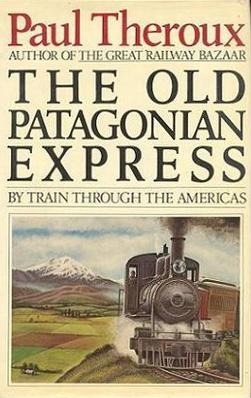
Three years later, the travel bug hit Theroux again. He studied maps and discovered that there was a continuous railway track (or so he thought) from Boston to the end of the line in Esquel, a town about two-thirds of the way down Argentina near the border with Chile. "I was seeking an adventure," Theroux wrote years later. "I wanted to leave my front door in Medford, Massachusetts, and head for Patagonia, and to do so without leaving the ground."
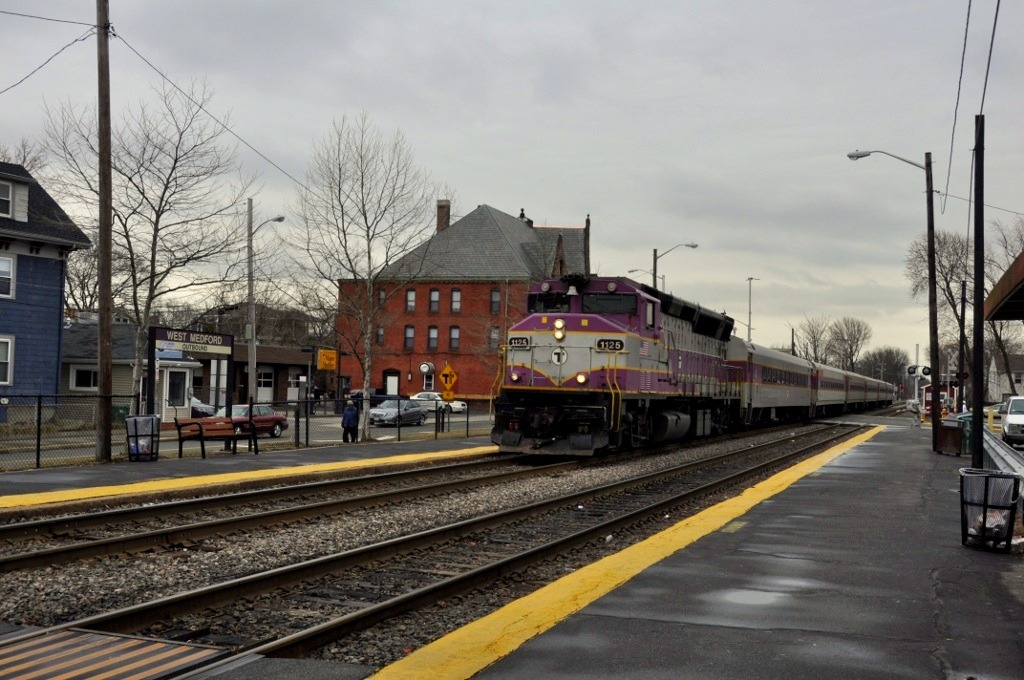
West Medford Train Station
*
On a freezing February afternoon in 1978, with a blizzard approaching, Theroux climbed aboard the local commuter train into Boston. "And then another train from Boston to Chicago, and so on," rattling south "in progressively more geriatric trains." His aim was to write "the ultimate book about getting there," the journey, not the destination, being the point. Along the way, he hoped to meet unusual people and to give them life. The book was to be "a series of portraits, of landscapes and people."
Theroux traveled light: "with a suitcase of dirty laundry, a sheaf of railway timetables, a map, and a pair of leak-proof shoes." He knew that train travel "is a great deal more trouble" than travel by airplane, "but it is uncomfortable in a way that is completely human and often reassuring."
At Laredo, Texas—"a respectable frontier town sprawling at the very end of the Amtrak line"—he took a taxi across the border into Nuevo Laredo. "Laredo had the airports and the churches; Nuevo Laredo, the brothels and basket factories. Each nationality had seemed to gravitate to its own special area of competence." Here, in a couple of sentences, is Theroux both at his wittiest and his most sardonic.
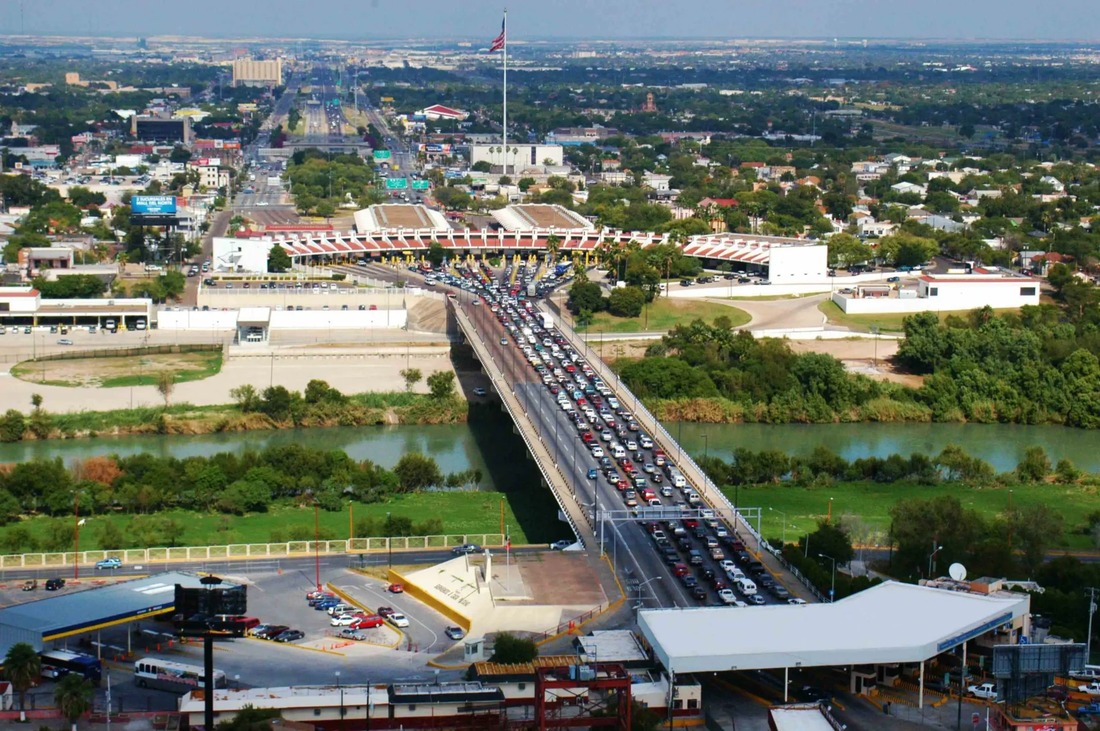
Laredo and Nuevo Laredo
*
Despite such cultural stereotypes, Theroux actually has interesting and trenchant things to say about Mexico. The relationship between Laredo and Nuevo Laredo struck him as an example of "cozy hypocrisy." It demonstrated, he writes, "all one needed to know about the morality of the Americas, the relationship between the puritanical efficiency north of the border and the bumbling and passionate disorder—the anarchy of sex and hunger—south of it."
On his way to Nuevo Laredo's train station, he notes the "great disrepair" of the town. "No building was without a broken window, no street without a wrecked car, no gutter not choked with garbage. It was cruelly ugly." At the same time, he acknowledges that this squalid place of no romance was "our bazaar, not Mexico's. It was a city existing to cater to the tastes of American visitors."
He stops to buy a souvenir and encounters a man "melting tubes of glass and drawing them thin and making model cars," a skill that "amounted almost to artistry," despite the fact that in the end what he fabricated was little more than junk. "It seemed a great waste, but not very different from the Zone [of prostitutes], which turned lovely little girls into bad-tempered and rapacious hags."
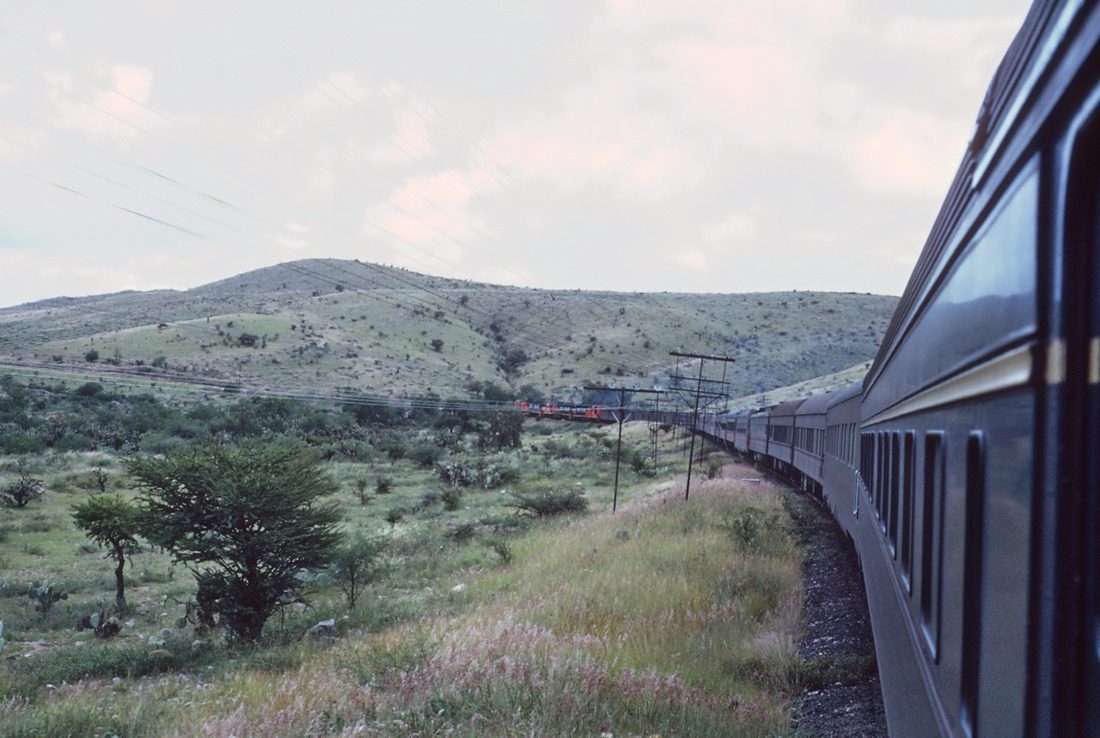
Aztec Eagle south of San Luis Potosi
*
His train to Mexico City, the Aztec Eagle, is fitted out with two sleeping cars, old American ones from a railway that had gone bankrupt. "The Mexicans did not have the money to rebuild sleeping cars … but by keeping them in trim they had managed to preserve the art-deco originality." In his compartment, sipping tequila, he muses on "slaphappy Mexican dishevelment" and tries to discern the stations they pass, "so poorly lighted I could not make out their names on the signboards." By midnight, he has finished his bottle of tequila. The sleeper is cold and his blankets thin. He sleeps fitfully.
Theroux is always alert to what he calls "that curious Mexican mixture of sparkle and decay, blue sky and bedragglement." Bedragglement, indeed. Adjectives like "dismal," "wretched," "sinister," "disgusting," "vulgar" abound in his descriptions of Mexico. In an effort to eschew typical travelogue enthusiasms, he trains his eye on what's not so pretty or picturesque: lurid newspaper headlines, the spiders and ants crawling in and out of the horsehair train cushions, mutilated animals, ragged children, tumble-down sheds.
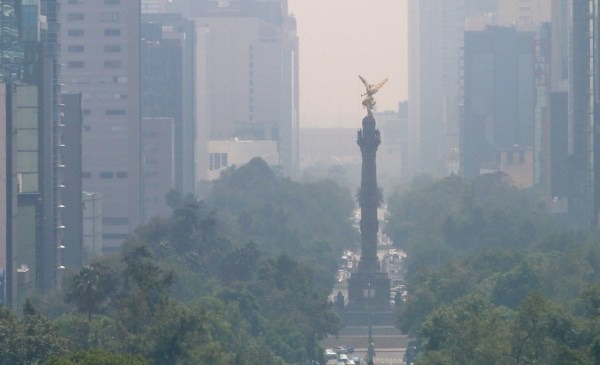
Smog-polluted Mexico City
*
The Aztec Eagle moves on, through San Luis Potosí, Querétaro, Huichapan, and Tula, finally arriving in Mexico City, "a smog-plagued metropolis of mammoth proportions." Theroux has no desire to see the city and soon switches trains, taking the Jarocho Express to Veracruz. The train has no dining car, so he buys a box lunch, fussily described as "one of those parody meals that are assembled by people who have a profound dedication to completeness but with a total disregard for taste."
In Veracruz he is obliged to stay two days until he can catch the next train to Guatemala. During his stopover, the city strikes him as "a faded seaport, with slums and tacky modernity crowding the quaintly ruined buildings at its heart." Not finding much to interest him, he walks to the Castle of San Juan de Ulua, where he takes in the permanent exhibit of Veracruz's past. "It was that most Mexican of enthusiasms," he notes, "humiliation as history…. In Mexico a hero is nearly always a corpse."
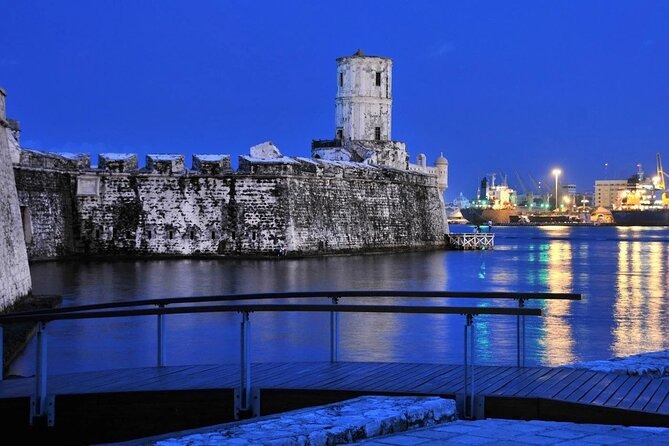
San Juan de Ulua Fortress
*
The passenger train to Guatemala—a "carelessly run" railroad of shabby cars and nauseating toilets—is agonizingly slow. After a whole day of traveling, mostly through swamps, Theroux manages to cover only a hundred miles. The slow pace gives him an opportunity to muse on Spanish place names, which, he says, do not often accurately describe a place and are apt to be only "ironies or simplifications." None of Lagunas Verdes was green, he notes, and La Dorada looked leaden rather than golden. "Latins found it hard to live with dull facts; the enchanting name, while not exactly making their town magical, at least took the curse off it."
As the train nears Guatemala, it stops frequently, but not at stations. "It slowed near cane fields or on marshland or in hot woods, and then the trumpeting engine went silent and jerked to a halt." The passengers grow restive, irritable, bored, frustrated, quarrelsome. "This was supposed to be enjoyment," Theroux thinks, "not a test of stamina or patience."

Zapotec women
*
By morning, they have reached the Pacific side of the Isthmus of Tehuantepec, the narrowest point in Mexico. This is Zapotec country, where matriarchy predominates. "The women owned land, fished, traded, farmed, and ran the local government; the men, with that look of silliness that comes of being bone-idle, lounged around."
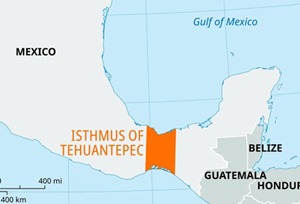
Isthmus of Tehuantepec
*
He tells us that the U.S. government explored the possibility of digging a canal across the Isthmus and that, when that failed, tried to get Mexico to hand over the territory so that a railroad could be built. (Don't let Trump know this!) With memories of the Mexican-American War fresh in their minds, the Mexicans refused to surrender Tehuantepec. A railway line was eventually built (largely by Chinese, who ended up staying). Little of that line or of Tehuanpec's once glorious day as a great crossroads of the world now remains.

Pijijiapan
*
On through the state of Chiapas, "so inhospitable and unmarked by any human effort, that the people seemed like pioneers." At Pijijiapan, the train stops in the middle of town, which blocks the road so that the hawkers of turkeys and chicken, corn and beans cannot cross, leaving them waiting in the hot sun, their fish turning rancid. At last, they move on. The landscape is dotted with the electric hues of jacaranda, hibiscus, bougainvillea, "in what was otherwise a desert of frail trees and barren soil broken by fields of corn and tobacco." At the Suchiate River, he shares a taxi with a Guatemalan mother and her four children, and they cross to the border town of Tecún Umán. The rolling hills and banana groves of Mexico are now behind him.
Theroux can be a curmudgeon—Mexico frequently comes under his jaundiced eye as a "dunghill"— but there is also much to admire in The Old Patagonian Express. He always does his homework—reading other travel accounts, boning up on history, consulting those timetables—and this deep knowledge is evident throughout. He has a novelist's ear for sharp, telling dialogue. And for the occasional moments of humor along the way. When, at one town somewhere in Mexico, a boy leans out the train window and asks a girl selling corn, "Where are we?" she laughs and tells him, "On a train."
As a lover of train travel, I'm sad that, unlike Theroux, almost fifty years ago, I can't get to Mexico by rail. Every night, I hear the whistling of the freight trains passing through San Miguel's handsome train station and wish it signaled the arrival of passengers. Maybe one day, I'll be able to make such a trip. To my way of thinking, that would be a far better option than arriving at the new airport that is being planned for the city.
Years later, reflecting on The Old Patagonian Express, Theroux confessed, "I was a thrill-seeking traveler, looking for something sensational to write about, but I did not look very deeply." In his late seventies, he set out to remedy that defect when he returned to Mexico, this time in a car, and, looking more deeply, wrote another travel book about his journey. That book will be the subject of my next installment of "The Writer in Mexico."
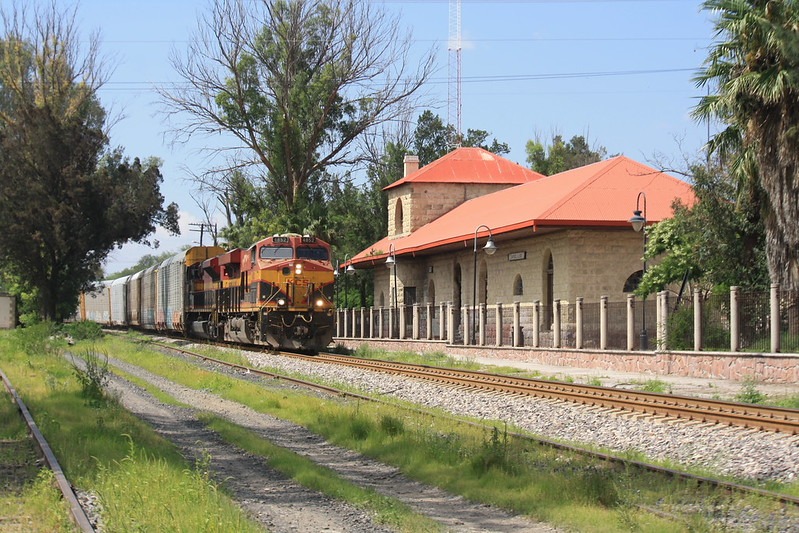
San Miguel train station
***
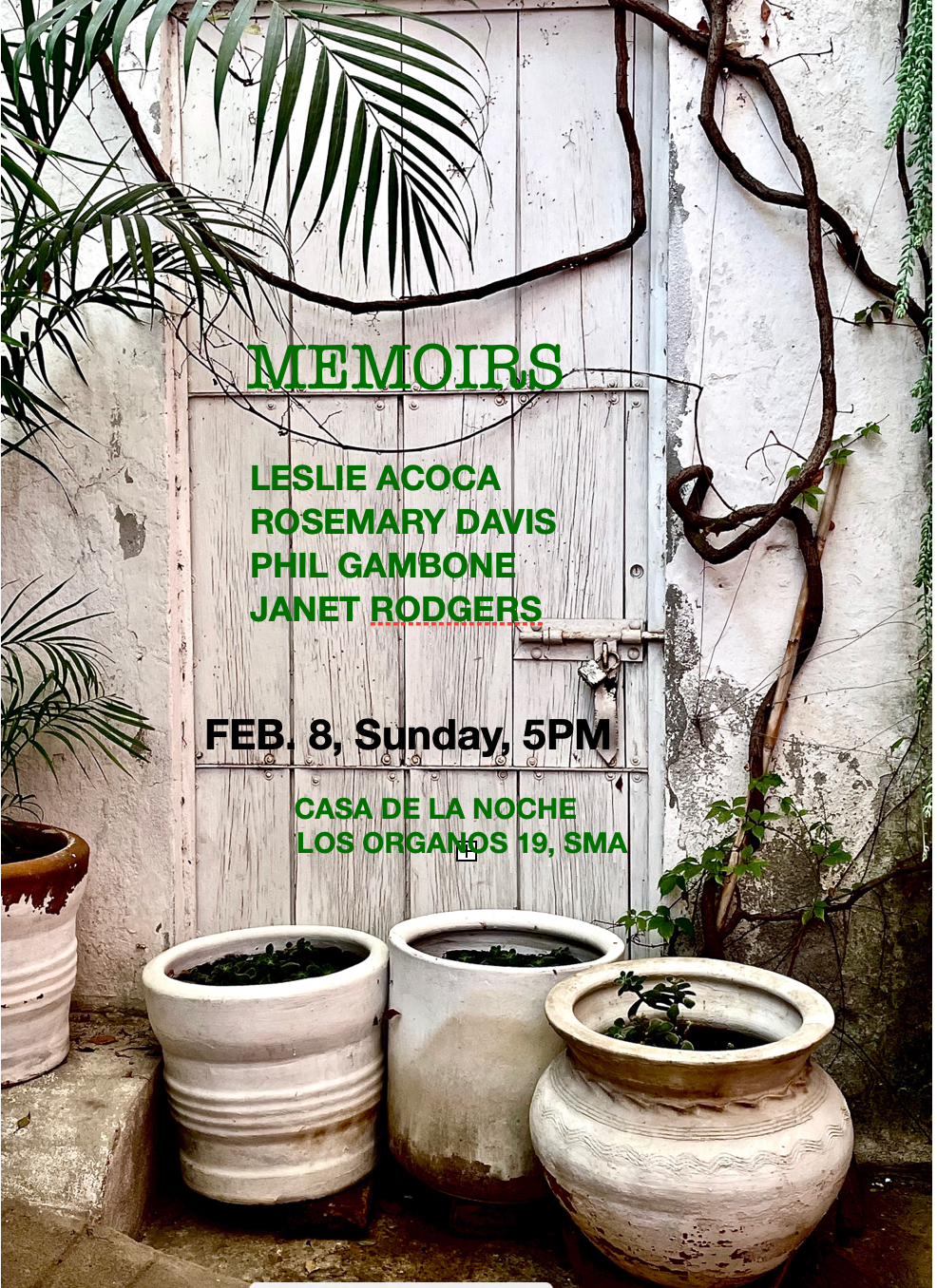
On Sunday, February 8, Philip Gambone will be reading from a new work-in-progress at Casa de la Noche.
See More
 **************

Philip Gambone, a retired high school English teacher, also taught creative and expository writing at Harvard for twenty-eight years. For over a decade, his book reviews appeared regularly in The New York Times. Phil is the author of seven books. His memoir, As Far As I Can Tell: Finding My Father in World War II, was named one of the Best Books of 2020 by the Boston Globe. His new collection of short stories, Zigzag, was published last year by Rattling Good Yarns Press. His books are available through Amazon and at "Tesoros," the bookshop at the Biblioteca.
**************
*****
Please contribute to Lokkal,
SMA's online collective:
 ***
***
Discover Lokkal: Mission
Visit SMA's Social Network
Contact / Contactar