June 28, 2026
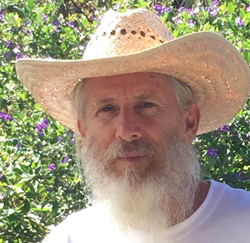
by Dr. David Fialkoff, Editor / Publisher
For the last few months, I've been ahead of the game, easing into ease, getting things done earlier than usual. For years, whenever someone suggested something extra for my plate, I would protest, "I'm pedalling as fast as I can." Six months ago, I started adding, "But I think that I'm getting to the top of the hill." Now I've crested. Whew!
The day before yesterday (June 20), Saturday in the mid-afternoon, I had already finished my Sunday morning newsletter. It was all wrapped up, scheduled to automatically send early the next morning. That magazine newsletter is a major part of my still Herculean workload. (Hercules' 10 Labors were one-offs; do it and done. Mine recur weekly.)
Sunday's undertaking involves, in addition to the newsletter itself, preparing the magazine's table of contents (to which the newsletter links) and the individual articles, usually 10 but that week 14 (to which the table of contents links).
Publishing for me is like body-building, hard work that exercises my muscles. Like artists, I too am flexing my talents, doing what I know how to do. Some people paint; I publish.
Recently I listened to two accounts of the nobility of the publishing profession (Patricia Hightower's Deep Water and "The Man Who Invented the Modern Israeli Canon"), both of which added to my editorial self-esteem; sometimes it does get a little lonely here at the keyboard.
So, as I was relating, the day before yesterday, Saturday in the mid-afternoon, with my Sunday newsletter "in the can" (Hollywood slang for having the filming of a movie finished with the celluloid reel stored in a canister), I decided to ride my bicycle into town to pay my internet bill at the Oxxo on Calzada de la Aurora and then to stop (also in colonia Guadalupe) at la Tienda de Gil to pick up some yogurt.
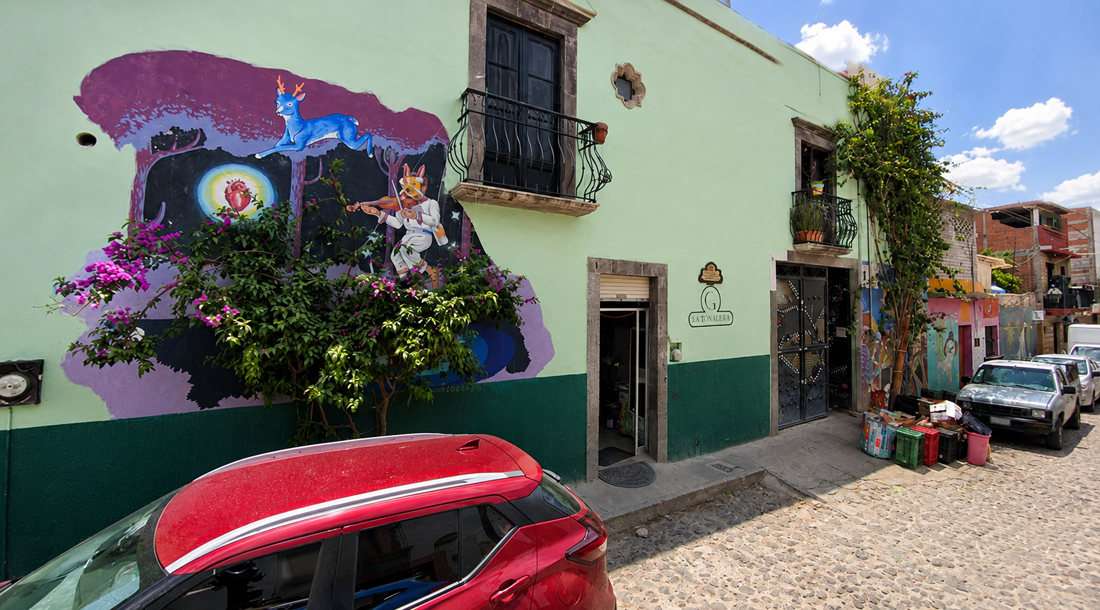
Gil's Tienda
*
Outside, in front of my house, as I was about to mount my bicycle, I looked up and noticed that the clouds, whose fluffy intermittent white masses had been periodically screening our fierce Mexican sun and so favoring a ride, had distinctly blackened eastward. In fact, off in that distance, alongside the Picachos in the direction of the mall, a dark vertical veil made it clear that rain was already falling there.
I have ridden in the rain here in San Miguel, through more than one deluge. I remember, on my way home to San Antonio from el Centro coming up Aldama towards Cardo, avoiding the stream that roared down the center of the street where the flagstones are. Those flat stones are my much preferred smooth, narrow path. But riding up through that down rushing current, going against the flow, was too much extra effort. I've ridden with rainwear (sometimes improvised) and without. I have fenders to shield me from the dirty water of the street. The worst of it is you get wet. So, stubbornly persistent, foolishly perhaps, I set off on my journey into town.
I felt the first drops when I was more than halfway to my destination, approaching the rotary where the road turns towards Dolores (near Pollo Feliz). I felt a few more when I left the Oxxo, my TotalPlay receipt in hand. Two minutes later, locking my bici to a pole on the corner in front of Gil's, I looked up on my way to the front door and saw my friend Jorge Catalan placing books in a glass-fronted case on the wall across from the store. Approaching Jorge and striking up a conversation I noticed alone on one end of the top shelf, the whole front cover staring right at me, Alan Furst's A Foreign Correspondent.
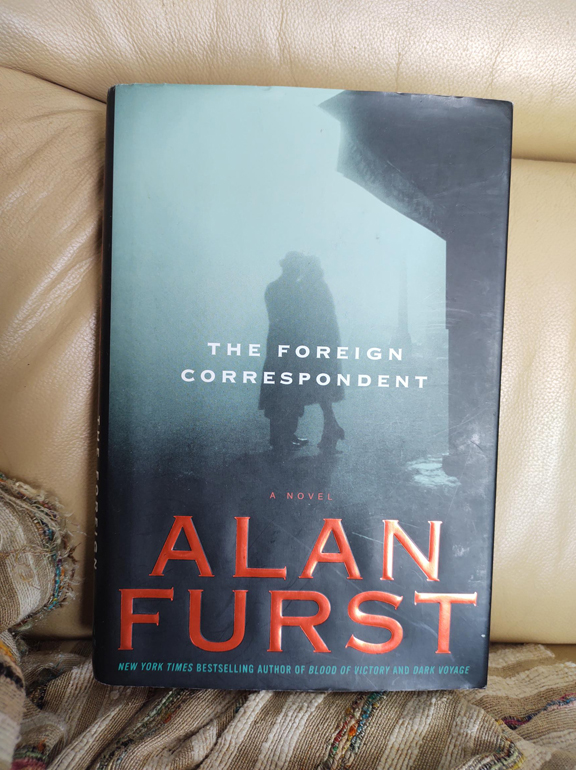
My friend Richard Adelman introduced me to spy novels a few years ago, loaning me his collection of Alan Furst novels one at a time. I have since listened to one book each of two other authors in the genre, John le Carré and also, Furst's chief inspiration, Eric Ambler. Le Carré, who was himself a spy, tells a good story, but (even if such is an accurate depiction of the spy world) is too complex for my taste. Ambler left a hole in his plot, not a big one, but for better and worse, it has always been my fate to look too closely. Furst suffers neither of those faults. His prose is superb. And he conveys a lot of history to boot. So, his book (not available online as an audiobook at the library to which I belong) was quite a find.
Moments later, with the book already secure in my bag, I was coming out of Gil's with my yogurt. The rain was then a steady light drizzle. Jorge, who had filled the books-for-free cabinet to capacity, asked me if I would like a ride back to my place, assuring me he was going in that general direction anyway. After a moment's consideration, during which the drizzle increased, and some encouragement from Jorge, I accepted.
Not the first time he had a bicycle in his car, wonderfully competent in all that he does, folding down the back seat and repositioning another nearly full box of books to the side, he slipped my bici in through the hatch and quite gallantly took us home. Just getting the bicycle out of his car, even though we were quick about it, my shoulders and back got damp. It was a cold rain, a chilly afternoon, and, inside changing into warm, dry clothes, I was very glad that I didn't have to ride through it wet.
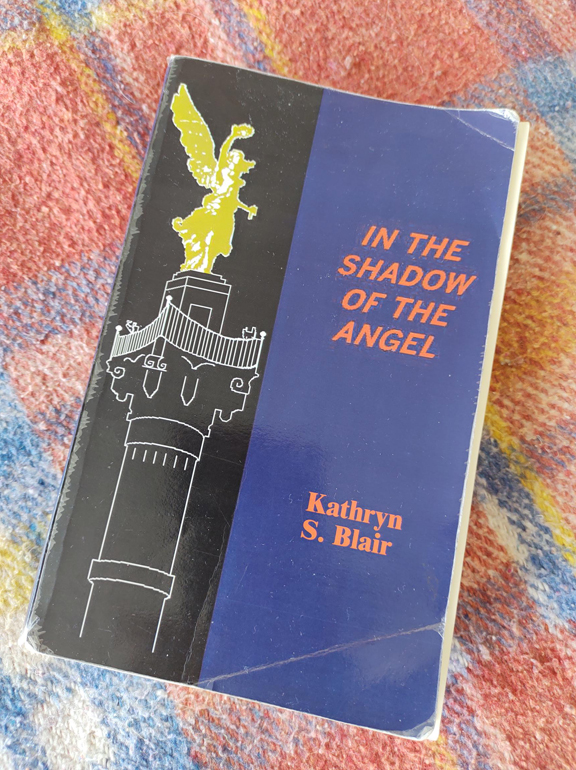
I'm also very glad that I have the Furst novel (which sits unopened on my night stand while I finish In the Shadow of the Angel, the "Mexican Gone With the Wind"). My life is better when I am involved in a good story, both literary and experiential.
Life is itself a story. Or, rather, it is a series of stories, often consecutive. Those who are generous in their appraisal of human nature often opine, "We all have our own point of view." But as I see it, almost everyone has adopted someone else's point of view. Hive mind being the norm (Buddha said, "The mind is conditioned"), it is nothing short of heroic to make your own way through life.
With less and less jest as I get older, I say, "I have abandoned my quest for truth and am now in the market for a good fantasy." A case in point: after long consideration of the demise of a recent romantic interlude, and finding no objective cause, I say, generously, and with no jest at all, that our stories, hers and mine, just diverged. Less generously, and more accurately, she stopped believing in mine.
A reason (there are many) that most people choose to act like someone else is that this telling and weaving of one's own tales (alone and with others) takes creativity and work; with the hardest,most creative work being the untangling of threads.
We remember that Alexander, when presented with the Gordian Knot, took out his sword and hacked it in two. (I suppose it took a few blows.) To me untying that fabled puzzle would have been noteworthy; slicing it just seems like cheating. But then, I have a low tolerance for loose ends, and I have not conquered the known world. It seems, heroic resolution, or at least its aftermath, is not always elegant.
Yesterday, Sunday, I went to a party in the neighborhood. Friends at the top of the hill were having people over to celebrate both their wedding anniversary and the inauguration of their third floor terraza. The terraza is really a largely-open (on two sides), enormous room, wonderfully appointed with a mesquite bar, tiled fireplace and a 360 degree view.

The husband, a master craftsman, himself did the woodwork, extensive throughout the house. A wonderful person, he obviously got the best efforts of the craftsmen he employed to do the rest. The Turkish chandelier, two dozen hand-painted orbs, hanging down the center of the three-storey staircase was the piece de resistance.
Religion (an essential part of all cultures everywhere until our modern age... and look how we are doing) is misunderstood. I approach the biblical commandments not as rules to follow, but as life advice: stealing and murdering do bad things to the thief and assassin. So, leaving the party last night, jogging through the rain the few blocks back to my humble abode, and changing into some warm, dry clothes, I was careful not to covet my neighbor's beautiful house.
Fifty years ago, when I came to Mexico for the first time I brought a big, metal-framed backpack. Someone whom the 19-year-old me met on that trip, seeing my load, advised me that it was better to travel lightly. And I suppose that is what I have been doing all along since.
My favorite story about Alexander involves Diogenes, the Greek philosopher who lived very lightly, giving up his home to live in a wine vat, his bowl for a fig leaf and his cup for the cupped palm of his hand. Because Diogenes would not visit Alexander, Alexander, accompanied by his generals, rode out to visit Diogenes, whom he found sunbathing naked on a rock.
Still on horseback (in my version of the tale), Alexander addressed the philosopher: "I am Alexander. Is there anything that I can do for you?" "Yes," Diogenes replied, "You can get out of my sun." Riding away, the generals mocking Diogenes as a madman, Alexander retorted, "Say what you will, but were I not Alexander, I would be Diogenes."
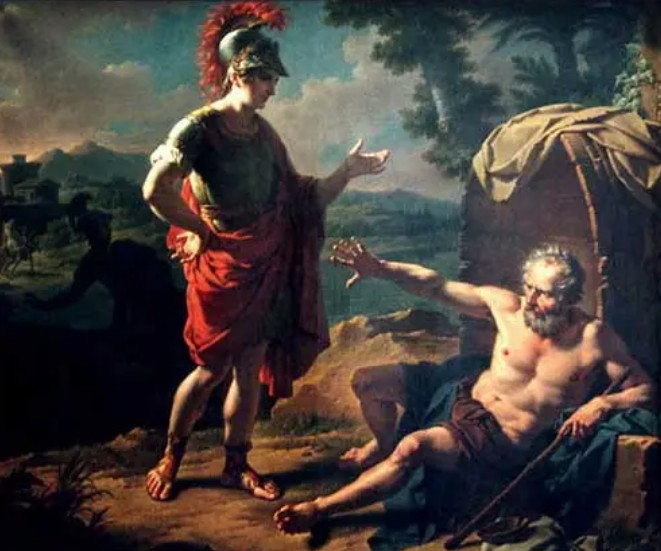
I am not Alexander nor Diogenes nor my friend up the hill. But, at almost 70 years of age I find myself publishing a literary journal in the best little city in the world, which is not a bad fate for a philosopher, or at least a story-teller, like me.