 Español
July 19, 2026
by Charles Miller
Service Set Identifier (SSID) is the name identifying a Wi-Fi network; a somewhat unique identifier broadcasted by routers to distinguish one wireless network from another. When connecting your computer, smart phone, or mobile device to Wi-Fi you will see a list of SSIDs belonging to you and your neighbors. Your home Wi-Fi probably has a SSID assigned by your Internet Service Provider, typically something like "Infinitum1234" or "Totalplay-2.4G." Many restaurants and coffee shops that provide public Wi-Fi change their SSID to make it easier for their customers to identify.
Customizing a network name is an easy way to identify the owner of a Wi-Fi network, but it can potentially convey a lot more information such as showing a sense of humor, or subtly discouraging freeloaders; no one with good sense would ask for the password for "FBI Surveillance Van #1376." A little less subtle was the restaurant that changed its Wi-Fi password to "TipYourServer20%!"
It is fairly easy to understand why someone changed the SSID of a Wi-Fi to read "Grandma click on this one" because it succinctly conveys the instructions for what Grandma is supposed to do. Names such as "404 Network Not Found" or ""No, I Won't Share the Wi-Fi" or "Stay Off My Wi-Fi" should be self-explanatory. Allegedly the Wi-Fi at a urologist's office was set to "It hurts when IP."
Knowing that the neighbors in an apartment building will see the list of Wi-Fi names from time to time, SSIDs have been used to communicate between neighboring tenants. When one neighbor changed their Wi-Fi name to "YourLoudMusicSucks" the unrepentant neighbor responded by rudely changing their SSID to "I slept with your wifi!" Another neighbor chimed in and changed their Wi-Fi name to read "Children behave yourselves!"
Some SSIDs contain religious overtones such as "Thou Shalt Not Covet Thy Neighbor's Wi-Fi" and "Rebellious Amish Family". And of course computer techies get in on the act by naming their Wi-Fi "sudo rm -rf /" (a command to erase a hard disk) and the password "YouWould'ntDare!"
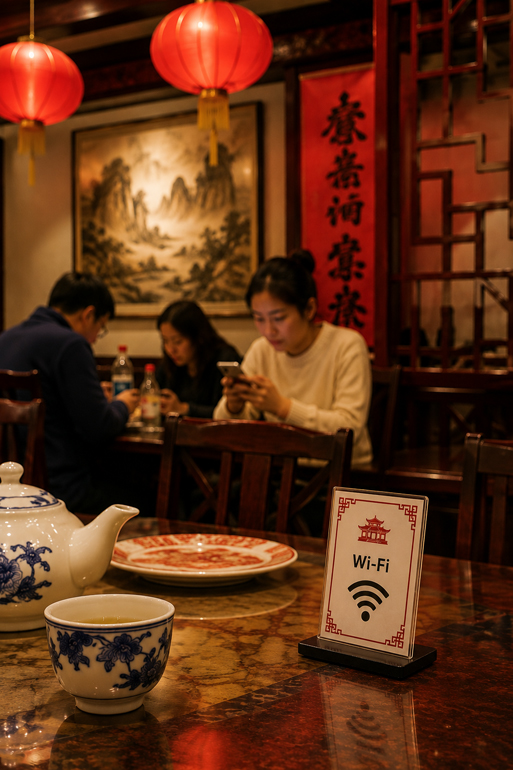
If you listen to pop music you might be able to guess that the password for "LAN Down Under" is "MenAtWork" or that "Aerosmith" is the password for the Wi-Fi at a Chinese restaurant; a clue for this the being their song "Wok This Way." A classical variant of that is the music store with the SSID "K 525" for which the obvious password is "Magic Flute." The SSID used by another Chinese restaurant is "Confucius Say…You Need Password." Another restaurant that apparently got tired of everyone asking for the password simply changed the name of the WiFi to read "Password is 12345678 – Click here" By the way, that is a very smart approach because anyone using that password has their connection automatically encrypted and isolated from others using the same restaurant Wi-Fi. Technically it is called inter-client isolation" and just using a password protects your connection, even from others using the same Wi-Fi and same password. This is more secure than having no password on a public Wi-Fi.
Even if you change the SSID of your network and the name is a joke, always use WPA2 or WPA3 encryption. Using a funny name does not stop hackers but a strong password usually does. Most routers permit your using a SSID and password of 32 characters so with that you can really get creative. Not all routers or other devices support using special characters, so a password like "¯\_(ツ)_/¯" might not work on everyone's hardware. By the way, that emoticon showing a person shrugging in the last sentence is a legal username or password on most Wi-Fi systems. The smiley face is a Japanese Katakana syllabary key not found on English or Spanish keyboards, but still a legal character if you could just find a way to type it.
What's the point of funny Wi-Fi names? It is because life is too short for "NETGEAR_4837" or "Megacable_3E63.". A funny Wi-Fi name shows off your personality, gives your neighbors something to smile about while they are scrolling for their signal and is a harmless way to show that you have a sense of humor.
**************

Charles Miller is a freelance computer consultant with decades of IT experience and a Texan with a lifetime love for Mexico. The opinions expressed are his own. He may be contacted at 415-101-8528 or email FAQ8 (at) SMAguru.com.
**************
*****
Please contribute to Lokkal,
SMA's online collective:
 ***
***
Discover Lokkal: Mission

Visit SMA's Social Network
Contact / Contactar