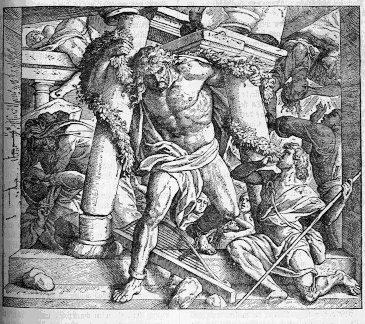
Blind Samson destroying the temple
Español
July 12, 2026
by Philip Gambone
In 1932, immediately after the publication of Brave New World, Aldous Huxley began work on a new novel, his sixth. He was hoping for a creative breakthrough of some kind. Huxley's earlier novels had cast a cynical eye on the world. Now he wanted to engage more deeply with life and politics and to dispense with his earlier view of the meaninglessness of the decadent world around him. Work on the new novel stalled. It wasn't until Huxley and his wife returned from a tour of Central America and Mexico that he was able to find his way to completing it. (See my "Aldous Huxley: A 'civilized mind coming to grips with Mexico'," Lokkal, June 28, 2026.) The result was Eyeless in Gaza, published in 1936. It represented the artistic and philosophical turning point the forty-two-year-old author was seeking.
Eyeless in Gaza focuses on Anthony Beavis, a self-centered intellectual with an appetite for "detached and irresponsible sensuality." Over the course of the novel, which moves back and forth in time, Huxley pieces together Anthony's life—the death of his mother when he is nine; his years in a boarding school, where true affection for others is discouraged; his undergraduate career at Oxford, where he develops a sneering sense of superiority; and his reckless and insensitive young adulthood.
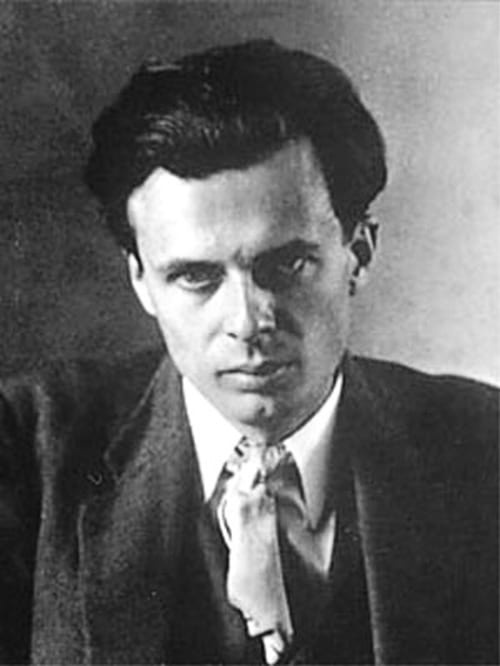
Aldous Huxley
*
Anthony is an elitist. He tries to justify his cavalier and callous behavior as a stance he is entitled to. And though he sometimes longs to be "serene like an old man and active like a young one," he continues to hobnob with jaded, frivolous people. And to indulge in some deplorable behavior. The chapters are interspersed with Anthony's mature diary entries, in which he reflects on his earlier dissolute life. "I catch myself showing off and trying to dominate by a purely verbal display of virtues which I don't put into practice," he writes in one entry. The novel ends when Anthony, now in his forties, undergoes a profound transformation, one that takes place in Mexico, leading him to a commitment to universal brotherly love and pacifism.
Huxley traces the evolution of this transformation by showing how certain traumatic events in Anthony's life have prepared the ground for his moral and spiritual about face. Those events include the death of his friend Brian Foxe, who commits suicide when he learns that Anthony has seduced his fiancée, and a bizarre incident when a dog falls out of an airplane, spattering Anthony and one of his lovers in blood and gore—a horrific wake-up call.
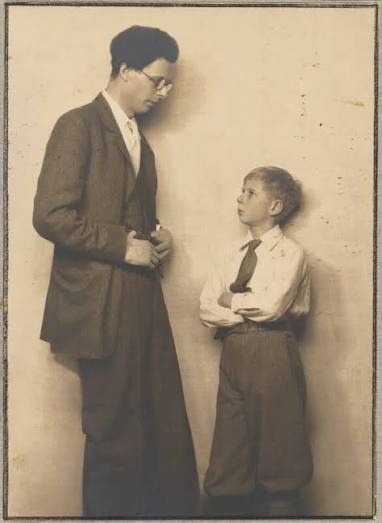
Huxley and his son
*
But it's not until Anthony makes an ill-conceived trip to Mexico with Mark Staithes, an old school chum, that he fully wakes up to the shambles that his life has become. From the very beginning, the trip—one heavily inspired by Huxley's own trip to Mexico in 1933—is a nightmare. Anthony is bitten by bedbugs and comes down with dysentery. In the markets, the vegetables are withering and the meat in the butchers' stalls is covered with a crust of flies. "When I die," he says, "this is the part of hell I shall be sent to."
As they travel on muleback to Oaxaca, Mark is gravely injured. Anthony enlists the help of a quirky Scots doctor, James Miller, who amputates Mark's leg. During Mark's recovery, Miller instructs Anthony in his quasi-Buddhist outlook on life. "You can't be intelligent about human beings unless you're first sentimental about them," Miller tells him. "Sentimental in the good sense, of course. In the sense of caring for them. It's the first indispensable condition of understanding them. If you don't care for them, you can't possibly understand them; all your acuteness will just be another form of stupidity."

Alexander Technique
*
Miller teaches Anthony the yoga-like Alexander Technique, which stresses good bodily posture as a means toward physical and mental health. The novel ends with a long soliloquy by the newly awakened Anthony in which he resolves to take steps toward being "united at the depths with other lives, with the rest of being."
Literary scholar Peter Firchow notes, "Unlike the Biblical Samson—or the Samson of John Milton's poem Samson Agonistes, from which Huxley drew the title of his novel—[Anthony] does not destroy his enemies but rather hopes to convert them peacefully." The novel is "a demonstration of how the metaphorically blind are made to see."
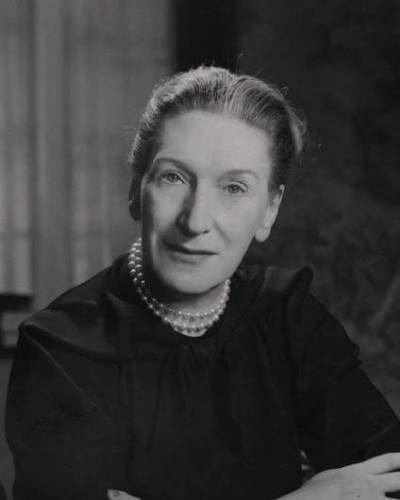
Sybille Bedford
*
Eyeless in Gaza is a big "novel of ideas" with a large cast of characters. The disjointed chronology may throw some readers off. And the heavy doses of philosophizing can sometimes be off-putting. "It is a curious book," Sybille Bedford, Huxley's first biographer, wrote. "There is much that is very good … and some things that are awful with the deliberate awfulness Aldous used to drag into his verse. One obvious defect of the book is the comparative brand-newness of the 'solution' inserts [diary entries]. The tract [moralizing church pamphlets], it was said, had got into the novel."
In 1936, when the novel came out, Huxley was still seeing his way toward his overall view of life, a humanistic and spiritual philosophy he continued to develop and refine over the next decades. Eyeless in Gaza was, as Bedford notes "the blue-print of what Aldous set out to discover and to be."
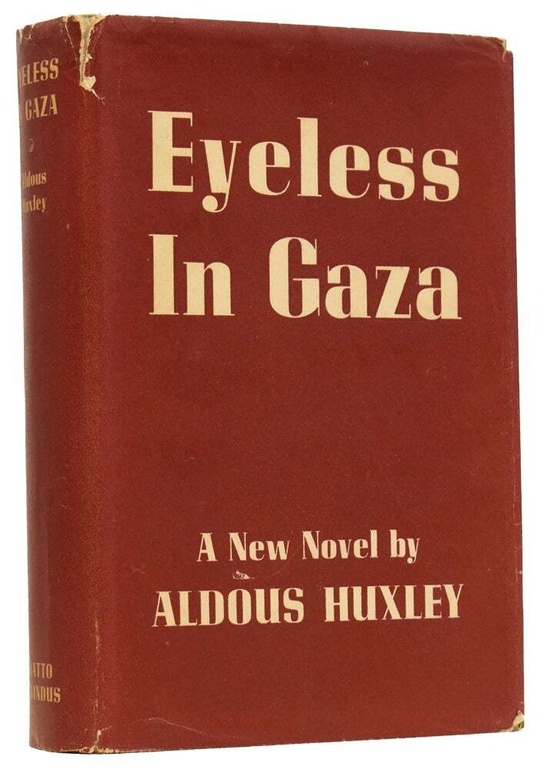
Eyeless in Gaza - first edition
*
For me, the novel's appeal is threefold: (1) its emphasis on Mexico as a place where radical personal transformation can occur; (2) its interesting scrambling of chronology; and (3) the way Huxley incorporated—yes, perhaps not always totally successfully—his philosophical views and nascent Buddhism into a conventional novel. Eyeless in Gaza may not appeal to every reader, but Aldous Huxley, both the novelist and essayist, is an author well worth digging into.
**************

Philip Gambone, a retired high school English teacher, also taught creative and expository writing at Harvard for twenty-eight years. For over a decade, his book reviews appeared regularly in The New York Times. Phil is the author of seven books. His memoir, As Far As I Can Tell: Finding My Father in World War II, was named one of the Best Books of 2020 by the Boston Globe. His new collection of short stories, Zigzag, was published last year by Rattling Good Yarns Press. His books are available through Amazon, Aurora Bookstore, and at "Tesoros," the bookshop at the Biblioteca.
**************
*****
Please contribute to Lokkal,
SMA's online collective:
 ***
***
Discover Lokkal: Mission

Visit SMA's Social Network
Contact / Contactar