 Español
June 28, 2026
Previous chapters
by Jan Baross
CHAPTER TWENTY-SIX
The village children sing outside Fecunda's window:
Señor Domingo is hardly dead.
Fecunda takes Miguel to bed.
Fecunda's gray breakfast smoke soots my windowsill. Her house still hogs the sunrise. Through the closed shutters I watch Miguel step out onto the top step of Fecunda's house, yawning and stretching as though he owned it.
Fecunda's life has changed so little. One morning her tent dresses hang in the closet next to Domingo's cotton shirts, the next day it is my husband's coarse pants that are draped in the dark beside her shapeless wardrobe. With Domingo gone, I am more widowed than Fecunda.
"Tortugina?" Gabito rises from the sink, glorious in his pressed naval jacket, bright red cummerbund, tight white pants, and boots he has polished to a wet shine. He wears the silly captain's hat that sits on his head like a giant snail.
"What are you dressed up for?" I say.
Gabito adjusts his blue jacket and white tights.
"I have decided to tell José," says Gabito. "Should I appear to him all at once or gradually?"
I am tired of tragic men.
"Do it this time, Gabito," I say. "He has lost one father. What could be better for José than to know he has another father who loves him?"
Gabito clicks his black leather heels together, smooths his hair, and stands up straight. He was never this nervous on the cliffs. Now that Gabito is finally ready, his nerves spread to me. This could end so badly.
"He will not talk to me, Gabito," I say. "This is his first day as a declared bastard, and that is very different from yesterday."
"Take my hand, Tortugina," says Gabito.
I feel the coolness of his damp skin. So much hope in his eyes, it may blind him to good sense.
"Be very gentle with how you do this, Gabito," I say.
I lead the way to José's door. There is no answer to my knock.
"José, I am coming in."
His door is the only one in the house that opens without a creak. José is still dressed in his funeral suit and sits on ink-stained sheets. Wads of paper litter the floor. He writes with the same intense gaze he has when he carves, his tongue making his mouth into a Q.
"José," I say. "Please forgive me. I am sorry I lied to you. Your real father is Gabito Ramirez. He was the most handsome and best octopus diver in all of El Pulpo."
He looks up for only an instant before turning his eyes back to his writing.
"So, I am still a bastard," he says.
"Your father was killed by the sea," I say.
"Be honest with him, Tortugina," says Gabito.
"It was my fault that he was killed by the sea," I say. "An accident."
"Then my father is dead?" says José.
"Not truly dead," I say. "He loved me so much that he came back to me as a ghost. We married and you were conceived. I married Miguel Svendik to give you the name of a living father."
José looks at me as though I have eaten an infant.
"Gabito, he thinks I am crazy. Show yourself!"
Gabito holds his head in his hands, beats his damaged brow with both fists.
"What a wonderful birthday," says José. "I find I am a bastard, and the son of a ghost and a madwoman. Thank you, Mamá. Thank you, Papá."
"José," I say, "this is not a joke."
I gesture toward Gabito, who stands inside the door, shaking as blood and sweat pour off him.
"He is right in front of you, José."
José stares through Gabito at the door, waiting for an entrance.
"Gabito!" I yell. "Do not do this to me!"
Gabito rubs his damp hands on his pants. He kneels in front of José and touches the boy's face with his transparent fingers.
"José," whispers Gabito, "I am so sorry. I thought I could do it."
Gabito closes his eyes, not willing to witness his own disaster.
José folds the paper with the blue ink into his jacket pocket.
"Well, Mamá?" says José.
There is no pity in his eyes.
"I have written to Pilar asking her to marry me. We will live far away from you and your madness. You will not tell me who my real father is because you are ashamed of him."
"No, José," I say. "I am not ashamed of him, or you!"
Never before has José left me without a kiss.
He walks right through Gabito, and my poor idiot ghost of a husband dissolves with a cry.
***
CHAPTER TWENTY-SEVEN
"Tortugina!"
It is the bullroar of Miguel. He kicks the back door open as though it were still his to destroy.
Miguel's wide body in my doorway blocks the soft light behind him.
"José pasted this poem on Fecunda's house," says Miguel. "It is an obscenity."
He throws the wadded paper at my chest. José's wrinkled, looping scrawl charges across the page with passionate swirls:
FOR PILAR
Little Pilar, your beauty all the world can see.
I declare my love for you in this decree.
I know you love Jesus and not me.
But the son of God cannot give you a baby.
Say you will be mine and marry me!
All my heart,
JOSÉ
I am glad he chose carpentry as a profession.
Miguel shifts just enough in the doorway that the sun streaks into my eyes.
"Tell José," he says, "that he can never court Pilar."
For once we agree. "Yes, as a wife she would be useless."
"Not that," he says. "It is because she is my daughter, and I will not allow your bastard near my daughter!"
He swings his carpenter kit away from me and turns to his day of grain, stain, and wood, chiseling old deities with new faces. With his broad back as my target, I throw a barb.
"Pilar is no more your daughter than José is your son," I say.
His shoulders rise as though I had actually stabbed him. He drops his wood kit and turns on me.
"You need a lesson!" he says.
I know those eyes. I know what they can do. My head wound feels hot.
"Not again!" I say.
I grab an iron poker with both hands. There is madness in my eyes. Miguel retreats backward out of the doorway, ready to defend himself. Swinging the poker in front of me, I follow him to the gate. He hurries into the path, never taking his gaze off me, and disappears behind Fecunda's lime-green door.
The morning clop of Lucinda's splayed hooves rouses me out of my anger. The camel gallops up the path at a heroic pace. Lucinda's sloppy face is breathing hard. On her hump are tied bushels of bright flowers. And riding on top of the bundle is my disheveled son.
"José!" I shout.
José speeds the camel by me. Spittle hangs in necklace loops from Lucinda's lips. Her small furry ears rotate as she sees me.
"José!"
"Stay away from me!" shouts José.
Following the compass of love, José steers Lucinda to the lime-green door. Crushed, heavy-scented blossoms release clouds of perfume against the camel's heat.
José's slips his fingers around a musky pile of succulents and throws them at Fecunda's door. They hit with force and scatter on the porch.
"Pilar!" shouts José. "You smell better than all the flowers in the world!"
The odor of Fecunda's frying dinner fish in heavy garlic is no match for the perfume of love. Fecunda leans out the kitchen window, shaking a small floured fish.
"Stay away from my daughter, you muttonhead. You are as crazy as your mother!"
José's arm is cocked with another fistful of flowers. "For Pilar!"
He throws, and the flowers land on the shelf of Fecunda's large bosom. Fecunda drops the fish, backs into the kitchen, and slams the shutters shut.
"José, you idiot child, you must win the mother to win the daughter!" I yell.
With a strong yank on the ropes, José loosens a bale of flowers.
"These flowers are for Señora Fecunda," he says, "and her beautiful daughter, Pilar!"
Bale after bale of sweet-smelling flowers drop from the camel onto Fecunda's doorstep. Frangipani, star orchids in jeweled strings, and long-stemmed tiger lilies. The pile is so high that the lime door is only an ugly memory.
There is a slow squeak of wood against wood as the front door opens. In a breath, the tower of bloom collapses into Fecunda's kitchen. But Pilar is not among those struggling in the mound of the perfumed petals.
José stands up on the camel's bare hump, spreads his arms, throws back his head, and yells, "Pilar! I love you. I love you! I love you!"
"José," I say. "Get down before you fall."
He is transfixed, staring upward into the sky. In a whisper of disbelief, he says, "Pilar"?
Pilar thrusts her small face over the edge of Fecunda's roof garden. She is pale between two large adobe pots filled with trembling pink bleeding hearts.
José stretches his arms to her, as close to his love as the hump of the camel allows. He presents the gift of himself to his beloved.
"Oh, Pilar," shouts José.
His body stretches upward. Looking down at him is the celibate constellation of Pilar's face: flat black eyes, the tight line of her lips, and her thin black eyebrows.
"Pilar," says José. "Did you receive my gift of the Madonna?"
Pilar holds a beautiful statue over the edge of the roof. José inhales deeply. Even at this distance in the purple light of late morning, I see that the beauty of this statue far surpasses anything José has done before. This Madonna is a full woman beneath her delicate rose-colored robe. One hand is forward as though touching a tender child. Her face is heart-shaped, and the tilt of her head has a celestial sweetness. This creation of José's is the closest an artist gets to God.
For the first time, I am grateful for Pilar just as she is. José has found a glass full of inspiration in her dry well. He spreads his arms wider, as though she might jump into them fully transformed by his love.
"Pilar," says José, "you are more beautiful than the Madonna."
"Blasphemer!" She opens her white fingers and drops the Madonna.
"No!" yells José.
The Madonna strikes him on the forehead, and he falls backward off the camel. The Madonna lands on the ground beside him. Her heart-shaped head breaks at the neck next to Lucinda's hoof. José reaches for the headless body. He sits up and holds the Madonna to his heart, as though that might make her whole again.
"José," I whisper.
He looks up at the roof.
"Pi-lar!" screams José
But Pilar is gone. Bleeding hearts tremble in her wake. José's slender neck is as bent as his wilted flowers.
I check the small gash on his forehead as he cradles his creation. For a moment he fits them together.
"José," I say, if you come home I will fix you a chocolate cake.
"You want me to eat?" he says.
"I want to offer you a solution, but cake is all I know to say," I say.
He places the Madonna's damaged body and head in my hands. The dullness in Pilar's eyes is now in his.
"I have to eat," says José. "My mother wants me to eat."
He staggers across the path to the old oleander bush, plucks flowers, and folds the poisonous blossoms into his mouth.
"José," I say, "no one is worth dying for!"
I try to stick my fingers into his mouth, but he pushes me away. He gags, chews, and starts down the path to the beach with handfuls of oleander. His feet crush the runner of petals that fell from the camel.
"At least come home to die!" I yell.
I run to catch up with him, raising the Madonna's body above his head. I slam the hard wood across the back of José's skull with more force than I intended. His body falls onto the piles of forgotten flowers. My fingers probe the poison petals out of his mouth. Gabito must act the father now and tell me what to do with our poor suffering son.
Why is it so hard to keep everyone alive?
Read more chapters
**************
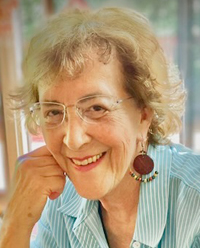
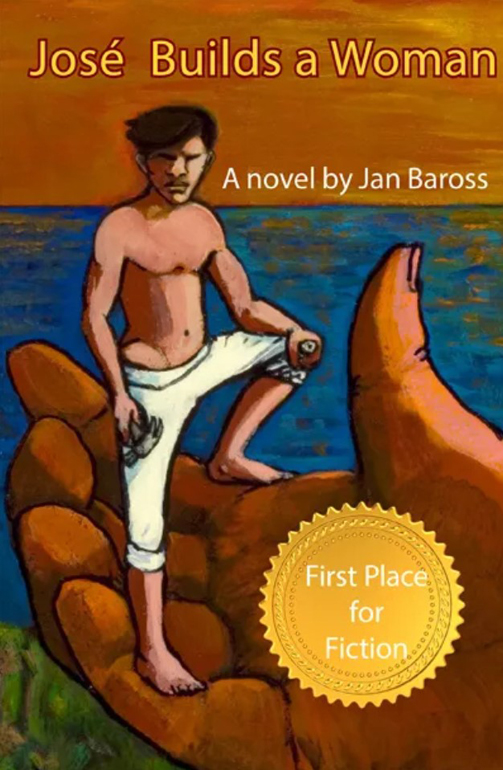
Jan Baross is an award-winning novelist, documentary filmmaker, photographer, screenwriter, librettist, film critic and taught filmmaking at Oregon State University. "Jose Builds a Woman," her debut novel published by Ooligan Press twenty years ago, in 2006, received first place for fiction. Ursula Le Guin gave it a thumbs up.
Baross lives six months a year in Portland, Oregon and SMA where loves designing posters for the Annual San Miguel Playwrights Winter Showcase. Books and Audible on Amazon. Films on YouTube.
www.janbaross.com
**************
*****
Please contribute to Lokkal,
SMA's online collective:
 ***
***
Discover Lokkal: Mission

Visit SMA's Social Network
Contact / Contactar