 Español
June 21, 2026
Previous chapters
by Jan Baross
CHAPTER TWENTY-FOUR
A horizontal rain floods the veranda. One moment it is silent, the next, a storm out of nowhere. Wild gusts uproot my tomatoes, peas, and squash, sending the plants sprawling root over root against the fence. Church bells ring an alarm, but I do not know the crisis.
I step out onto the veranda and pull my shawl over my head at the sound of a terrible crash. A dead seagull slides off the roof in a waterfall of broken tiles.
The once dusty lane between my house and Fecunda's is now a brown stream of rushing water. Sheriff Nina Fumar's giant body shuffles down the watery path headed for the sea. She carries little Mayor Perfecciona on her shoulders.
"Follow me! Watch your feet! Bring rope!" shouts the little mayor. "Domingo and the fishermen are caught in the storm."
Domingo! He knows the sea better than he knows his own wife. I run into the house and bang on the doors of José and Miguel.
"Wake up! Emergency!"
Without waiting for them, I leave the safety of the veranda with a rope slung over my shoulder. Wind and rain tear at the yellow bandana, drenching my head bandage.
Señora Nauseobondo splashes down the path in a man's big boots and canvas pants, carrying a brandy bottle. Farmers, storekeepers, municipals, bartenders, drunks, and Padre Monástico, all hastily dressed from their early awakenings, carrying ropes and blankets toward the beach.
Fecunda's door flies open. The warm rectangle of light breaks to pieces in the wind. Fecunda, a force of nature herself, plows into the dark storm, her eyes stretched with fear. Behind her, the children carry hooks and ropes and a wool blanket.
Fecunda is not thinking as she tries to run, steps too fast, slips, and belly-plunges forward into the stream. She shakes her head and wipes her eyes with one hand. She is shaking too badly to rise. She howls into the storm, "Domingo!"
I step into the flow of brown water and rush to her side. "Fecunda! Get up!"
Fecunda pushes herself up into a kneeling position. We balance each other as she rises. Roots, stones, and bits of wood bump our legs as we are swept down the flooded path.
Fecunda and I, the children, Miguel and José splash out of the wild, unbounded torrent that trenches down to the sea. We are the last of the villagers to reach the beach.
With strong ropes and the strong backs of the villagers, Aurelio's bucking blue boat is hauled beyond the grasp of the sea and left tilting on the sand. Rafael's boat, Salvador's boat, Nicola's boat. They are pulled one by one from the sea. The boats are safe, and the fishermen are safe, swarmed by their families, swathed in blankets, and drinking Señora Nauseobondo's brandy.
Only Domingo's yellow boat is still tossing high in the waves, too far away for the rope to reach.
By the sea's edge, Fecunda beats her head in a helpless dance. No part of her is strong or long enough to save her husband. In the blinding wind, it is impossible to see if Domingo is still on the boat.
"Domingo!" screams Fecunda.
"Papá!" scream his children.
Sheriff Nina Fumar's massive bulk wades into the waves with an anchor hook tied to a long rope. She herself is tied to a long rope held by a line of men. Sheriff Nina spins the hook in a wider and wider circle above her head and finally throws it with all her force at Domingo's boat.
The hook falls short.
A towering wave sucks Domingo's boat into the curl and pushes it toward shore. Sheriff Nina throws again, and this time the barbs catch on the inside of the hull.
With a roar heard over the storm, the villagers run to help the line of men haul the boat ashore. Fecunda, the children, José and I, even Miguel with a bleary hangover, all pull on the rope that will save Domingo.
The storm tries to take the boat out again, but as one village, we pull Domingo's boat toward the beach. If we had hooked a whale, it could not be a worse fight.
I look up into the sky and silently beg Gabito. "Gabito, help him! I will never forgive you if he dies!"
As the boat is drawn closer through the savage waves, we can see that Domingo has tied himself to the short, broken mast. He waves to us, unties the ropes around his waist, and grabs an oar.
Long legs of lightning run stilted across the sky. Suddenly a flash, then a jagged streak pierces the clouds and strikes Domingo. For a split second his wet body is frozen in the light. And then he is gone.
"Domingo!" Fecunda is not alone in the wail that rises into the wind from the hearts of all the villagers.
We pull and pull, but the boat grows heavier as the cracked hull takes on water. At last Domingo's boat rests on shore, a black burn mark near the mast, through the hull, but no Domingo.
"Damn you, Gabito!" I yell silently at him. "You could have saved him!"
Fecunda's face is pale with disbelief.
"How can this happen to a man who calls the sea his mother?" she wails into the storm.
I stop breathing to stop time. If this moment passes to the next, it will begin the time in which Domingo is dead.
The children stand silently, as we all do, hoping the sea will give us back the body of this beloved man to bury among his family.
Sheriff Nina Fumar's giant body waits with patience in the freezing surf. Finally she shouts over the roar of the ocean, "There he is!"
Moments later, a black, loose-limbed form is thrown ashore. The sheriff races to pick up Domingo before the sea sucks him back. She lays him on the beach.
Fecunda and the children run toward him. The wind makes no dent in her now.
Villagers gather around the family in a protective circle. Domingo lies in the center, his blackened skin welded drum-tight across his bones. His eyes and mouth are drawn shut. His teeth are set to greet death.
"Domingo!" wails Fecunda.
Two of the sons wrap their father in the wool blanket.
Padre Monástico's wet white hair blows in the wind, and he makes the sign of the cross over Domingo's burnt body.
I leave the circle and lean on Domingo's boat for support, the part of his boat that carries the name "Precioso, Beloved." I will always remember that he was the best of men. José comes to stand beside me. Perhaps he is thinking of the beautiful figurehead he was going to carve for Domingo's boat.
Domingo's sons pick up his wrapped body and put him on their shoulders. He must weigh almost nothing with all the meat of his muscles charred to a crisp.
The dark gray clouds and wild wind are gradually draining back to the sea, leaving the sands washed clean.
Miguel supports Fecunda as we all follow them up the dune and through the brown stream. José trails a few feet behind Pilar. I am last in the procession, hugging the small comfort of perhaps having known Domingo's last loving words.
The lime-green door opens, and Fecunda's house fills with wet people and death. Domingo will need to be washed, the family consoled, a meal cooked.
I walk to my side of the path through layers of silt and wood. The backyard is filled with broken limbs and split tiles. There is cold comfort in the lighter rain. I let it wash over me, let it feel like tears because I cannot cry yet.
The fishpond overflows. Carp flip in mud puddles. I scoop their orange bodies back into the water. Sitting on the stone, I watch them send ripples from below. A death howl rises up inside me, but before the tears begin, a pair of dark eyes float from under a damaged lily pad.
Gabito rises out of the water. Raindrops run off his skin like oil as he climbs out of the pond. His boots are topped with waterweeds.
"Tortugina," he says. "So many tears for another woman's husband?"
He props himself up on the stone next to me. I shiver as he leans closer. His smile looks blood-stained.
"He was my friend, Gabito. He was the only one who was kind to me. Why did you not help him?"
Gabito scoops up a tiny orange carp and gently places him back in the water.
"There was nothing I could do. I do not have such powers."
He watches two carp below the surface swimming together. There is bitterness in his voice.
"Last night, I knew I could never tell José I was his father. Then I thought I had lost you too, to Señor Domingo."
I move away from the touch of his wool jacket. Gabito holds more darkness in his heart than I ever knew.
"Señor Domingo was killed for a smile?" I say.
"I did not kill him!"
He says it with such force that I want to believe him.
"Perhaps that is true," I say, "or you would have killed Miguel Svendik by now."
He drags me up and over to the corner of my house and points to Fecunda's kitchen window.
"Look, Tortugina," he says. "Miguel Svendik is dead to you already."
Inside Fecunda's kitchen, with Domingo lying burnt on the long breakfast table, Miguel holds Fecunda tenderly in his arms. He enfolds her, a gentle expression on his face. I have never really seen them together, not like this. His embrace is sweeter than all the sex in the world. I can see it is a good love.
Now the tears begin, and I am certain they will never stop. Gabito wraps me in his arms as though I were very small. He still smells like home, El Pulpo, and the green smell of the sea. I am as beloved to Gabito as Fecunda is to my husband. Whatever Gabito has done, he is my only love. He holds me tight.
"Ah, Tortugina," sighs Gabito. "Things will be so much simpler for us when you are dead."
***
CHAPTER TWENTY-FIVE
The cemetery is overgrown with untended flowers trumpeting up the walls of the yellow limestone church. On the shale roof, an old cast-iron weather vane points to the cove where Domingo died. Gray clouds spin apart in the cold sea air.
I hold José's hand for warmth. Loose candy wrappers whip against our polished shoes as we walk toward the edge of the crowd. The lunch I cooked smells good on José, fried potatoes and onions.
In the freezing gusts, crowds of mourners gather around the closed coffin of Domingo. Black hats, black dresses, black shawls and jackets dark as crows. It is strange in Las Mujeres to see everyone in one color.
José leans gently against my shoulder, holding a small replica of Domingo's boat, "Precioso," to leave at the gravesite. He looks at the closed coffin.
"Mamá, what do the dead look like, when they are not burned up?"
"The same as in life, José, only more formal."
Domingo, Domingo, I will only remember you as you were. You are loved for so many reasons. You will always be recalled with the taste of fresh fish in our mouths.
Padre Monástico licks his lips and prays in silence as the last of the villagers take their places around the upturned earth. At the head of the closed coffin, Fecunda and her children stand so close to each other in their mourning clothes that they could have been cut from one piece of cloth.
Above the wind-shaken pages, the Padre raises his hand in a gesture that includes us all.
"Let us sing the fisherman's lament, to lighten our sorrow that is as heavy as one of Domingo's halibuts on a bed of rice and greens with a side of cloved prunes."
Fecunda looks up at him, but she says nothing. Padre sings with the voice of a castrato. His mouth is surprisingly large for such a little-boy voice.
Take our brother, oh Lord.
He swims with the fish,
The fish he once caught.
The fish we once ate.
A good man swims
With the fish. AMEN.
It is much easier to picture Domingo swimming with the fish than lying in the cold earth. We all want Domingo to swim from the sea with his net, ready to feed us again.
The chorus is broken by Fecunda's hawk screech. Her body lurches onto the creaking support planks that hold Domingo's wood coffin above a six-foot hole. Her gloved hands lift the heavy, carved lid and push it off. In the dark-stained rectangle, Domingo's charred Indian face seems to float above the whiteness of the sheet.
"Domingo!" she wails.
Fecunda lowers her body into the coffin, covering poor Domingo. I expect his legs and arms to flail, but all I see is Fecunda's rump. Support planks crack under her weight.
The giant arms of Sheriff Nina Fumar drag Fecunda off the coffin just as the planks give way. The coffin tips. Domingo's head hits the top. His black shoes bounce once above the wood rim as the coffin drops through the broken planks into the grave. Fecunda wails into the wind, and even the cormorants are thrown off course.
"Fecunda, you are behaving like a jackass," she says. "Drop the lid gently on the coffin, gentlemen, and let us continue with the dignity this man deserves."
Miguel Svendik moves slowly to Fecunda's side. His footing is certain as he stands beside her. Whenever Miguel is this close to me, I have a terrible itch on my head. The scab on my scalp remembers the raised ax, the missed weight of my braid.
He looks up at me as I scratch my black scarf. Fecunda must feel the heat of his gaze leave her. Her thick elbow jabs his ribs. He is caught breathless by the blow. She points at me through her tears.
"Tortugina, you dare come to my husband's funeral, you whore. You seduced my Domingo in your kitchen last night!"
"Fecunda, enough! There's a time and a place for slander!"
The villagers' eyes widen with interest. "This is the time and place! Let her speak."
"Very well, what is your retort, Tortugina?" says the mayor.
They turn to me as though they were all attached to the same weather vane.
"Señor Domingo was kind enough to come for José's birthday," I say. "I invited him because Miguel has abandoned us for Fecunda's kitchen. Miguel and Fecunda drank together almost all night. Señor Domingo kept us company until Miguel came home."
Fecunda leans her widow's bulk against Miguel. The weight would crush lesser men, but her touch makes him younger. He has a glow that only comes with the kind of love I have seen in Gabito's eyes and recognize immediately.
"Fecunda and I were together," says Miguel, "but not alone. We were with the children having dinner. Is that right, Pilar?"
Pilar's head nods up and down like a long-beaked heron spearing minnows.
"Domingo and I were with José!" I say.
Miguel's face streams with tears. "I do not care, Tortugina! I have lived too long under the unhappy curse!" Miguel speaks in a voice that comes from a heart I did not know he had.
"I want happiness! So, with all my heart, I, Miguel Svendik of the cursed house of Svendik, declare my undying love for my cousin Fecunda Peres and her children."
A cold wind blows under my scarf. The villagers speak in outraged whispers.
"This is bad luck!"
"Domingo is not even buried yet."
"Perhaps he can hear them."
Fecunda speaks to the crowd with no shame in her voice. "I declare my love for Miguel Svendik. I will live with him, as his wife, but there will be no marriage because of the Svendik curse, and because of Tortugina. If you remain my friends or not, it makes no difference to me. You still have to buy my shellfish."
Wives cling tightly to their husbands. It was easy to ignore Miguel and Fecunda's love for each other as long as it was hidden. But to witness it in the daylight, to confront such passion in the cemetery, they must all face the fragile nature of their own unions.
Fecunda leans close to Miguel and kisses him on the mouth. If a face could shatter from joy, it would be his.
"Shame, Fecunda!" shout the villagers. "Shame, Miguel!"
For one fleeting moment, I am no longer an outcast. I am on the same side as the villagers.
"Shame on you!" I shout.
José, anger flushing his face crimson, looks up at Miguel.
Miguel is not finished. He waves his hands for attention and speaks in a voice as flat as Pilar's eyes. "You, José, are not my son. You and your mother, I disavow!"
José's beautiful frescoed face crumbles with confusion.
"But I am your son!"
"Ask your mother," growls Miguel.
"Papá, how can you call me a bastard in front of the whole village?"
José throws his small carving of Domingo's boat at Miguel, runs through the crowd and out the iron gates.
"Tortugina," says Miguel. "Look what misery you have made."
"Miguel," I say. "Look what misery you have made!"
I pull the black scarf and the bloodied bandage off my head and turn to show the villagers my wound, a huge scab with black stitches. A cold breeze makes the wound hurt like teeth on ice.
"This is what happened when Miguel tried to cut my head off," I say.
His deed registers in the long memories of the villagers and in the eyes of Fecunda.
I step closer to the mud-slick gravesite so that Fecunda and Miguel can have a good look.
"You see, Fecunda," I say. "You see how Miguel Svendik serves love? And you, Miguel, you have tethered yourself to a fat sea cow for the rest of your life! Who am I to not wish you well?"
I throw the blood-dried bandages at Fecunda, a rosy gift for the pretend bride. The back of my head is a silent accusation as I walk slowly away, letting my footsteps retreat along the same path José has taken.
Read more chapters
**************
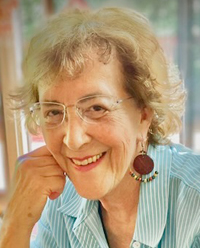
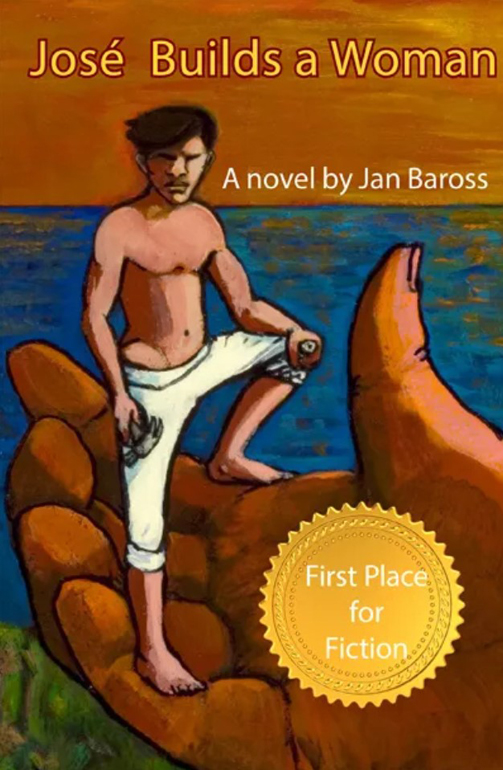
Jan Baross is an award-winning novelist, documentary filmmaker, photographer, screenwriter, librettist, film critic and taught filmmaking at Oregon State University. "Jose Builds a Woman," her debut novel published by Ooligan Press twenty years ago, in 2006, received first place for fiction. Ursula Le Guin gave it a thumbs up.
Baross lives six months a year in Portland, Oregon and SMA where loves designing posters for the Annual San Miguel Playwrights Winter Showcase. Books and Audible on Amazon. Films on YouTube.
www.janbaross.com
**************
*****
Please contribute to Lokkal,
SMA's online collective:
 ***
***
Discover Lokkal: Mission

Visit SMA's Social Network
Contact / Contactar