 Español
March 1, 2026
by Jan Baross
I know you exist, not only because your eyes fly open
And shed their light on things, like an open window—-
But also because you were molded in clay, you were fired
in Chillan, in an astounded adobe oven.
—Pablo Neruda
***
Prologue
In the shade of the purple jacaranda in the jungle by the sea, my son José builds a woman.
José makes adobe bricks in the hot morning sun with red clay from the River Rojo and straw from our fields. He rolls his hands over the wet earth. The bricks form to the shapes he will need. Rounded for the buttocks, curved for the breasts, sturdy for the flat toes.
While the bricks dry in the sun, José clears a knoll of pepper trees and builds tall scaffolding from the branches. In the center of the scaffolding, he lays dry adobe bricks, as deep and wide as five beds. On top of the base, José builds the woman's feet. Her ankles are strong and slender, her shins straight, her thighs thick with being a woman, her mound gently curved. Her torso, small breasts, and strong neck rise gradually toward the top of the canopied trees. Creamy, wet clay between the bricks weds them like the layers of a cake.
José pauses to inhale the female landscape of the jungle, the hard-perfumed blossoms of orchids, the soft scent of tendriled trees and the rich tunnels of moist undergrowth.
He inhales all this and breathes it into the woman he is building.
As the woman reaches a great height, José grows until he reaches a great height as well. He no longer needs the scaffolding.
I look up at José's wide back.
"My son, your brown body grows as the woman grows."
José pours a gruel of wet clay over her body and polishes her skin until it looks as smooth as the sweat on his cheeks.
"My son, the woman is as high as one home on top of another, yet her body is headless."
José strides to the bank of the Río Rojo, kneels, and scoops clay into the shape of a head. He molds the deep inset of the woman's eyes, the slight droop of sleepy lids set close to a strong nose. His strong arms knot and unknot in light and shadow until he completes the woman's face.
José picks up the woman's head and carries it to her body in the jungle clearing. He is the height of his creation.
He places the woman's head on her neck. She opens her eyes, though her feet do not move from the foundation. Her wide face above the treetops startles two cormorants in flight. José raises his mouth to kiss her.
"My son, you have given the woman my face."
José bends over me and casts his giant dark shadow over my body. There is no escape from the consuming fire of his eyes. His fingers, red and cracked with crimson mud, reach for me.
***
Part one
I AM TORTUGINA. They call me little turtle because I am snappish. My mouth has an overbite. Some say I look predatory, but I am good in bed.
I was born in a two-story house by the sea, in the village of El Pulpo, sixteen years before I gave birth to Joseé. The village is called El Pulpo because octopus is the only thing we have to sell in abundance.
All houses in El Pulpo are white, built by the rule of one because one color is good enough for everyone. White homes built with stones from the quarry, white slate roofs, white lye walls of the church and white dust in the breeze from shells shattered by the sea. Our white village, high on a cliff, looks like a many tiered wedding cake with a hundred black doors. To outsiders it may seem edible, but to me, it is stale as old bread.
On the night I was born, Mamá said a white dog howled in the doorway all night and a shattering storm brought hail the size of coconuts that cracked the church bell. When the hail was directly over our house, an albino bird dropped bloody from the sky onto the roof and Mamá grunted like a pig.
I slid out in a rush of liquid, small and pale like an octopus pulled from a dark cave. My bones long to return to the safety of fluids.
"Ayee, another girl!" Papá said, holding my streaked legs apart. "I am going to Ignacio's Tavern to curse in silence."
My two sisters wept with Mamá. I was the last child she could have. No son to bear the burden of Papá's store. But I did not cry.
It was my destiny to make my family weep for not wanting me as I was.
Most of the time I do not live in my white village. I live in my dreams, the only place where there is color. Not smooth legs of rich red topsoil, or yellow cracks of the arroyo, or tilled furrows of dark curled mud. No, my dreams are the colors of the sea, an escape into the weightless veins of manganese, stretches of purple through muscular green currents. A thin membrane separates the sea and the pulsing of my dream to be an octopus diver.
With my head dreaming on a white brocade pillow, the nightly enchantment begins. A plunge into the warm, green sea with Gabito. He is the most beautiful octopus diver in all of El Pulpo. We dive side by side past rocks packed in foam, from clear azure to dim greens, deeper and deeper, to ancient underwater caves. In my hands I hold a net.
"Show me," I whisper into Gabito's perfect ear.
Along the dark base of the cliffs, there are octopus of
all sizes and colors. The orange ones are closer to the sun. The green and purple ones live deeper. Their boneless legs straighten and disappear into the sanctuary of small caves. Gabito reaches into a hole, and because this is a dream, the octopus rush into our nets.
"You see, Gabito," I say. "Nothing is a struggle when we hunt together."
Gabito pushes my shoulders back into the white sand. It splits with the weight of my spine and rises in granular puffs on the soft current. My body is trapped between his strong brown legs. He holds my arms above my head. My body is not afraid of the water, of the sea, of liquid of any kind, any more than his is. He slides his hands inside my nightgown.
"I want nothing more than you," says Gabito.
In celebration, my flannelled hips rise off the sand toward the hard muscles inside Gabito's good luck yellow swim shorts.
"At last," he says.
"At last," I say.
Gabito kisses me. Our lips release two long strands of silver bubbles that become one.
"Little turtle." Mamá's voice is the foghorn of my dreams. "Arise morning glory."
I am caught in the undertow of her voice.
Gabito slips sadly away, riding a dark current to the deeper safety of the sea. Mamá pulls back the quilt. A quick movement like a bird's dry wing. The chilled air shrivels my nipples.
"Mamá," I moan.
"Hush before you wake your sisters," whispers Mamá.
She wraps her fat arms around me. Mamá's blue robe has the sour smell of sleep. She slips her cold hand under my nightgown and pulls off my underwear. She holds it up to the crack of light at the door.
"No blood yet, Tortugina," says Mamá. "If you delay being a woman this long, you are bound to have bad dreams."
She pats my cheek too hard. I snap my overbite at her wrist. Mamá shuffles toward the bedroom door in her crushed slippers.
"Hurry, hurry, little turtle," she says. Mamá's world turns too fast for me.
Read more chapters
**************
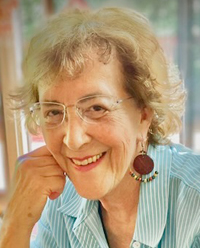
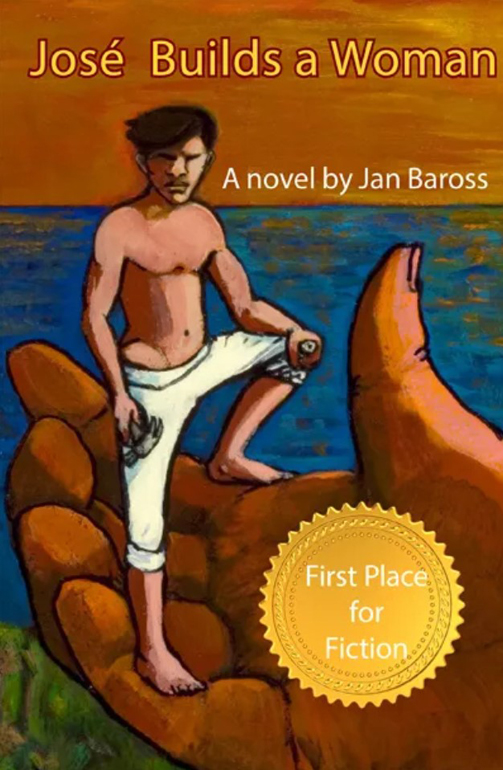
Jan Baross is an award-winning novelist, documentary filmmaker, photographer, screenwriter, librettist, film critic and taught filmmaking at Oregon State University. "Jose Builds a Woman," her debut novel published by Ooligan Press twenty years ago, in 2006, received first place for fiction. Ursula Le Guin gave it a thumbs up.
Baross lives six months a year in Portland, Oregon and SMA where loves designing posters for the Annual San Miguel Playwrights Winter Showcase. Books and Audible on Amazon. Films on YouTube.
www.janbaross.com
**************
*****
Please contribute to Lokkal,
SMA's online collective:
 ***
***
Discover Lokkal: Mission
Visit SMA's Social Network
Contact / Contactar