 Español
March 8, 2026
by Alan Goldfarb
When I was a kid I remember hearing adults talk about things I didn't fully understand. They used words that became known and common enough but remained superficial and empty of any real significance.
Words like arthritis, car crash, divorce, surgery, suicidal depression, or addiction. At different points in my adulthood I came to understand the depth of the experiences that accompany these kinds of things, either in person or through someone close to me.
This is the story of how I came to a greater awareness of the significance of International Women's Day. When I heard this story I cried, and asked and was given permission by the women involved to write it out.
*
The dearest person in my life in Mexico is a woman named Patricia Rivera (Patí). She was born in the city of Querétaro where she still resides. For many years she had been a veterinarian who specialized in the care of lactating sows and piglets.
She left that career for a more creative lifestyle and opened a jewelry business offering skills training to a small group of inmates at the Cereso Femenil, Querétaro's federal maximum security women's prison.
There is a small section of workshops in the prison where some of the women are allowed to do paid work crafting products for various external businesses. Patí and her crew make earrings, necklaces, and bracelets from non-precious materials like string, seeds, stones, pewter, wood and ceramic beads.
Some of the work is also produced in a little studio at her home where her family has a small rooming house. On occasion, some of the women who were inmates live in the rooming house after their release. Patí is like a sister to these women and they share the events of their lives. Many incredible stories arise from this corner of the world of women that is well outside of mainstream society.
Maribél is a childhood friend of Patí since their days in grade school. After marrying she moved to Europe and lives in Germany. Recently she was unexpectedly back in Querétaro to help her sister Liliana through a family crisis.
Liliana is a divorced mother with primary custody of her twin 13 year old daughters. She and her ex-husband chose to split some time ago but maintain a positive relationship. They are committed to co-parenting their girls to provide them with a good education and upbringing.
A friend from San Luis Potosí called Liliana and told her that her 22 year old son was moving to Querétaro for a job there. She asked if her son could stay at Liliana's house for a short time while he got settled. Liliana agreed and the young man came to live with them.
The situation turned out to be a disaster, the young man was rude and aggressive, disrupted the household and created a lot of problems. Liliana called her friend and informed her that unfortunately it wasn't working out, and she ejected the young man from her home.
Within a couple of days, she realized that one of her daughters was in distress and asked her what was going on. The girl confided that she had been raped by the young man, but that she was so ashamed she didn't know how to tell her mother.
Liliana was completely shocked but maintained calm and immediately looked into crisis services and trauma counseling for her daughter. She also asked her ex husband to meet to discuss the girls. When they got together she explained to him what had happened.
The husband was crushed to learn of these events. He worried about the trauma inflicted on his young daughter and that the family would be unable to obtain justice in the chaos and dysfunction of Mexico's criminal justice system. He knew that most perpetrators commit violent crimes with impunity.
He was infuriated at the victimization of his daughter and the realization that she could possibly carry the effects of this experience for a large part of her life. He was further enraged by the possibility that the young man would experience no consequences for what he had done.
Unbeknownst to Liliana, the father went out and delivered street justice. He found the young man at his place of work and dragged him out into an alley. He took out a pistol and shot him in the leg so that he couldn't run off. Then he gave him a cold, conscious, and deliberate beating, something he hoped the violator of his daughter would remember for the rest of his life. He left him in the street where his coworkers found him. He was taken to the hospital for his injuries.
Liliana didn't know about any of this. She was focussed on the immediate necessity of creating the best response that she could for the psychological wellbeing and recovery of her daughter.
A couple of nights later at around 2:00 in the morning, while she and her daughters were sleeping, there was a series of loud bangs. The front door to her house broke open and exploded off its hinges. Fifteen heavily armed police entered the house. In front of her screaming, traumatized daughters, they dragged Liliana out into the night and took her to prison. The ex-husband had also been jailed, Maribél came to look after the injured girl, and Liliana's home was left literally broken.
What had happened was that when the young man was hospitalized, his gunshot wound required a police report. When the officers arrived and interviewed the young man, he denounced both Liliana and her husband as the criminals who had attacked him.
Liliana endured two weeks in the prison at Cereso Feminil before she could see a lawyer. The lawyer agreed to work on getting her released, took payment upfront, but turned out to be a predator and disappeared with her money.
At this point, Maribél from Germany, who was taking care of her sister Liliana's now twice traumatized daughter, called and asked for help from Patí the jeweler who had been working with the prison inmates for the last 10 years.
Patí asked the parolees who were living in her rooming house and working in her studio for help.These women communicated with their sister-inmates who were still inside. The inmates created a safe space for Liliana in the prison and brought her a lawyer who was professional and reputable. Liliana paid this second lawyer and hoped for the best.
At this point it was March 8th, International Women's Day, which was marked in Querétaro by a demonstration in protest against domestic abuse, rape, and femicides at the hands of men, and the impunity that was afforded to the perpetrators under the Mexican criminal justice system.
The women don't want to live in fear and are asking the community at large and the government in particular to denounce this unacceptable violence, to stop tolerating it, and to prioritize enacting concrete policies that will create a safer society for them.
Maribél took her injured niece to the Women's March. Together they gathered with the women and blocked the downtown traffic, carrying signs and shouting slogans. They were frustrated and angry and sweating in the heat of the sun. Together, over and over they raised their voices louder and louder as they shouted their slogans. Tangible energy like electricity was running through the plaza. At a certain point there was a peak moment where a swell of transpersonal feminine power poured through the consciousness of the crowd and illuminated the young girl.
When she received that transmission from the thousands of gathered sisters and mothers and aunts and grandmothers she experienced her first moment of healing and said, "Wow!"
The lawyer kept his word and did go to work for Liliana. She was finally released 32 days after being arrested. She was given a choice to either remain in prison and go to trial in the future to try for complete exoneration or accept a plea deal where she would have a criminal record and go free immediately.
She took the plea deal along with the criminal record and was reunited with her daughter later that day.
* * * * *
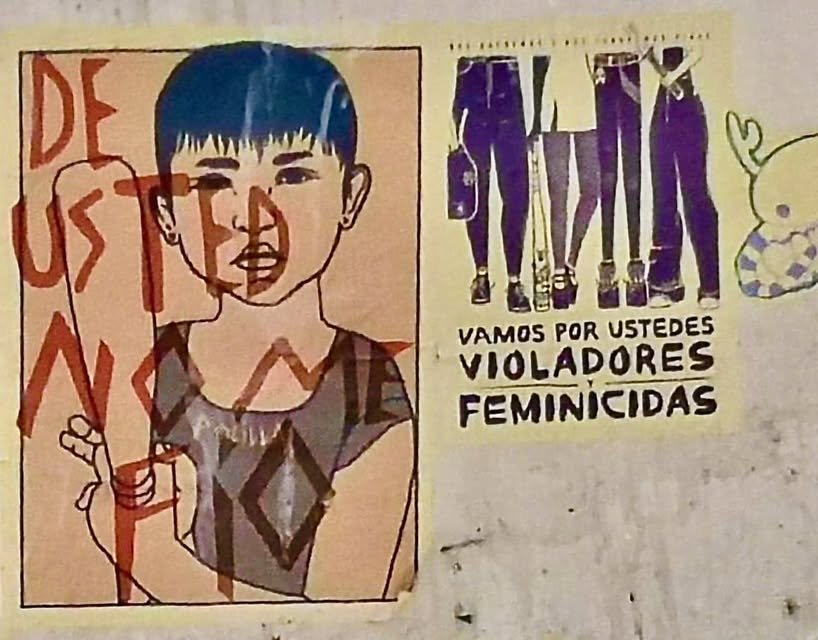
A note on the photographs: I took the photo of the posters. They were pasted on a railroad overpass in Querétaro the same week as the demonstration. The young girl says, "I don't trust you." She has pierced ears, holds a baseball bat, and has a boy's haircut to disguise her gender. In parts of rural Mexico that are under control of drug cartels, some villagers give their young adolescent daughters these haircuts so that they don't get snatched up and disappeared into human trafficking by the narcos who come through looking for anything they can exploit.
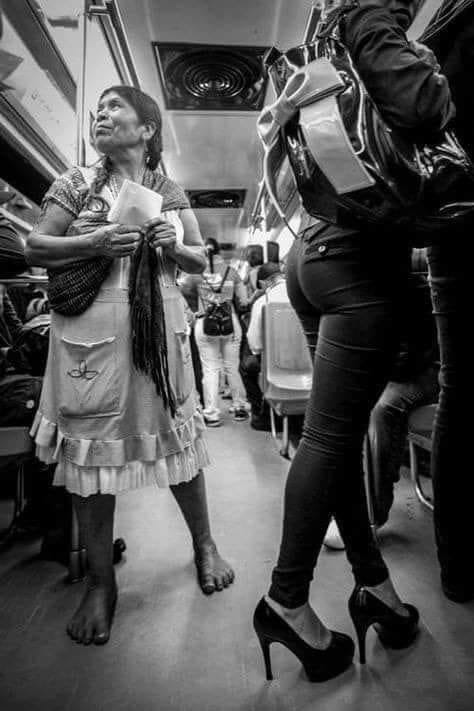
The other photo was taken in the metro in Mexico City by a photographer named Daniel Rodríguez Villa in 2014.
**************
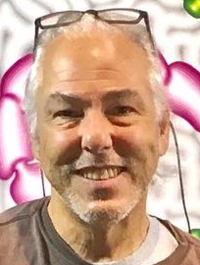
Alan Goldfarb, a native New Yorker, began studying ceramics as a boy. During high school he was introduced to glassblowing. He attended college at the School For American Craftsmen. In 1983 he opened a glassblowing studio in Burlington Vermont, which he ran until 2006.
In the course of that time he continued to study under noted international artists like Dale Chihuly, Italian maestros Lino Tagliapietra and Pino Signoretto, and Swedish designer Bertil Vallien. He also taught workshops at various colleges, museums, and craft schools.
He received awards, grants, and scholarships for his studio work, and a number of his pieces are in private and public collections, including the Corning Museum of Glass, The Museum of Fine Arts Boston, and The Smithsonian Institution. A studio notebook of his drawings is also preserved in the Rakow Research Library.
He closed his glass studio in 2006 and moved to San Miguel de Allende. Following a hiatus he opened a woodworking and art studio creating handcrafted furniture, sculptural objects, and paintings. From 2021 to the present he has worked with local albañiles building a handcrafted adobe house in the countryside.
His short stories have been published in the Gihon River Review, Lokkal Magazine, and the anthology, "Craftspeople; In Their Own Words."
Comments or feedback? Please practice kindness. Contact Alan at:
goldfarb.alan@gmail.com
Please contribute to Lokkal,
SMA's online collective:
 ***
***
Discover Lokkal: Mission
Visit SMA's Social Network
Contact / Contactar