 Español
May 3, 2026
Previous chapters
by Jan Baross
CHAPTER TEN
The Saturday night sky over the Promenade is lit by a slice of moon. Papá is dressed in his new brown suit that looks like his old brown suit. The way Mamá dresses for special occasions always embarrasses me a little. Her giant fake pearls look like carnival lights. The big imitation turquoise, silver, and gold rings and bracelets click like castanets. Huge ruby-red earrings hang like lanterns to her shoulders.
Véronica and Amanda walk ahead of us in the long white dresses of virgins on the prowl. Their black shawls are carefully draped, and their hair is sleeked into plump buns.
My shoes, nails, cheeks, and lips are all rouged, shined, and polished by Mamá. I am starched and ironed and armored in stiff white linen. My shoes pinch under the long hem that almost sweeps the ground.
"You have never looked better," Mamá says.
The starched edge of the eyelet cotton collar scrapes my neck wound.
"I have never felt worse," I say.
Papá was right. Who on earth would want me? We are still the outcast family. No one looks up at us or waves a hand in greeting as we pass.
Out of their dented instruments, the band blasts mariachi too loudly. Their only official uniform is the light blue and gold military-style hats that have been passed down from generation to generation until none of the hats fit the present owners. Only death prevents the band members from playing their Saturday night calling. The worst offender of sound is twenty-year-old Sweaty Oskar, replacing his trumpet-playing grandpapá, ninety-nine-year-old Deaf Giles. Deaf Giles had been squatting to watch his deaf dog, Conga, relieve herself when a garbage wagon backed over them both.
A loud fart cuts through the slide of sour notes of "Mi Corazon." Children laugh and surround Polo, who sells wooden ducks that make rude noises when you pull the string in their tail. His son Multo remembers to avoid my gaze, hawking his red, white, and blue balloons through the crowd. Multo's wife Estrella cooks in her small food stand, fried flour tortillas that swell crispy with the heat and are sprinkled with white powdered sugar. She turns away from my eyes only to spill sugar on the heads of little Poncho and his brother waiting with their coins.
Toothless Señora Grosera stirs hot chilies and dripping meat on her tiny flat grill but does not give me her grin.
As Papá and Mamá lead me under dark shadows cast by the trees, Mother Mary Inmaculada wings among her flock. The nun is greeted by couples crowding the benches with more children between them than teeth. The well-behaved children lean on their parents' knees and smile at Mother Mary. The loud ones play games in the fountain, drowning paper boats with sticks.
The church bells ring eight times, vibrating through the hollow bones of deaf belfry birds and frightening them into flight. The beating of wings over the Plaza de Allende is the final signal to begin the Promenade de los Adolescentes.
The girls break from their families and gather under small white lights wound around the square-trimmed trees. Fat, skinny, tall, short virgins with breasts budding, breasts budded, hanging like breadfruit, hidden in halters. Their sleek, dark hair is curled, matted, braided, and bunned.
The girls link arms in friendships of twos and threes. At the front, Lapiza, Skinny Vicente's sister, leads with her long bean nose. Behind her is Gordo's sister with a face like an omelet. Big Luis's sister, Esmeralda, squints her weak cat eyes above a lanyard of gold beads. The band plays "Forever Promenade." On their slow journey to the wedding bed, the girls begin their clockwise circling over the stones of the plaza.
This is my first promenade without Gabito. Never again will he be among the boys gathering in small packs to circle the virgin feast. He will not join them with their big metal belt buckles that draw attention to their tight dark pants. Crisp white shirts strain tight around their chests and waists. When Gabito inhaled, I could see his nipples through the cotton. He too had heavy-heeled boots and hair so thick with grease it reflected the tree lights.
The boys move counter-clockwise to the girls, clowning on one boot heel then the other to catch the eye of their special love. Gordo bounces past Porca. Skinny Vicente makes a shy bow when he sees his Alta, a girl so tall there are pine needles in her hair. Tomás whispers Miquela's name. Her parents are anxious to introduce a healthy dose of Tomás's swagger into the fragile bones of Miquela's bloodline. Tomás rubs his pant leg with the edge of his palm as he passes her.
In the circling line, Véronica catches up to her only friend, a serious, dark girl with brittle hair. But the girl puts distance between them. Sweet sister Amanda watches César approach. His love for her always shows in his soft face crowned with a curly mop of brown hair. But this time, César turns away from the outcast Amanda. Poor Amanda looks back and watches him walking with his friends.
"Go join your sisters," says Papá.
"Yes," I say, "the promenade looks like such fun."
Papá never responds to my sarcasm.
"Tortugina," says Mamá. "There is Geraldo, the new boy, Señor Valencia's sister's son. Go capture his heart."
Mamá points to a boy with the dull eyes of a goat.
"Yes, Mamá," I say.
Papá gives me an encouraging push on the back. I trip through the boys' line. Their boot heels spark.
On the inside line, the girls walk with their eyes deliberately downcast. According to tradition, the girls look down at their feet as they pass the boys. It is an unshakable fact that the harder a boy works for your glance, the more value he places on your gaze. And if he values your eyes, think what high esteem he places on the rest of you.
Geraldo, the goat-eyed beast, rolls toward me counter-clockwise. His face reminds me of Papá when he is preoccupied with groceries. As a husband, he would probably complain about socks and make me massage his cold vegetable garden.
I join the other girls in their downward gaze of modesty. But what good is looking down, if Geraldo does not know I am trying to avoid his eyes? In a desperate time one must be forgiven for desperate acts. I step in front of Geraldo. The force of our collision nearly knocks me over.
"I am so sorry, Señorita," he says. "Are you all right?"
He tries to move around me, but I move with him.
"Geraldo, what do you say, will you marry me?"
Geraldo looks at my eyes, my best feature, and then his glance takes in my overbite. He shoves gently past.
"Señorita, you must be mistaking me for another."
Now at least he knows that I exist and that my intentions are honorable.
When Geraldo circles toward me again, I step in front of him. I need one more small gesture to stop him, but I have no small gestures. When he starts to circle away, I arch my back so that my nipples stick out like small noses against the cloth.
"Geraldo! Life with me will not be dull," I say.
I raise the hem of the long white dress above my knees. Geraldo stops, and his face turns red. His eyes lap at my legs. I am encouraged to raise my hem higher. I look up at him like the black-and-white tease pictures in Señor Duro's back room.
"Tortugina!" yells Papá.
Other boys circle me, two and three deep, hard bodies pushing, metal buckles clashing against heavy leather belts, the friction of knife-crisp cotton. Their eyes glaze. Their pants blossom.
"Show us more!" they shout.
I am surrounded by the smoky smell of overheated boys. The Promenade de los Adolescentes now stands completely still, a line that has not stood still in three hundred and fifty years.
To capture Geraldo completely, I flip my dress up for a quick flash of underwear. The boys howl so loudly that a matador might have struck his final blow. Miquela and the girls are the last to gather. They are wide-eyed around the flames of their future husbands. They cannot believe that the outcast Tortugina is the center of the blaze.
"Tortugina!" Papá yells, closer this time.
My hem drops to the cobblestones quickly to hide the show of legs. I turn slowly in place so that Geraldo sees all sides of my dancing hips and knows he is a lucky man. For a few precious moments, every boy in the village desires me.
"Tortugina!"
Papá's voice is louder than the band. The musicians in the gazebo let their instruments drop slowly from their lips. The music is replaced by loud whispers. Papá pushes through the boys' stiff bodies. Their hands jump out of their pockets. Papá grabs my arm and slaps my face. I barely feel his palm, but the sharp sound shatters something fragile between us.
"Tortugina," says Papá, "you have condemned yourself!"
Papá's fingers grip the back of my neck. He pushes me ahead of him to break through the wall of boys. Instead of moving aside, their bodies surround us. Papá wades into them, pulling me after him. The boys make way for him, but the divers ram their bodies into me. Geraldo manages a pinch on my rump, but it does not feel like a proposal.
Outside the horde of boys, Mamá grabs my arm.
"Tortugina, you promised to make me proud!"
Papá pulls me with a strong grip on my other arm. I am stretched between them like laundry on a line.
"But Mamá, Geraldo would not look at me."
Papá yanks me loose from Mamá.
"Mother Mary Inmaculada!" shouts Papá. "Please, come claim your acolyte!"
A black, flapping shadow clamps her talons on my wrist. Papá releases his hold as though to cleanse himself.
"She is yours!" he says.
Mother Mary has a jailer's glint in her eye.
"Mamá!" I yell.
Mother Mary turns her thick heels toward the convent. She splits the cool evening air with the bow of her black habit. In her wake, I am the day's catch. Had I a hook through my mouth, I could not be more miserable.
"Mamá!" I yell.
"There is nothing more I can do, Tortugina!" yells Mamá.
Mother Mary's savage pace keeps me off balance. The villagers surge in waves of orange lanterns. They turn up the wicks, and their tall shadows dwarf the buildings. Boys run wild in the street, carrying the singed smell of hot wicks and overheated metal. Girls cling to each other. There is weeping all around me as the villagers follow us to the convent. Something in the quiet weave of the village has been loosened.
"Tortugina," hisses Mother Mary Inmaculada. "You have set the devil free in El Pulpo!"
***
CHAPTER ELEVEN
A stand of distant cottonwood trees lies ahead. One small window of the convent shines kerosene yellow. The old stable looks like the nightmare tale where witches eat small children. I picture myself scrubbing dung-rotted floor planks, washing cracked plates in cold suds, with perhaps an occasional taste of fried pulpo with eggs, garlic, and cilantro to remind me of home.
Let the old nun try to tie me to a cross. I'll make her regret every moment of our lives together.
Suddenly Mother Mary halts on the convent trail and holds up her hand. The villagers stop behind us. The hiss of cicadas fills the night air as we stand silently behind the old church listening to odd snorts and the slow gait of giant hooves coming toward us. It could be the Devil, but it sounds more like a horse with a cold. If Satan has come for Tortugina, he smells of pipe tobacco.
Large brown creature eyes loom out of the darkness and move into the lantern light. It looks like a long-legged cow with a sloppy face.
A man rides on top of the creature, which is piled high with provisions. The stranger's face is golden brown, and his beard is the same color as Papá's dark brown coat. The rest of him is dressed in a white shirt and white pants, soft straw sombrero, and heavy leather sandals. The open collar shows the wide, hairy chest of a man who works hard for his beans. He jerks a rope attached to his animal's head, and it stops in front of Mother Mary Inmaculada. His hands are large and stained on the tips with tobacco or the walnut finish of a wood craftsman. The man removes his straw hat in a proud gesture toward me.
"Señorita." His voice is so deep it rattles the bones in my chest. The man takes a pipe out of his beard and blows blue smoke.
"My name is Miguel Svendik from Las Mujeres, and this is my camel, Lucinda."
For the beast's long hairy legs and splayed hooves to make sense, this camel creature must have come from a place where the water is deep and muddy. And it has a name. Most of the dogs in El Pulpo have names, but not the livestock.
Mother Mary holds her lantern up to the camel's face. The creature's eyes are bordered with long lashes like a whore in Señor Duro's back-room pictures. Its rubbery upper lip is split in two. The camel snorts and covers Mother Mary's lantern with a streak of yellow snot. The nun gives a little cry, but she does not retreat.
Miguel Svendik wiggles his thick dark eyebrows at me. I wiggle my eyebrows to answer his. We are two street dogs making friendly signals. He twitches his nose. I twitch mine and he laughs.
In the boom of his laughter, I hear a flash flood roar. He is the danger of high tides. He is the threat of a monsoon. He is not the gentle underwater current of my Gabito.
Miguel Svendik kicks Lucinda's shaggy shoulders. The camel lowers itself to its knees. Had it been made of metal, there would have been a great deal of clanking.
Once the creature has squatted on the ground, the villagers surround it. Miguel dismounts by sliding off. He is shorter once his feet touch the ground, not much taller than Papá, who is only slightly taller than me, and I am not much higher than the ears of a burro.
Mother Mary steps forward to meet his gaze. "What is your business here, Señor Svendik?"
"I am searching for a wife. I want this green-eyed woman."
Mother Mary Inmaculada straightens. A proposal of marriage? These are words that are usually accompanied by months of coffee negotiations. The rogue face of this man who asks so boldly for a wife is beginning to look beautiful to me.
Mother Mary plants her heavy shoes on the trail. "Your manners are offensive. Your beast is unwholesome. A man courts a woman in the traditional fashion or he does not court at all! And this green-eyed girl is going to be a nun."
Miguel Svendik smiles at me. "God will be disappointed today, Sister. This woman is made for a man's bed."
The villagers bleat like goats. "Did he say Be-e-e-d?"
Before Mother Mary can speak again, he steps around her and bows to me.
"What is your name, my beauty?"
No one has ever called me "beauty." This stranger's intentions are on his face for all to see. His fingers do not touch me, but they are twitching in my direction.
"Tortugina. Tortugina María Gomez."
I want to step backward until I am home. This is not a boy to play with. This is a full-grown man I cannot manage at all. I barely have the courage to look in his eyes.
"Tortugina," says Miguel Svendik.
His wide nostrils seem to inhale my name and a little part of me too. "Little turtle, have you a hard shell to hide a soft heart?"
His eyes and his question make me feel naked.
"Who is the father of Tortugina?" he says to the crowd.
To my relief, Mamá appears, dragging Papá through the crowd, and shoves him forward. Papá makes a little show of straightening his jacket and stands as tall as he can.
"I am Señor Hector Gomez," says Papá. "What do you want of my daughter?"
Everyone in the village slowly encircles Papá, Mamá, and me. This is the first time I have felt protected by these people. Though I am a stranger in my own village, I am not as much a stranger as this man.
Miguel bows and lifts his hat. "I am Miguel Svendik from the village of Las Mujeres."
He looks at Mamá. "Who is this beautiful woman by your side?"
Mamá's face turns bright red in the kerosene light.
"My wife," says Papá.
Papá moves a little closer to Mamá. Miguel speaks, and it sounds like a command.
"Señor and Señora Gomez, I would consider it an honor to marry your daughter, Tortugina."
I am sure Papá never thought he would have the opportunity to contract marriage on my behalf. Mamá moves behind me, her fingers kneading my shoulder the way she readies bread. Her prayers are answered. The problem of Tortugina evaporates with the arrival of a man on a shaggy beast.
"If you wish to marry my daughter," says Papá, "you may begin by joining us for supper tomorrow night."
Miguel Svendik folds his arms and looks as lawless as a storm.
"I do not have the luxury of tradition, Señor Gomez. I have been away from home for too long in search of a bride. I am a man on a schedule, and these are my terms. I do not require a dowry. I accept Tortugina with the dress on her back, and I want to marry her tonight. I will undertake all expenses."
Mother Mary Inmaculada stares at Miguel Svendik. "No tradition?"
The villagers turn to each other. "No tradition?"
But Papá heard the man's words in the cash register of his mind: "All expenses are mine." Mamá drops her hand behind Papá's back and pinches. Papá jumps and holds out his hand to Miguel Svendik.
"Welcome to my family, Señor Svendik."
Miguel Svendik's eyes stroke my body as though we were alone in a bed. He is the kind of someone no one is prepared for, especially not me.
The heavy-chested man drops to one knee. He is a seducer from the mountains of the moon, a fire-breather from hell. The camel is kneeling behind him on its square knees as though it too were proposing.
"Tortugina, you must answer for yourself," says Miguel Svendik. "Do you want to be my bride?"
Papá, Mamá, Amanda, Véronica, and the villagers hold their breath waiting for my answer. In this silence, I am the focus of hundreds of eyes. It is worth stretching the moment. Mother Mary Inmaculada crushes her rosary beads in her fist. I am swimming out of her reach. Mamá nods at me to accept. But I am not a fraud. First, I must tell Miguel Svendik that I am already married and pregnant. Then if he still wants me, I will go.
"Señor Svendik," I say. "Before we wed, you should know that I . . ."
Mamá rolls her eyes and shouts, "TAKE HER, SEÑOR!"
"Take her! Take her! Take her, please!" chant the boys, girls, daughters, sons, brothers, sisters, mothers, fathers, grandmothers, grandfathers, cousins, uncles, in-laws, and musicians of El Pulpo.
Miguel Svendik smiles and waits with patience for my acceptance of him.
I shout over my neighbors' chants.
"I will marry you, Señor Miguel Svendik, but there are things you should know."
Miguel Svendik nods. "Later, little turtle."
He bounds up off his knees to lift Papá in an embrace.
"Papá!" says Miguel.
He swings Papá in a circle, round and round, and kisses him before setting him back on the dusty trail. Papá's eyes are still spinning. "Son!" he manages to say.
Miguel kisses Mamá's hand and leaves the deep imprint of his lips on her flesh.
"You have made me so happy, Señor!" she says.
She pats Miguel Svendik's muscled arm and looks at Lucinda. "Señor Svendik, where did you get this creature?"
"The story of my camel," he says, "is one hundred years old. I will tell it to my wife one day, and she can tell it to you, if she wishes."
The faces of the villagers have changed in the last few moments. As I look around, their eyes seem to be saying, "Is there actually something of value in Tortugina that we have failed to notice all these years?"
Miguel Svendik now feels free to take me in his arms. The soft straw hat in his fist bounces against my rump. But the rest of him is not so soft. I am hugging a brick wall with a pipe-tobacco beard. Over Miguel's broad shoulder, I see something floating toward me. It looks like a mistake of nature. A dark shimmer, too fast for a storm cloud, coming straight at me. Gabito stops flying at me only when his face is inches from my face.
"Have you forgotten so soon, Tortugina," he says, "that I am your husband?"
No one seems to notice Gabito floating behind Miguel's back. The villagers buzz like hornets around us, smiling at me and yelling their congratulations. I form a silent answer to Gabito.
"Forgive me, Gabito, but to give our son a name, I need a husband who is still breathing."
These very sensible words make no impact. He wipes a silver tear from his bad eye and cocks his head. His curls shake as he sobs. He is far more sensitive as a ghost.
"Gabito," I say, "tell me what you want me to do."
Gabito flies away from me. He stops over the camel and jumps up and down on the provisions strapped to its back. The poor animal bellows and rocks on its knees. Its oriental eyes flash. Lucinda rises off the ground with a great deal of clanking. Pots and pans fall. Bags of grain spill to the ground. The villagers back away as the animal nips madly at its own back.
Gabito flies toward the cliff in a shower of sparks. A young palm bends in his wake. He drops over the edge back into the sea.
Miguel Svendik runs to soothe his camel, but Lucinda bolts down the dark, dusty trail. He runs after her calling her name. His hat bounces ridiculously. Both of them are headed in the direction of the silent convent where I was to have spent my life.
Read more chapters
**************

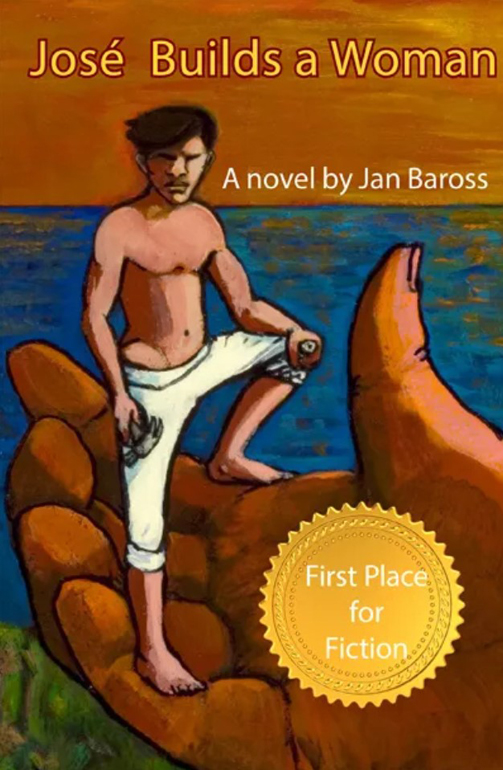
Jan Baross is an award-winning novelist, documentary filmmaker, photographer, screenwriter, librettist, film critic and taught filmmaking at Oregon State University. "Jose Builds a Woman," her debut novel published by Ooligan Press twenty years ago, in 2006, received first place for fiction. Ursula Le Guin gave it a thumbs up.
Baross lives six months a year in Portland, Oregon and SMA where loves designing posters for the Annual San Miguel Playwrights Winter Showcase. Books and Audible on Amazon. Films on YouTube.
www.janbaross.com
**************
*****
Please contribute to Lokkal,
SMA's online collective:
 ***
***
Discover Lokkal: Mission
Visit SMA's Social Network
Contact / Contactar