 Español
May 24, 2026
Previous chapters
by Jan Baross
CHAPTER FIFTEEN
Mamá's kitchen was her refuge. She was happy alone with her thick iron pans and fresh produce. I am merely alone on my first morning in Miguel's kitchen with its light-blue ceiling. I do not know where to begin to make it my own.
Domingo and I left Miguel's cargo by the wall, along with a few souvenirs. I am one souvenir of Miguel's trip, having unpacked myself, shed my shawl, and placed myself on one of his chairs.
I sip Miguel's bitter coffee and remember the well-ordered shelves of Papá's store. This kitchen is a woman's arrangement: the spacing of rice, flour, sugar jars, garlic, and herb clusters hanging on the wall, the stacks of pots on the stove. I think it must be Fecunda who oversees. I move the salt and pepper bowls from the side of the table to the center. Everything that was in some kind of order, I re-order, until I feel some of my disorder in the room.
I cannot stop thinking of Señor Domingo's kind eyes. We have a sadness in common. If he came through my door again, with his dark calm, I would go to his boat and live with him on white fish and wine.
Miguel opens the back door with the late morning light behind him. I pick my steaming cup off the table and inhale the heat.
"Did you enjoy your cousin's coffee?"
He hangs his head and looks at the stacked packages piled along the wall.
"I stayed too long," says Miguel. "I did not mean for you to do this by yourself."
"Señor Domingo helped me."
That shames him. I get up and cut a slice of cheese and tomato for him, with hot chilies, and fold it into one of the old woman's cold tortillas.
He sits and I drop the plate on the table in front of him. He folds the sparse meal into his mouth until his cheeks are tight and churning. His eyes start to water.
It is the red peppers. Revenge is simple in the kitchen. He pushes the plate away and drinks a bottle of beer in one gulp.
"A good first meal," he chokes.
Wiping his hands on the tablecloth, he stands up and wraps his arms around me. My nose is crushed in the trail dust of his shirt.
"Have you seen the house yet?" he says.
I shake my head. He walks me into the next room that is so dark no shadows dwell there.
"This is where I come to be alone," he says.
Miguel opens the shutters. Afternoon light spreads across a dark wood floor. A heavy, hand-carved bench sits in front of a stone fireplace. The bench looks like Miguel, with its massive, carved back, thick curled arms, and powerful legs. A dark wood hutch suffocates one entire wall. Painted tin trays fill the shelves. On one side of the room is a dining table as big as a coffin, surrounded by high-backed chairs. People are irrelevant when it comes to this kind of furniture.
Miguel Svendik runs his hand over the table's stained finish. "This is my work."
He wants me to like it. But my eyes are drawn to a chair by the fireplace that is delicate of limb.
"That chair is my father's work," he says.
Geese flock in an intricate pattern on the back of the chair. A soft pillow on the seat is hollowed from use. I recognize the shape of the bottom. It is Miguel Svendik's nest for his silent moments.
Over the fireplace hangs a small painting of a foreign landscape with tall pointed trees, a beautiful yellow-ochre villa, a fountain, and a soft blue sky. It matches the light sky-blue of the ceiling.
"Why are the edges of the painting burned?" I say.
Miguel's eyes are suddenly on a journey past the fountain to the yellow villa. When his eyes return to me, they are wet with tears.
"My father burned all of my mother's things after she left us, but I saved the painting from the ashes."
Miguel lowers his thick body into his father's delicate chair. I imagine the fireplace filled with his mother's things: a smoking painting, melting gold, fine-fringed shawls turned to cinders.
Miguel sits forward in the chair.
"My father wanted a wife more than he wanted to breathe. But he could not find a woman who wanted to marry him."
His voice sounds smoky, inhaling the singed memories of his mother. I stare at the painting.
"Was that because of the curse?" I say.
"Tortugina! That is a fairy tale! Some people are stupid enough to believe it, but I have proven it wrong, with you!"
"Will you tell me how?" I say.
"Later." He grabs a knife and a piece of half-carved wood from a small table next to the chair and begins to whittle furiously.
"Has this anything to do with your mother?"
"No! The story of my mother began when a white-haired professor came to dig at the ancient Indian ruins outside the village," says Miguel. "He was Italian. His young wife was called Celestina. It was said by everyone who saw her beauty that she was an angel."
Miguel's hard strokes carve the rough shape of a woman.
"My father was sent to repair the closet door in the professor's room. That is how they met."
He brushes the wood chips off his knee.
"One day the professor died in the ruins. Celestina buried the old man with the last of the grant money. On the way back from the funeral, Celestina sat down to weep in a grove of brilliant flame trees. My father came to comfort her tears. That is all he hoped for. But Celestina was a woman who had to love someone at every moment of her life. For the first time, my father felt a woman's touch, and then could not live without her."
There is a roughness in Miguel's voice.
"My father never understood why my educated Italian mother married him, a simple carpenter. I remember Papá was the happiest man alive, while she was with us. They did not speak much. Papá said later, copulation was their common language."
Miguel cuts the wooden figure into a slender body.
"My father built her this home and painted it red and purple, for the colors of his heart. After some time, Celestina began receiving letters from a man in her village. She left for Italy when I was four and sent us a piece of paper that erased our family. Father burned the annulment in the fireplace, with all that she left behind, except for me and the bottles of vintage wine. The painting is her family's home. She is buried there."
Miguel throws his crude carving of a woman into the fireplace.
"She is buried here too." He rubs his chest, as though his heart were tearing in two.
For the first time, I feel tenderness toward the man I married. He pulls me into his lap and presses his wet cheeks into my blouse. This dampness opens my heart in a way Angelicus Maximus never could. I rub the sun lines along the back of his neck.
"Tortugina," he says, "promise you will never leave. I will not have my sons suffer as I did."
"Sons?" I say.
"Promise," he says.
I let the moment carry me into a promise. "I promise," I say, though I have never been good at promises.
"Good," he says. "I want to show you something that I think you will like."
He lifts me off his lap and leads me to a beautifully carved door on the other side of the room. It is oiled but unstained, so the natural design of the wood has guided the carving of small angels. I do not need to ask.
"My father's work," Miguel says.
He opens the door. "This room has been waiting for you for a long time, Tortugina."
I step inside a large rectangular room painted dark blue. Lining the walls, I count twelve child-sized beds with thick, lovingly carved headboards. At the end of each bed is a child-sized set of hand-made carpenter's tools in an open wood box.
"You and I will fill this room with our sons," he says.
I place my palms over my belly. "Twelve sons can kill a woman."
"The boys will always have each other," says Miguel, "just as Fecunda's children have each other."
He picks me up in his arms as though I were a baby. "I have one last room to show you."
The bedroom, of course. It is crowded with more of Miguel's heavy furniture. Things he probably could not sell. A bureau, a desk, a chair, and a giant armoire with carved leaves. The headboard is covered in bloated cherubs. Covering the bed is a large quilt that droops onto goatskin rugs.
This room's ceiling is painted the same sky blue as the kitchen, the front room, the children's room, and the hallway.
"Why are all your ceilings blue?" I say.
He puts me down on a goatskin rug. "All ceilings in Las Mujeres are painted blue so the spiders will think it is the sky and not build their complicated webs over our lives."
"In El Pulpo, we knock them down with a broom," I say.
A musky smell is suspended in the room, as though the sex had started without us.
"Here, we will make my sons," he says and sniffs us both. "I think we could use a bath."
He opens a heavy door to the outside. The door is so poorly matched, it shrieks against the frame.
"I am better at furniture," he says.
A wide veranda overlooks a garden and the sea in the far distance. Purple bougainvillea twists up columns to the red tile roof. The warm afternoon air is filled with the scent of honeysuckle burning like incense in the sun. A stone-rimmed fishpond is filled with green lily pads.
"I have made you this beautiful garden," he says.
His green eyes gather in the colors of his work. One side of the garden is over-crowded with vegetables and dangling crab-sized flowers. There is a large patch of corn, ripe tomatoes, squash, melons, and grapes.
I work my finger through the hole in my pocket. What is left for me here or in the house? Everything smells of his hands.
"Maybe you should make your own children too," I say.
Miguel laughs. "Tortugina. We will have a hot shower and you will feel better."
He reaches above my head and unscrews a cap on a metal pipe that is sticking through the roof. Sun-warmed water soaks our hair, clothes, and skin. He undresses himself and me, then caps the pipe. With a wet sea-sponge, he soaps us both, and the soap falls onto the clothes under our feet. He stamps and twists his feet on his white soapy clothes.
"I wash my clothes in the bachelor way," he says. "You can do the same."
I stamp and twist on my soapy clothes while we take turns sudsing each other's dusty parts. When the water falls on us again, it washes away the fragrance of the road. Miguel shakes his wet hair like a dog. I shake my hair too, since there are no towels here. We leave our wet footprints across the veranda tiles, over the goat rugs to the bed. I am almost too tired to sleep. We hold each other under the quilt and trap dampness between our skins. Breasts to nipples, we are the rule of two finding a balance. He rolls me stomach down, face on the sheet. His knees separate my legs. He pulls me backward, so that I am up on my knees. This is the mounting position for street dogs that I watch in the Plaza de Allende. Never again will I wonder how it feels for them. Angelicus Maximus pumps into my dampness. The explosion comes fast for him, but not for me. He is released into sleep. I am wide awake with the same unbearable ache in my woman's mound that he gave me on the camel. He rolls over on his stomach and spreads out like an octopus, until there is no place left for me to rest. I listen as his whistling snores use up what little air is left in the room. His furniture hoards the rest.
The cramping will not let me sleep, but I am learning to make it disappear faster than before. Miguel's wetness dries on my thighs as I slide over the sheets out of bed and into the afternoon warmth of the garden. The warm sunshine is a balm on my sore, naked, camel-bounced body. In case there are giants or midgets or furry neighbors lurking, I kneel behind the leafy vegetables and crawl down a furrow. The air is plant heated. My knees and palms plod the warm earth, over ripe melons. A tomato plant droops from too much ripeness. A rasping sheath of corn scratches my ribs. At the end of the garden, I find one small patch of dusty red earth that Miguel Svendik has not yet covered.
I squat and relieve my bladder in the middle of the dust. This tiny piece of earth is mine. The loin cramp from Miguel's quick sex is gone now. I curl around the wet spot, nesting in the warm dusty earth, blanketed by the sun, and fall asleep.
***
CHAPTER SEVENTEEN
Across the path, Señor Domingo opens his lime-green door. He has come to know me as his early morning companion. A great wad of folded fishnet rests on his shoulder. He comes to stand beneath my window.
"Good morning, Señora Tortugina," he whispers. "I hope your day is good."
I give him a warm corn roll packaged in a palm leaf. He stuffs it in his woven lunch sack.
"You are very kind, Señora," he says and lifts his hat.
Below Señor Domingo's everyday words are deep tremors. Though he is so ordinary, when he speaks, it feels as though great plains shift below the surface of my life.
"You are a good friend, Señor Domingo," I say.
Whatever I say seems to please him.
From the veranda, I watch Señor Domingo's small figure walk to his boat with the net on his shoulder. My hot corn roll bumps in the lunch bag on his hip. He and another man, one of the giant Casimir clown clan, push their boat into the sea and jump aboard. My great longing to set sail with him has not diminished.
"Tortugina!"
Fecunda walks toward me wearing a long yellow smock that makes her look like a human sunrise. She carries her kitchen fork, and when she is close, she touches my chest with it.
"Keep your eyes on your own husband," she says.
She presses the prongs harder then raises the fork to her mouth, pretending to eat my heart.
"You came over for this?" I say.
She smacks her lips.
"Miguel wants you to work," she says, "to pay him the dowry you never had. He wants me to invite you to join our Women Divers' Co-operative."
I choke on my coffee. "Divers?"
"I hope that is of no interest to you," says Fecunda.
"When?"
"Now."
I have been waiting all my life for this moment. I throw the coffee cup into the garden and run to the bedroom. Miguel is awake and dressed.
"I cannot fix breakfast today," I say.
I slip on my pink swimsuit underneath my clothes. Since Mamá made it so long ago, it is a little tight. Today it will feel water for the first time. In the kitchen I throw a towel around my neck, grab a few tortillas, a bucket, and fly out the door.
Fecunda and children are waiting in the path with baskets balanced on their heads. Fecunda's iron hair is caked to her head with the grease of sleep.
"So, turtle-girl is going to join us," says Fecunda.
Miguel opens our front door. Tucked under his arm is his carving, the half-finished head of the Virgin.
Fecunda blocks him at the door with her hands on her hips.
"Miguelito," says Fecunda. "This is a trial. If there ends up being less money for me, she is fired!"
Miguel laughs.
"Cousin," says Miguel, "you call yourself a businesswoman? With two more hands you will have more to sell."
Miguel feints to the right and then, when Fecunda moves, runs left around her big hips. He blows me a good-bye kiss with his chisel hand.
"Work hard, Tortugina, and do not disgrace the house of Svendik."
The "cursed" house of Svendik I want to remind him. My disgrace is always assumed.
Fecunda stamps her foot then turns on me. "Why are you standing there like an idiot?"
Fecunda's feet splay outward in a duck waddle. Her older children follow in a line, carrying the smaller ones on their hips. They look like a long, basket-headed animal. I follow them along the landscape of Las Mujeres that slides easily from land to sand, from sand to sea.
Red-eyed and looking straight ahead, Fecunda has more on her mind than the tiny albino clinging to her breast. Over the steady rush of waves, she shouts, "Cousin, I will watch you closely. One mistake, you are out."
I tighten the hold on my basket, reviewing what I learned from watching Gabito.
"Fecunda, if you are an example of the village divers, I am already better than any of you. You are lucky to have me."
Fecunda grabs my shoulder with the hand that does not hold the albino. The smell of her sweat is harsh, garlic blended with baby vomit. The children scuttle away from us and disappear around an outcrop of stone.
"You are nothing more than a cursed Svendik bride! You have married into the house of Svendik because no woman in her right mind would have Miguel for a husband . . . including me!"
Fecunda's eyes are as wild as whitecaps.
"What is this terrible curse?" I say.
"If Miguelito does not tell you, I will not!"
Fecunda's great yellow bulk rolls like a keel-less tug over the sand. Her thighs rub together with a chafing sound. That woman cannot move without causing friction.
Far up the beach, a large cove with clear blue water covers miles of shallow reef. Huge whitecaps break at the edge of the reef and unruffle into smooth swells a few feet above the coral.
On the beach, three pregnant women sit and smoke pipes under a palm tree. They look older than me by a few years, but much younger than Fecunda. When they see Fecunda's children running toward them, they help each other up. I can only wonder about a village that sends its pregnant women to dive.
Fecunda pulls a pipe from her cleavage as the pregnant women stoop to hug the children.
"Rosa, Mimosa, and Auntie Patina," says Fecunda, "this is Tortugina Svendik. She thinks she is better than us."
"Not in all ways," I say, "but I can hold my breath to the count of four hundred."
Fecunda blows blue tobacco smoke. "You see what I mean?"
Instead of being impressed, the women look confused. The giraffe-necked woman in a blue smock slaps me on the back like a man.
"I am Auntie Patina. I saw you at Dia del Circo yesterday."
Her chin is even with the top of my head. Her skin is stained like a quilt with different shades of brown and pink. The patches of color seem to change as if she were moving through pockets of dappled light.
She frowns at me. "I have to say that we are not happy to share our earnings. In fact, there is little advantage for us."
I slap her on the back harder than she slapped me.
"I promise to out-catch all of you."
A squat woman with a bun of coppery hair and bright red lip rouge takes my hand. "I am Rosa. You are welcome, if we profit." She presses my palm to the red smock covering her stomach.
"It is kicking!" she says.
Her baby knocks itself against my hand. None of these women look like they can walk long distances, much less dive. Perhaps they hold rocks and sink to the bottom for their catch.
A shy, black-haired woman with long dark lashes and a pale smock holds her hand out. "I am Mimosa."
"Mimosa," says Auntie Patina, "you will teach Tortugina."
Mimosa's lips part in a big smile. The gaps between her teeth would leave a strange pattern on her husband's shoulder.
"Hello, Tortugina," Mimosa says sweetly. "Would you like to know what we do?"
"There is only one question on my mind," I say. "Does anyone have enough good manners to tell me the secret of my husband's curse?"
Auntie Patina shakes her head.
"It is not manners we lack, Tortugina. We in the Divers' Co-op are businesswomen. Fair trade. Tell us a secret first."
That seems fair. I have many secrets that I do not want and so I will give them to the divers.
"I am married to another man," I say, "who I truly love. His child is inside me. I married Miguel Svendik because my husband is dead. But not really dead."
The women whoop, laugh, and slap each other on their backs.
"That," says Fecunda, "is the Svendik curse. Tortugina, you are the true destiny of Miguelito."
"I will tell her," says Auntie Patina.
The women take the opportunity to pull their pipes out of their smocks and light them.
"You know from the circus pageant about the young acrobat, Thor," says Auntie Patina.
"In the silver tights and pink blouse," says Rosa.
"He is Miguel's great-great-grandfather," I say.
Auntie Patina nods. "When the circus was abandoned here, he was kept by the ancient Señora Sepulchura and became her boy-whore. Even when her granddaughter married Thor, the old woman insisted on his favors. She became pregnant with Thor's child. It died inside her and could not be gotten out. She blamed Thor for her agony. Before she died she left this curse on her family."
The women in unison chant the curse: "May the house of Svendik suffer the curse of knowing only the pain of love without the pleasure."
"She cursed her own descendents," I say. "Could there be a more stupid revenge?"
"Welcome to the family," says Fecunda.
Fecunda gives her children a last hug. "Stay out of the water. Gather only fallen coconuts and do not die."
The children leave their baskets to be filled by the women, and run up the beach.
Fecunda and Rosa, Mimosa, and Auntie Patina unsnap big safety pins from their chests and spread their legs apart in the sand. They bend over their smock stomachs and stretch their hands through their legs. Pulling the back of their smocks up front, through their crotches, they pin the material on their waists to make short pants.
"How can you dive dressed like that?" I say.
The women smile and wade into the ankle-deep water. Their sandals crunch the reef skeletons. I pull my skirt and blouse off, ready for the dive in my pink-striped swimsuit. When I pick up my bucket and wade into the shallow water, the four women turn to stare and laugh.
"Where I come from," I say, "the divers wear swimsuits. They leap off cliffs fifty feet high and hold their breath."
Fecunda empties her pipe against her palm and sticks the stem deep in her cleavage.
"Tortugina," says Fecunda, "we can hold our breath too. Shall we show her how good we are, ladies?"
The women inhale in unison. With small knives, the women bend, twist, and cut black mussels off the rocks, tossing them into the baskets floating next to their knees. They stand and release their breath.
Fecunda spreads her arms. "You see how professional we are, Tortugina. Now let us see you fill your whole bucket without taking a breath."
Fecunda's laugh starts them all laughing again. The heat rising in my face only makes the women laugh more. Rosa caws like a crow. Auntie Patina is louder than a mule. Mimosa's fingers cover the smiling gaps in her teeth.
"You call yourselves divers?" I yell. "You are a joke!"
Mimosa nods her dark braided head. "We are a joke, Tortugina. Fecunda named us the Deep Diving Co-operative thinking we might charge more if it sounded dangerous. But everyone knows we stand in a few feet of water and there are few difficulties in what we do."
My stomach feels like Lucinda kicked me. All those years of training, holding my breath, for nothing.
Mimosa wades over to me. "Tortugina, just do the mussels. The little red crabs are hard to keep in the basket. The gray and white patches in the shallows are oysters, but they are hard to cut loose."
Fecunda calls back over her shoulder.
"The most prized is the tiny green snail, 'carmelo verde,' because it is like a sweet green candy. We are lucky if we find a handful a week, and the villagers pay dearly for each one. Try to find those and impress me!"
Impress Fecunda? She'll be lucky if I do not strangle her. Mimosa pulls a delicate silver chain from her deep bosom. A tiny emerald shell hangs from it. She sucks the shell and holds it into the sun. It glows like a jewel with the moisture from her mouth.
"I wear one for luck," she says.
Fecunda, Rosa, and Auntie Patina lift their feet gently, walking in different directions across the reef. Mimosa steps into the shallows. "Tortugina, stay away from the edge of the reef. A strong current can pull you out to sea."
The tide drifts out past my calves in foaming tails. Beneath the water are white and gray oyster shells, bunched close together. I grab, twist, pull, and toss them into the bucket until my knuckles are bloody.
I picture Señor Domingo with his white sail wide open speeding to my rescue. "Come with me, Tortugina, and we will never return to land!"
Spray soaks my back and interrupts my daydreaming. I turn and find myself closer to the edge of the reef than I meant to be. Danger has a current all its own, and I am made for it. Unless I dive, I will never know if I am a diver like Gabito. I let the deepening tide shift me closer to the edge. The water is up to my breast. A basket of shells rattles behind me.
"Tortugina!" shouts Fecunda. "Come back! Miguel will kill me if you drown!"
A giant wave breaks at the reef's edge and curls above my head. I inhale air as the water covers me. Doubled undertows drag me over the edge, shredding my swimsuit. A snaking current wraps around my waist and pulls me from warm surface water down into a cold blue valley. No bottom to the sea, no white sand to reflect the sun.
Swimming toward me out of the dark blue is a familiar face. Gabito takes me in his arms and cradles me out of the cold current upward toward the sun.
"Tortugina," says Gabito, "how I have missed your wild, sweet body."
His restored heart pumps under the membrane of his chest, and his bubbles are in my hair. Gabito covers my face with sweet kisses. I smooth his hair over the crack in his head and wrap my legs around his hips.
"Tortugina," he says. "It is impossible to gather enough of you in my arms."
His captain's suit floats off with my shredded swimsuit and we are naked. Gabito is inside me. He is perfect inside me, pushing gently, so that little José does not flinch in my womb. We move together, the same rhythm, the same time, we are the same. Gabito pumps so far inside me there is no more Tortugina. Then, a sudden sweet release of every muscle that has been clenched since Miguel left me aching on the side of the bed. Inside my flesh, I am as warm and loose as syrup, soothed in Gabito's sugar-brown arms. The burden of curses drifts away.
"Gabito, we must stay like this forever."
We are both so far inside each other's pleasure we can barely hold on.
"It is not your time, Tortugina. You must go home for our baby."
"I know." I wrap my arms tighter around his neck. "But no one here likes me. I am an outcast because of Miguel."
He strokes my face with his long fingers. "If I make the village love you, will you be content for now?"
"Can you?" I say.
Gabito gives me one long kiss, and I taste good-bye. Then he swims in a circle around my body faster and faster counter-clockwise. The sea begins to swirl, with me in the center. Like a cork from a bottle, Gabito shoots me through the top of the waves into the air.
My reflection darkens the waves under me for an instant then shatters as my sandals splash safely onto the reef.
Rosa, Mimosa, Auntie Patina, and Fecunda are watery figures up to their crotches.
"Tortugina!" shouts Fecunda.
She churns toward me. The women follow her, a herd of heavy thighs and bouncing stomachs, plowing through the waves with panic on their faces. I think I recognize a chance for friendship in their eyes.
Mimosa is the first to reach me. She throws her long headscarf over my nakedness and takes my bucket. I did not realize I had it in hand or how heavy it was.
Mimosa looks down and screams. "My God in heaven!"
Rosa splashes close and looks inside. "Look!"
Auntie Patina sticks her giraffe-neck over. "Oh, bless you, Tortugina!"
I do not know what I have done until Fecunda reaches into my bucket and pulls out a fistful of emerald shells. She puts one between her teeth, sucks, chews, and swallows. A smile fills her face. Each woman pops a green snail, sucks, chews, and ends with a stupid grin.
Gabito's promise is fulfilled, but the change is so sudden, it feels like a nosebleed.
Fecunda puts a shell in my mouth. She is feeding me her gratitude. "Suck and chew."
My mouth fills with the saltiness of brined olives and the cool richness of fresh raw oysters. There is also something sweet and remote. No wonder they are a delicacy.
Fecunda, Rosa, Mimosa, and Auntie Patina cocoon me inside their arms and help me to the sand. The mixed scent of them is like home. Fecunda's garlic skin, Auntie Patina's wine breath, Mimosa's chopped mushroom earth scent, and Rosa's flower perfume. I let them drape their arms around me and dry me with their towels.
Tears would escape me if I had not had such practice holding them in. Approval, like sex, even with Gabito, is not entirely pleasant when experienced for the first time.
I am caught in the spider web of their friendship. Their appetite frightens me, but I am more afraid that they will not like the taste of me. This must be what it is like not to be Tortugina. A normal person, with friends, must live continually inside this confusing euphoria.
"Thanks to Tortugina," says Fecunda, "who is bound to me by the unshakable contract of marriage, we are all going to be very rich."
Read more chapters
**************
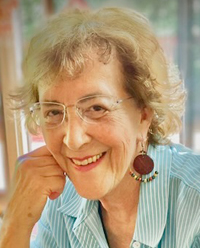
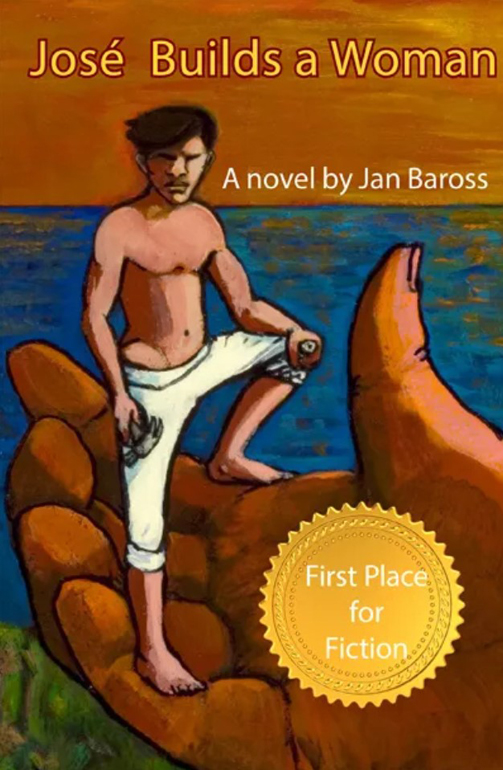
Jan Baross is an award-winning novelist, documentary filmmaker, photographer, screenwriter, librettist, film critic and taught filmmaking at Oregon State University. "Jose Builds a Woman," her debut novel published by Ooligan Press twenty years ago, in 2006, received first place for fiction. Ursula Le Guin gave it a thumbs up.
Baross lives six months a year in Portland, Oregon and SMA where loves designing posters for the Annual San Miguel Playwrights Winter Showcase. Books and Audible on Amazon. Films on YouTube.
www.janbaross.com
**************
*****
Please contribute to Lokkal,
SMA's online collective:
 ***
***
Discover Lokkal: Mission
Visit SMA's Social Network
Contact / Contactar