A River and a City that Sing
|
|
 Español
May 17, 2026
by Philip Gambone
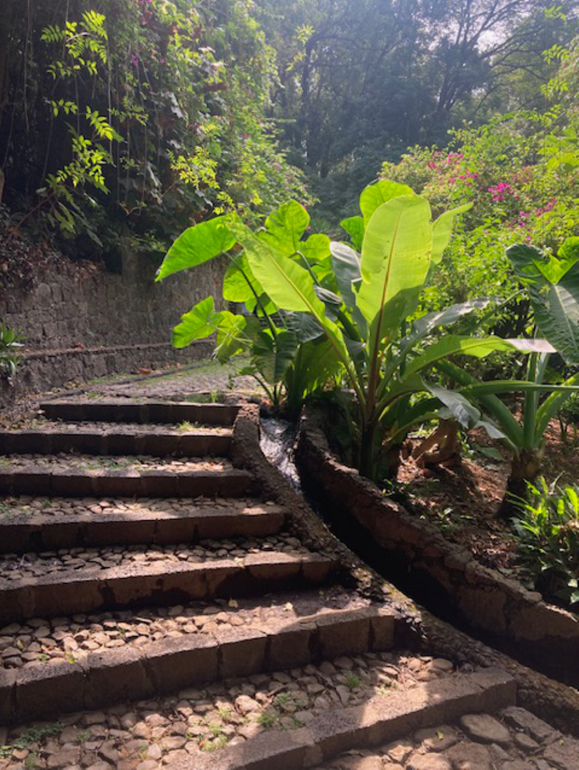
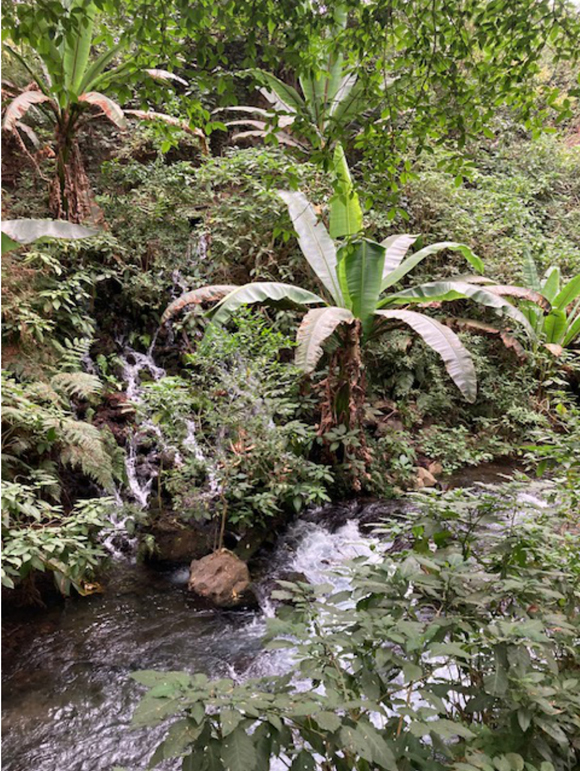
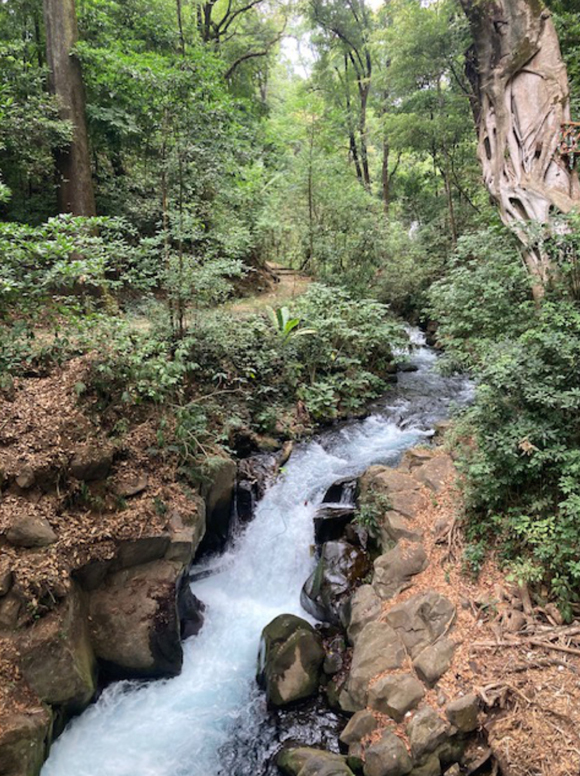
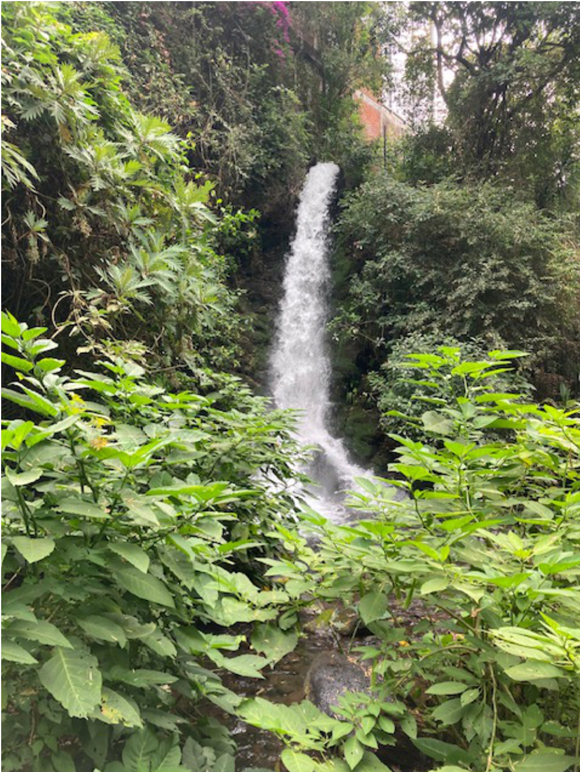
On a recent visit to Uruapan in the state of Michoacán, I spent a delightful morning meandering through the city's justly celebrated national park. A little over a thousand acres large, the park is situated on land originally used by the nobility of the Purépecha people as a pleasure spot. One can see why these Indigenous people were attracted to the place. It is a cool, lush, well-watered retreat overgrown with semi-tropical, broad-leafed vegetation. The Cupatitzio River runs through, cutting a rocky ravine as it flows along.
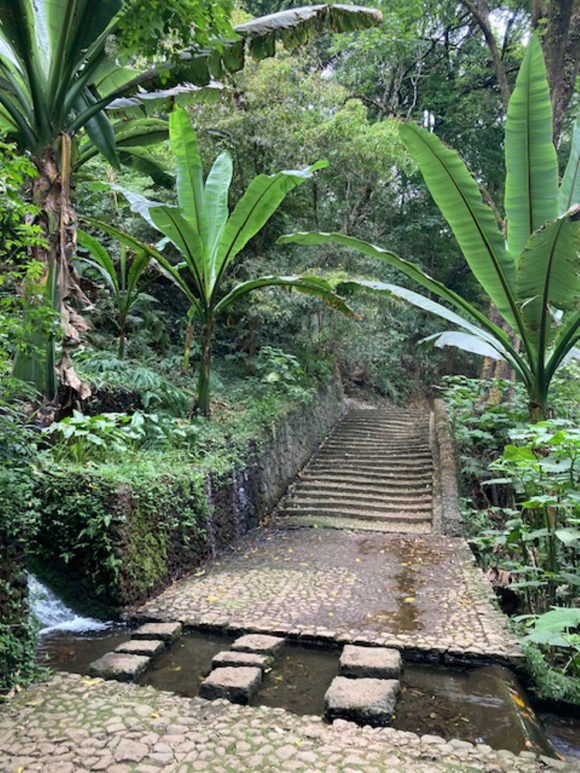
After the Conquest, the area fell into the possession of encomenderos, Spanish colonial landholders, and eventually became the property of various elite Mexican families. In 1938, the government under President Lázaro Cárdenas bought the land and turned it into a national park. The area, at that point in time a country estate, was redesigned with pathways, fountains, and gazebos, all aimed at preserving the vegetation and transforming the space into a national park, one of Mexico's smallest and most intimate. Its official name is Parque Nacional Eduardo Ruiz, in honor of a local writer and historian.
After paying my 50-peso entrance fee, I entered the park, walking along the Circuito de los Poetas, a stone path bordered by handsome signboards, each one dedicated to a local poet. "This is a space that seeks to preserve and celebrate the sublime value of culture in a natural environment brimming with life, beauty, and splendor,"I read. "Its atmosphere reflects the grandeur of words, paying homage and recognition to the illustrious legacy that poets and writers from Uruapan have forged throughout their lives and careers."
I thought that "illustrious legacy" might be laying it on a bit thick, but, as I later learned, Uruapan enjoyed a reputation as a community of artists, writers, poets, journalists, and intellectuals. Six poets who called Uruapan their home are featured along the Circuito de los Poetas. Each signboard gives a brief biographical sketch of one of the poets and a sample of his or her poems.
The first poet, Raúl Ríos Romero (1927-2004), was a mechanical engineer and a professor of English. Ríos founded two magazines and published several collections of poetry. His 2001 poem, "Brother Tree," beautifully captures the restfulness and inspiration that the magnificent, towering trees in the Parque Nacional provide:
|
|
|
|
BROTHER TREE
Grant me your shade, for I come weary
from chasing my own shadow with the sun upon my back
from chasing my shadow beneath the full moon...
Let me rest here with you,
and let me be steeped in the green of your leaves;
tell me of the travelers who came here
seeking renewed strength for their journeys,
who knew how to keep moving ever forward,
with their gaze fixed upon the sun
and fearing nothing...
Make me vibrate with life once more upon my path...
So that I may continue toward my destiny...
Thank you, Brother Tree, for your shade!
| |
|
|
The only female poet represented is Teresa Magaña Silva (1920-2007). Although she was born in Tingambato, Michoacán, she "dedicated her life and heart to Uruapan." Magaña was a principal and teacher at secondary and preparatory schools. A humanist, altruist, and promoter of culture and art, she was passionate about poetry, especially that of the Spanish Golden Age. Like Ríos, she is represented by a lovely nature poem, one that was anthologized in a collection of poems by Uruapan poets published in 1983 in commemoration of the 450th anniversary of the founding of the city:
|
|
|
|
EVENING POEM
Evenings caressed by the skies
lend tenderness to my dreams;
and the inspiration of your celestial sweetness
inspires my landscapes.
The nostalgia of yesterday turns to joy,
and my sorrows pour forth in sighs;
oases and mirages mingle
with the warm caress of your breath.
There is nothing in you that does not become sacred;
you transform winter into spring,
you turn the barren into the fertile,
you are a nest of love, heaven, and dream.
That is why I belong to you, because it is divine
to give you this love that intoxicates my soul;
and if I die watching you walk away,
I die, to live with your memory.
| |
|
|
Luis Ortiz Arias (1960-2003) was one of those Uruapan poets "neither particularly well remembered nor prominent in today's commercial literary landscape," according to the editors of Tres Poetas Uruapenses, an anthology in which he is featured. Ortiz was a biologist, researcher, lecturer, and writer. In addition to his poetry, he published two novels The Secret of the Snail and Because of the Night. His poem "Rust – Nostalgia" is a dark eerie lyric:
|
|
|
|
RUST – NOSTALGIA
Rust – Nostalgia
anguish that pervades everything
solitary garden full of grass.
Enclosed garden
suspended over the cataclysm.
Wolves in the night
do not console me.
Loose words float
around me.
Eyes that look at me,
forcing me to look at them.
Whirlpools that attract me
and carry me beyond the void.
Rust - Nostalgia
suspended over cataclysm
facing the wind
I walk
I run
I flee from myself.
| |
|
|
Francisco Hurtado Mendoza (1937- ) is considered one of Michoacán's most prolific poets. A teacher at the Eduardo Ruiz High School, he has contributed literary criticism to periodicals and presented numerous lectures on literature and psychology. Hurtado's poems celebrate Uruapan and the legends of Michoacán, such as the following sonnet, a tender love letter to his beloved city.
|
|
|
|
URUAPAN
In your body there is a smile of crystals,
which, at the divine conjuring of your eyes,
become light, springs,
become caresses and fresh red lips.
You have no mysteries of history
because you have shaped it in your women;
because you have adorned it with your glory,
and in a kiss you have united sunsets...
Uruapan, you who pour an entire sky
into an indigenous amphora of stars,
I would like, with the longing of some flight,
to travel with you and be younger,
to watch over you and be an archangel,
and to immortalize you and be Beethoven.
| |
|
|
According to the signboard dedicated to him, Ramón Ortiz de Montellano Álvarez (1934-1964) "carved out a place for himself through his elegant and polished writing, which reveals great erudition and profound encyclopedic knowledge." This hypersensitive poet's short life was a tragic one, a story that is only vaguely alluded to on the Circuito. According to his friend, José Luis Ríos Romero, Ortiz de Montellano did his writing in a "special place in the family home, which he called his ‘attic,' where he spent hours of the day and night reading and writing in an order and disorder that only he understood." Much of his work was published only in newspapers and small literary magazines, and was quickly forgotten.
"My poor friend," Ríos Romero wrote, "we let him die in solitude and abandonment. My poor friend, we failed to give him love and understanding; what every human being needs to avoid succumbing on life's journey. God sent him into this world with a pen and paper in his hands, but didn't equip him sufficiently to face life's blows."
"Poets are unfortunate artists; no one reads their work, no one is interested in knowing and appreciating what they write, not even their closest relatives. My poor friend, he had the misfortune of living in a society where matter triumphs over spirit, and literature and art in general are considered superfluous. Little by little, all the ships of his dreams foundered on the reefs of reality. Little by little, he became convinced that neither the people of Uruapan nor any of the women who had been the object of his tormented infatuations were interested in his literary works, and finding no support or recognition from anyone, with a broken soul and his dreams shattered, he preferred to die rather than give up as a writer."
Ortiz de Montellano's work is represented by two short poems on his signboard. Here is one of them, a sad, chilling leave-taking:
|
|
|
|
TO THE EARTH
O fragrant earth, my Mother!:
Before I part from your side
and go forth to meet destiny,
let me lie here in your bosom
to contemplate the infinite path ahead.
Soon I will depart... Upon my return,
if I do not succumb in the fierce battle,
I will come, Mother, to bring you my greeting,
a flower, a tear, and a kiss.
| |
|
|
The final poet along the Circuito is Juventino Herrera Prado (1892-1980), who grew up in the Indigenous Community of Chilchota. He is represented by an excerpt from his poem that celebrates the river that runs through the park:
|
|
|
|
SYMPHONY OF THE CUPATITZIO
Gentle, smooth, purest, adorable,
it sighs to the quiet swaying of the grove,
displaying the incomparable beauty
of its iridescent silken undulation.
Of this river that in its resting places
reflects in the sapphire of its pools
the merging golden hues of evening,
so that the sick and dejected soul,
may once again have the charms of life
and a little blue star of illusion.
| |
|
|
The name of the river, Cupatitzio, means "River that sings." It certainly does as it rushes and cascades through the Parque Nacional. As I left to return to the city, a twenty-minute stroll away, it struck me that Uruapan sings, too—in the festive street music that you hear everywhere and in the passionate, plaintive, and joyous poets who made this place their home.
**************
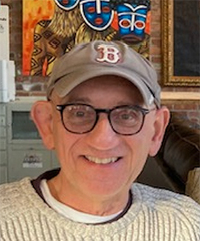
Philip Gambone, a retired high school English teacher, also taught creative and expository writing at Harvard for twenty-eight years. For over a decade, his book reviews appeared regularly in The New York Times. Phil is the author of seven books. His memoir, As Far As I Can Tell: Finding My Father in World War II, was named one of the Best Books of 2020 by the Boston Globe. His new collection of short stories, Zigzag, was published last year by Rattling Good Yarns Press. His books are available through Amazon, Aurora Bookstore, and at "Tesoros," the bookshop at the Biblioteca.
**************
*****
Please contribute to Lokkal,
SMA's online collective:
 ***
***
Discover Lokkal: Mission
Visit SMA's Social Network
Contact / Contactar

|
|
|
|
| | |
Click ads
Contact / Contactar
copyright 2026
|