 Español
November 1, 2026
by Charles Miller
A few months back the subject of this column was cosmic rays, high energy radiation from outer space, and the deleterious effect they can have on computer systems. Radiation in the form invisible speeding bullets, particles of high energy from exploding stars, supernovas in deep space and moving near the speed of light are constantly raining down on us. These microscopic bullets from the cosmos can have real world consequences. With elections soon to take place in the U.S. this is a good time to look back at the story of Maria Vindevoghel and her encounter with a cosmic ray.
In the Belgian federal elections of 2003, Maria Vindevoghel was a candidate for the Belgium Chamber of Representatives in the Brussels-Halle-Vilvoorde electoral district. When the votes on the computerized voting machines were tabulated, Maria appeared to have won by thousands of votes. The voting machines said so, but every human who looked at the numbers could see that the total was more than what was numerically possible. When the vote was audited all of the candidates in the race were confirmed to have the correct number of votes recorded in the voting machines, except that the computers in the voting machines showed Maria having exactly 4,096 votes more than was possible. That number 4,096 is sure to jump out to anyone with knowledge of computer programming or binary numbers.
The planet Earth and everything on it is being constantly bombarded by cosmic rays. These particles are protons and helium nuclei from our sun and supernovas in deep space. They do not create detectable "bullet holes" as they pass through matter at near-light speeds, ionizing atoms along straight-line tracks. Only the secondary effects can be detected in a laboratory or with a Geiger. These invisible speeding bullets are constantly raining down on us and have been doing so for many millennia.
The thing that makes the current millennium, the one we started 25 years ago, different is the miniaturization of electronics. In the 1960s when computers stored data on paper Hollerith cards punched with rectangular holes, a few extra subatomic-scale holes from cosmic bullets were too small to register. But today when one of these particles pierces a transistor or other semiconductor it has the capacity to sometimes strike in just the right place to create a large number of free charge carriers. These electrons could cause a "bit flip" changing one byte of the computer’s binary language from a one to a zero.
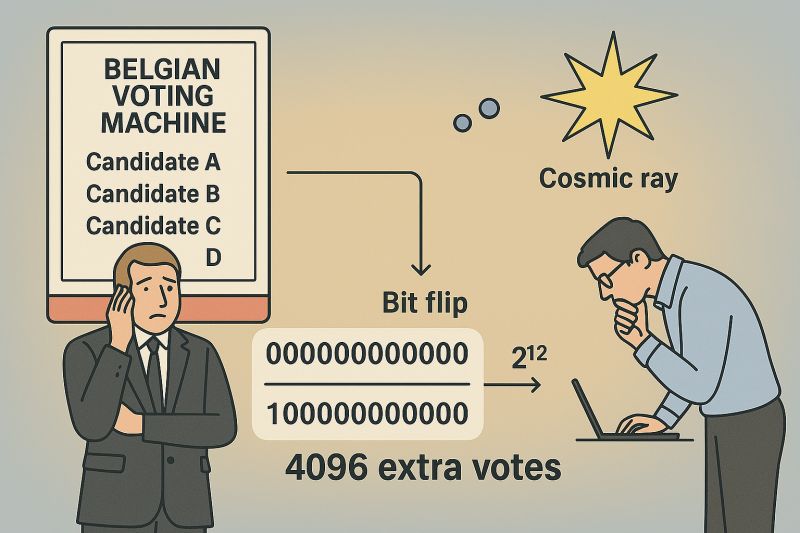
This is known as a Single Event Upset (SEU), which is physically undetectable. The "bullet hole" is too small to be seen even under a microscope. One clue that a SEU might exist is that a bit flip is always 2 to the power of x (2, 4, 8, 16, 32, 64, 128, 256, 512, 1024, 2048, 4096, etc,). That is why it was suspicious that Maria Vindevoghel got exactly 4,096 extra votes.
An audit of the voting machine software allegedly showed its vote count was correct. Every test of the machine and its software seemed to show it was correct. But a head count of the voters indicated there were 4,096 more votes than there were people. The authorities had to conclude that a Single Event Upset caused by a cosmic bullet piercing one of the electronic components in the voting machine had caused the bit flip that created 4,096 votes out of thin air.
For the next election Belgium tested a "ticketing" safeguard with machines that printed a paper record of each vote. Those paper ballots were counted and compared with the electronic totals and if the counts differed, the paper count was supposed to prevail.
Many argue that paper ballots are generally more reliable than electronic voting machines based on verifiability, auditability, and resilience to technical or malicious interference. Paper ballots versus voting machines does not have to be an either/or choice. Electronic systems using VVPAT (Voter-Verified Paper Audit Trail) use both. These machines are considered highly reliable because they combine the speed of electronic counting with the auditability of paper ballots.
**************

Charles Miller is a freelance computer consultant with decades of IT experience and a Texan with a lifetime love for Mexico. The opinions expressed are his own. He may be contacted at 415-101-8528 or email FAQ8 (at) SMAguru.com.
**************
*****
Please contribute to Lokkal,
SMA's online collective:
 ***
Discover Lokkal: Mission

Visit SMA's Social Network
Contact / Contactar