September 6, 2026
by Dr. David Fialkoff, Editor / Publisher
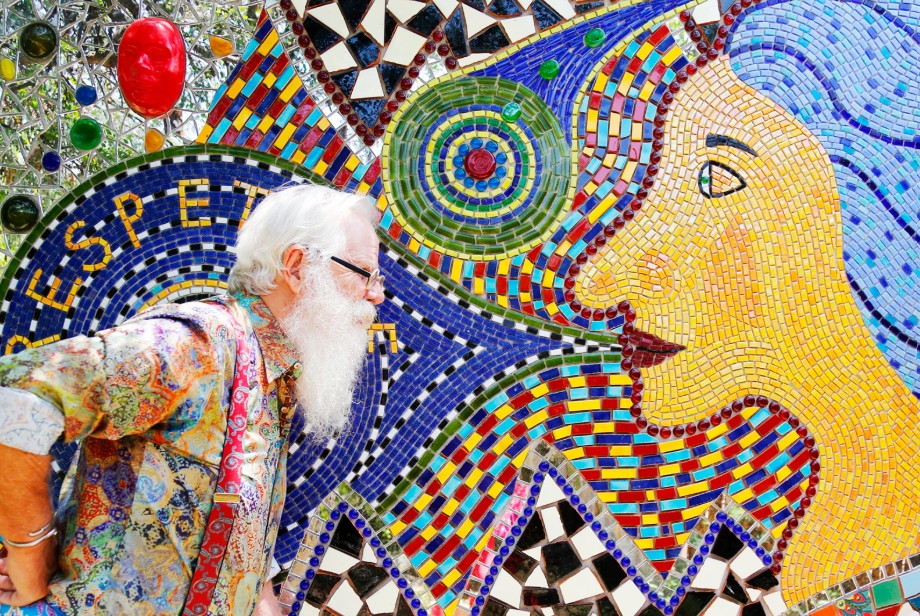
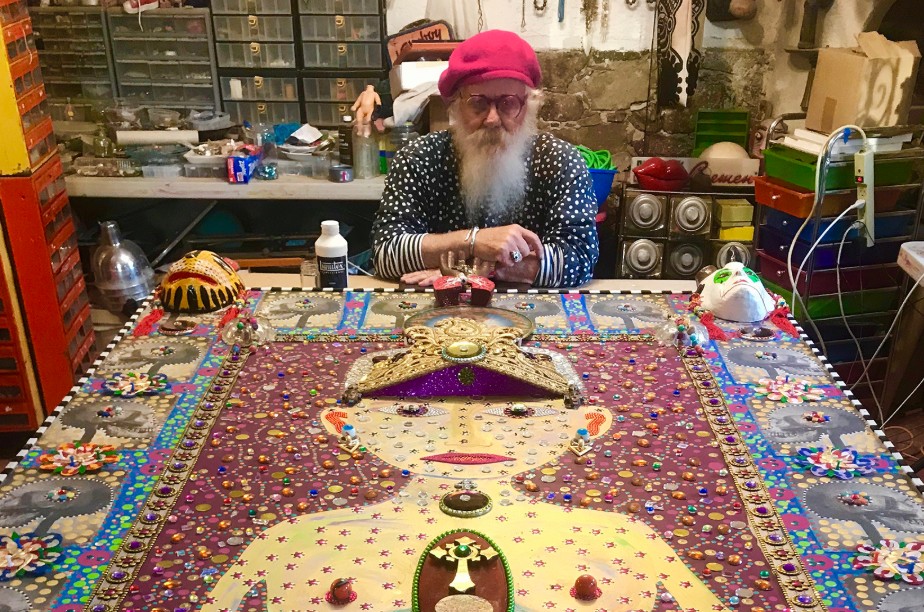
Images and Art- Made By Anado
A decade before he left the body, Anado McLauchlin came to my house for dinner. I prepared for him my famous miso soup, which, like his art, is a mosaic of flavors. He loved it. Across the table, as part of our lively discussion he declared, "People don't need religion." I retorted just as strongly, "You don't need religion. But people need religion. Without religion people would be eating each other." Nietzsche, it turns out, agreed with me.
German philosopher Friedric Nietzsche (1844-1900) saw the future, predicting the suffering that modernity would bring, that every generation from 1900 until now has experienced. He identified its cause, summing up society's principal structural flaw, without nostalgia or celebration, in three words, "Gott ist tot," God is dead.
For centuries, belief in God (and the Christian moral framework built on it) functioned as society's organizing principle. It gave people a shared sense of absolute truth, objective morality, ultimate meaning, and a reason to accept suffering and self-denial. It worked, sociologically and psychologically, for a very long time.
This organizing principle failed, the belief in God died, because it had become impossible to honestly, intellectually believe anymore. Increasing skepticism wrought by several centuries of intellectual development: Enlightenment reason and science, historical criticism of the Bible, philosophy, had eroded religious faith. By Nietzsche's time educated modern people (whether they admitted it or not) no longer actually believed in religion's claims. Still, running on inertia, society was built as if they did.
Nietzsche was not sentimental about the old religious order. He was a fierce critic of Christian morality, calling it a "slave morality," observing that it was motivated by psychological resentment rather than truth. But he was also not naively glad that it was collapsing. He saw a real danger in the vacuum it leaves, fearing either nihilism, the risk that nothing will step in to replace the lost sense of meaning, or that cheaper, unexamined substitutes would arise in the void (including the destructive ideologies with which his work is sometimes, controversially and largely inaccurately, associated).
Diagnosing the death of religious belief as a sociological and psychological event, Nietzsche worried about what happens when a civilization loses its cohesive foundational myth, and hasn't yet built anything honest to replace it. Neitzsche saw two possible outcomes of this dangerous state of affairs:
1- The Übermensch (Superman)
This figure heroically undergoes "the revaluation of all values," actively examining rather than accepting them on authority or habit. He creates new values, and so meaning, from a position of strength, not from resentment or fear (the "slave morality"), affirming life completely, including suffering. Neitzsche admitted that most people are not supermen, and so unable to do this. Hence he despaired that his "last man" was the far more likely outcome for the mass of humanity.
2- Last Man
The "last man" outcome has two consequences, two dynamics, the first passive and the second active.
The first is a shrunken, complacent, risk-averse humanity who have stopped asking the big questions. They, or rather we, have "invented happiness" in the smallest, most petty sense, giving up on greatness, struggle, and any transcendent aspiration, settling instead for safety and shallow pleasure. We see all around us lives of conformity and entertainment (with work also a form of entertainment). We are urged to embrace a narcissistic, consumer society that has traded meaning for comfort, with all danger, ambition, and suffering engineered out, now under AI management.
The second consequence of Nietzsche's "last man," involves secular ideologies being adopted with religious faith and fervor. This much more active dynamic explains a lot about our troubled modern world.
A "God-shaped hole"
The function religion performs doesn't disappear just because the old content did. You can take the boy out of the religion, but you cannot take the religion out of the boy. When you strip away traditional religion, society spontaneously manufactures new sacred objects to worship. A "God-shaped hole" gets filled with ideology.
French sociologist Émile Durkheim's (1858–1917) core insight (from his study of Australian Aboriginal totemism) was that religion isn't really about the supernatural at all. Rather it is a society worshipping itself through sacred symbols. He defines religion as a unified system of beliefs and practices related to sacred things that unite people into one moral community. Here "sacred" doesn't require anything supernatural, but rather something a group has collectively set apart as deserving reverence, something off-limits to profane treatment. A flag, a founding revolution, a national anthem, a sports team, a political movement, the response to a pandemic can all function exactly as a totem once did.
Durkheim's most striking claim argued that even the officially anti-religious French Revolution generated its own religion, spontaneously sanctifying "the Motherland," "Freedom," "Reason" as sacred entities, complete with new rituals, altars, and festivals dedicated to Reason and a Supreme Being.

Journalist and author Robert Wright's approach is more evolutionary/psychological. He claims that religious impulses and moral intuitions evolved because they conferred group-cohesion advantages, and that modern secular ideologies can hijack the same tribal, sacred-vs-profane psychological machinery on which religion once ran. He argues that our brains are built to sort the world into "sacred in-group" and "profane out-group" regardless of whether the content is religious or political. His work often lands on the idea that secular political tribalism (left/right) increasingly functions with the same us-vs-them, moral-certainty, heresy-punishing dynamics that religious sectarianism uses.
Columnist, author Ross Douthat is a religious believer who makes the case that modern political and identity movements function as substitute religions, but badly. This is because they inherit religion's psychological intensity (moral certainty, conversion narratives, heresy-hunting, martyrdom) without religion's traditional checks (humility before transcendence, universal love commandments, a coherent metaphysics, institutions built over centuries to restrain zealotry). His book Bad Religion specifically argues that American religious decline didn't produce a more rational, secular society, but rather a proliferation of heretical, undisciplined pseudo-religions (prosperity gospel, political messianism, nationalism, therapeutic self-worship), precisely the "cheap, unexamined substitutes" Nietzsche worried about.
Any society will generate sacred substitutes (Durkheim), because there is evolutionary/psychological machinery that makes the substitution easy (Wright), but these substitutes are dangerous/inferior as they get religion's intensity without its wisdom or restraint (Douthat).

What Nietzsche Missed
The science that killed God is now reviving Him. For most of the 20th century (following the materialist or behaviorist position) science believed that mind ("the ghost in the machine," formerly known as "soul") did not exist, at least not as a separate thing. Mind, our most intimate experience, was dismissed by science as an epiphenomenon, unworthy of study, a byproduct of the electrical (and chemical) activity of the brain.
But today a growing number of prominent scientists contend that, as with getting blood from a stone, you cannot derive consciousness from inert matter. They admit, no matter how many billions of years you allow for the process, that mind cannot be derived from mindless material. Today many dozens of respected scientific theories regard mind as non-emergent, as a primary (non-derivative) cosmic force, that, like gravity and electromagnetism, just is.
Prominent among these theories is Panpsychism (Galen Strawson, Philip Goff), which posits a sort of basic mind-dust, present in every atom, that has somehow organized itself, evolving into higher consciousness like ours. It concedes that non-material mind exists, but assumes that biology marks its greatest extent; the door has been forced open, but only a crack.
Another prominent theory on the subject is Idealism (Bernardo Kastrup). This posits the existence of a Mind-at-Large, which (like Plato's Ideals) informs our ideas. Here again, in accord with science's anti-God dogma and in response to his colleagues accusation of theism, Kastrup prejudicially, without any explanation insists that his Mind-at-Large, unlike traditional concepts of a moral God, is unconcerned with us, the little, individual minds (souls) that the Cosmic Mind has engendered. Kastrup suggestes that we humans are "dissociated alters" of one universal mind, similar to how dissociative identity disorder produces distinct centers of experience (multiple-personalities) within one underlying psyche.
Unlike Panpsychism, I believe that mind extends infinitely beyond mammals and octopi. Unlike Idealism, I hold that the Universal Mind is universally interested, in us and everything.
Nietzsche did not anticipate that today's rigorous, secular philosophy of mind (without any religious agenda), pursued honestly (with exactly the strength-not-comfort spirit he demanded) would arrive again at something like religion's God, resupplying we "last men" with the moral cohesion our society needs.