Yui Sakamoto
Español
September 13, 2026
by Marni Hills
My father died in 2019. It seemed no one else in our family was interested in the thankless job of unscrambling an entire property overflowing with hoarded stuff - including six decades of his art. In Part I of this article, I wrote about my experience, the overwhelming frustration, and eventual triumph of presenting his life’s work in a beautiful gallery show.
As I went through that process, I began to wonder: what happens to the life’s work of other artists when they die? San Miguel has an absurd number of artists per capita. Surely I was not the only one facing the challenges of stewarding an artistic legacy. So I began asking questions around town about artists who have passed. Not about their character or inspiration, but about the caretaker of their estates: who is responsible, how did they become responsible, and how do they feel about it?
From Scolding to Celebrating
When I decided to write about my experience as an accidental steward of an artistic legacy, I planned to scold living artists who have not made a plan for their demise. But what I discovered in my research and interviews was so much more nuanced, interesting and impactful.
As I unearthed and reached out to other protectors of creative legacies, the response was surprisingly quick and friendly. The chance to speak with someone who has shared their burden, their grief, their trials and tribulations immediately created a bridge of understanding and sympathy. But instead of uncovering more stories just like mine, I found a range of drastically different experiences with difficulties both greater and lesser than my own. What united us all was the shock, the loss, and a moral obligation to do the work of preserving and presenting, no matter what it took.
The Stewards of San Miguel
I have lived here for almost five years. I've been to hundreds of art walks, galleries, artist studios, workshops, classes…this is an artist's haven. We celebrate them in galleries, honor them in life (and in death) with heartfelt and emotional celebrations of their life and work. When I got the idea to interview stewards of San Miguel artists who were no longer with us, I knew immediately which legacies I wanted to learn more about.
***

Yui Sakamoto
Yui Sakamoto - Surrealist Rock Star
One of the first people I was able to speak with was gallerist Gabriela Hurtado of Intersección Arte Contemporáneo, located just inside the main entrance of the Fabrica Aurora, where one of my favorite local artists, Japanese-born painter Yui Sakamoto (1981-2024), exhibited. Unlike my father, who was completely unknown, Yui had already gained international acclaim at a relatively young age for his intricate paintings that blend Japanese precision with the Mexican symbolism of his beloved adopted country.
Yui's surreal, dreamlike paintings, created with unbelievable detail, humor, and mythological depth, had quickly made him one of the gallery's most successful artists. Personally, I am kind of obsessed with his work, as it reminds me of how I felt in art school when I first saw the strange and twisted visions of two of my other lifelong favorites, Hieronymous Bosch and Pieter Bruegel the Elder.
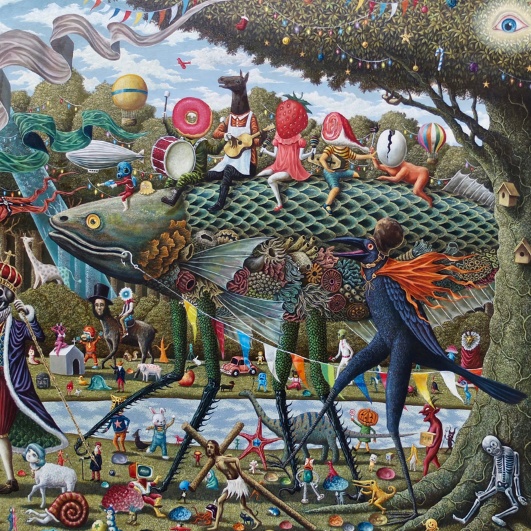
Yui Sakamoto
*
"Every single painting Yui brought to us, we sold," Gabriela told me. "He became one of our permanent artists very quickly."
Then everything changed. On August 9, 2024, Sakamoto suffered a severe asthma attack that resulted in cardiac arrest, leaving him hospitalized, unresponsive, in a coma for eleven days before his death on August 20. His wife Ena and their five children were left behind, suddenly faced with unimaginable grief.
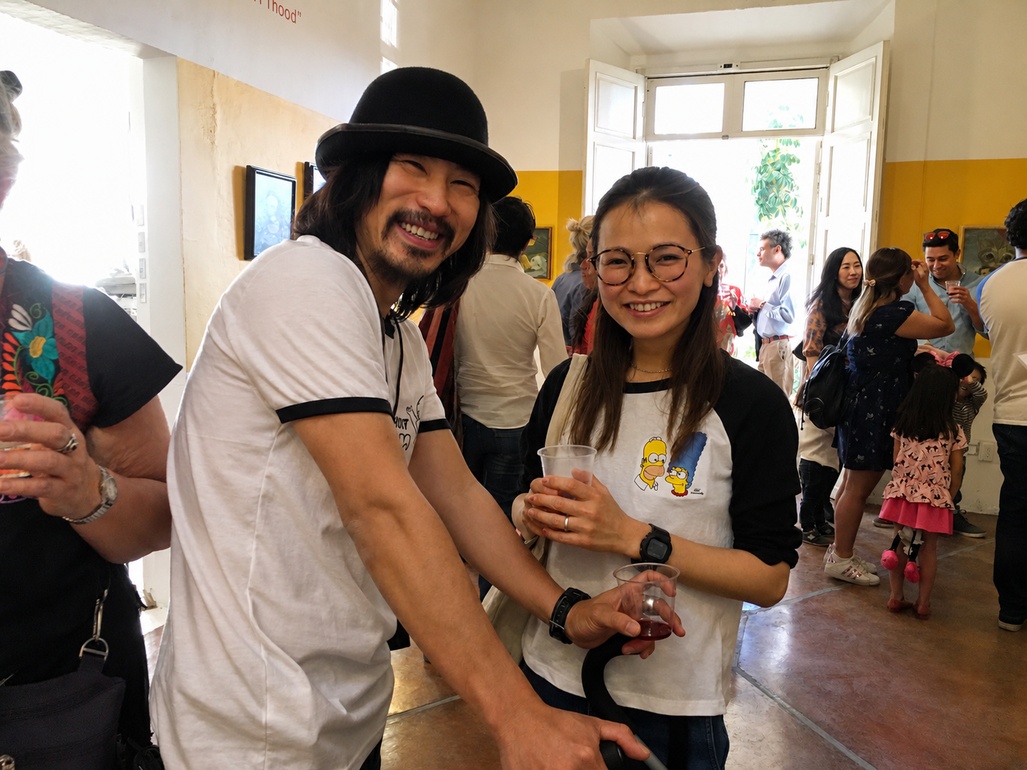
Yui and Ena Sakamoto
*
Gabriela explained that grief wasn't the only challenge waiting for the family. Yui's work was still hanging at Intersección. Paintings had been committed to other exhibitions around the world. Collectors were expecting deliveries. Inventories had to be verified. Questions continued arriving even though the artist who had always answered them was gone. It was then that Gabriela took on the role of a sort of protector, a shield, a conduit between the family and the art world.
As I listened to Gabriela describe the chaos and shock everyone experienced those first weeks after Yui's passing, we both welled up with tears, realizing how similar our experiences were. The circumstances surrounding my father's death had been entirely different, but I recognized the same collision of loss and responsibility. Before you've even had time to absorb what has happened, practical decisions begin demanding attention. Where is the artwork? What has already been promised? Who knows the inventory? Who can be trusted?
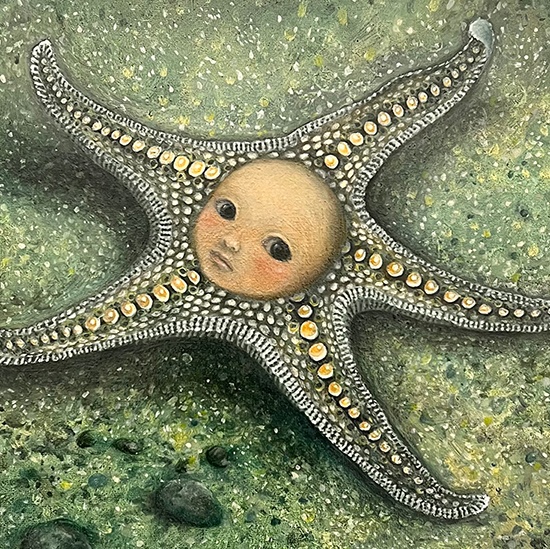
"Suenos Flotantes," Ena Sakamoto
*
For Gabriela, that last question became especially important. "We know exactly what we have," she told me. "We know exactly the prices and the value, and Ena trusts us."
That trust has become the foundation for protecting Yui's incredible work. Gabriela selflessly continues trying to help locate paintings that ended up in galleries around the country, so they can be returned to the family, not because anyone has asked her to, but because she believes those decisions should belong to Ena. "Bring them to Ena," she said. "Then she can decide if she wants to sell them, keep them for the children, or for the future."
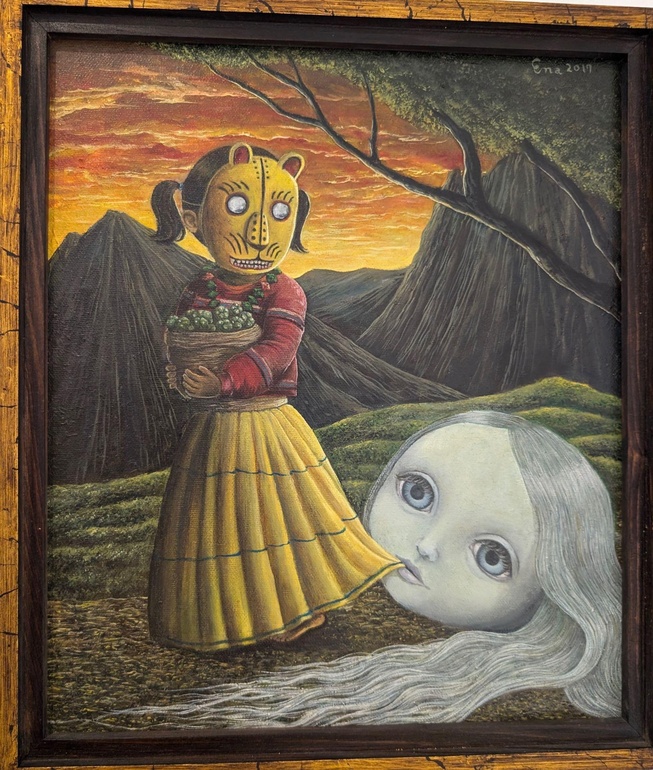
"Mask," Ena Sakamoto
*
Listening to her, I realized her stewardship wasn't about controlling Yui's work. It was about bridging language and cultural barriers, protecting choices until the right people are ready to make them.
In a beautiful posthumous pivot, Gabriela encouraged Ena, herself an artist, to begin painting again after Yui's death. She submitted six paintings to be shown at the gallery. Every one of them was quickly snapped up by collectors. If she wanted to continue creating and selling, she could probably replace the income that Yui brought in - with her own creations.
Perhaps becoming responsible for this process isn't only about preserving what an artist leaves behind. Sometimes it's about making space for creativity to continue in entirely new ways.
***
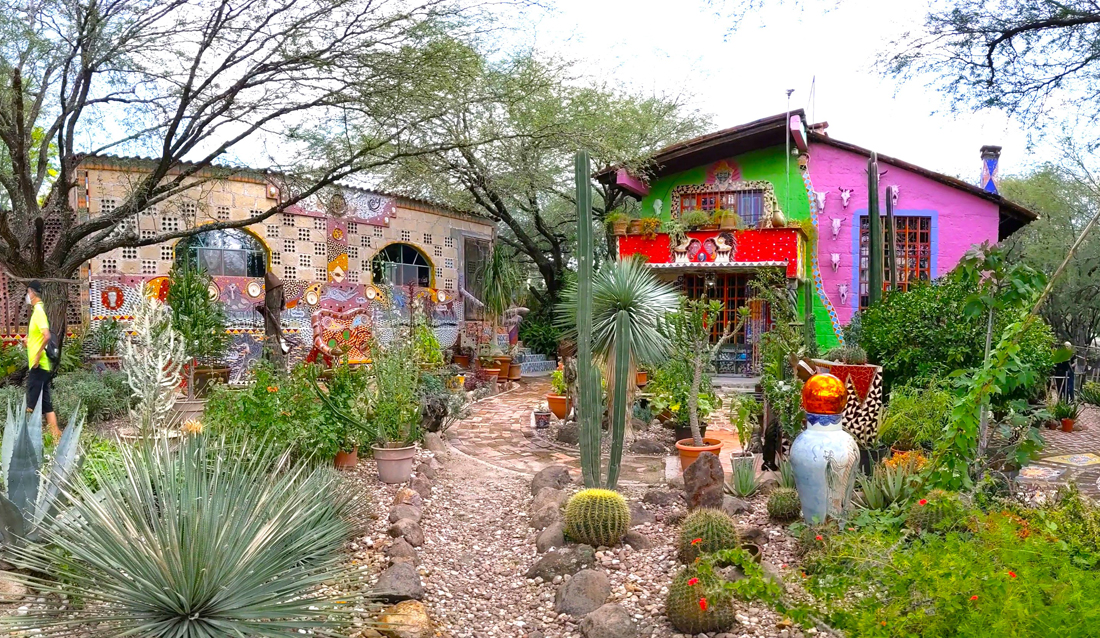
Casa de Las Ranas in La Cieneguita - photo by Marni
Mexican Mosaics- A Living Place
My small connection to Anado McLauchlin's story began just 3 months before my father's death. My friend Julie sent me an itinerary for a week-long mosaics workshop after encountering a glimpse of Casa de Las Ranas from an airport shuttle she happened to share with a lively, fascinating couple - Anado and his husband Richard Schultz.
When I read about the opportunity to create in situ mosaics in an immersive experience with Anado himself, I signed up. It was my first ever visit to San Miguel. It's wild to think that years later, Richard and I would become members of the same overwhelmed caretakers club.

Richard and Anado, image from the book Advanced Love by Ari Seth Cohen
A Community of Inspiration
The workshop wasn't simply "classes." We were completely immersed, spending eight or more hours each day working side by side with Anado and his Mexican crew. Later we gathered for dinners, conversation, and music in the evenings. I found it exhilarating to watch how people responded to them. As they would enter a restaurant dressed in their hilarious bright colors, mismatched socks, and matching white beards, people would rush up to them, gushing and asking for photos. They were true celebrities in San Miguel. Embodying creativity, artistic freedom, and a joyful presence.
One afternoon, Anado asked the group if anyone could cut hair. At the time, I was a professional dog groomer, so I jokingly volunteered. I ended up giving him a haircut, hardly something I imagined when I signed up for a mosaic workshop. It's one of those wonderfully ordinary memories that reminds me how quickly strangers can become friends when you spend long days creating together.
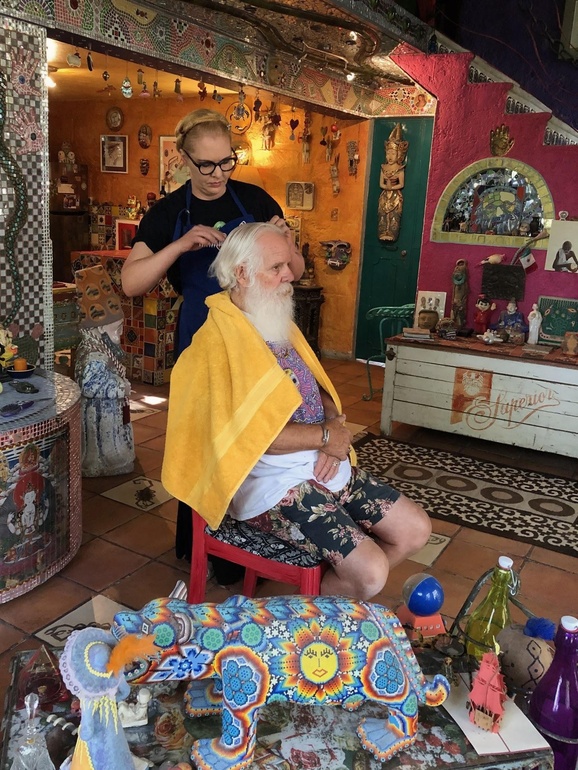
Anado slipped away (cancer) in the spring of 2021. We returned to La Cieneguita in August of 2021 to attend his celebration of life party. Our mosaic work on the walls still shimmered where we had left it. Yet the absence was unmistakable.
For years, visitors had come to see and hear from Anado about his extraordinary life's work. Now it was Richard who quietly carried the responsibility. For him, stewardship means something entirely different from the other stories. It's more than collections and archives. Richard has become the face of an experience - this legacy is alive. Gardens and gallery buildings need tending and repair. Visitors arrive for guided tours, expecting to feel the magic of a place that has become part of San Miguel's artistic identity. I reached out to Richard a few times for a comment. He never got back to me. He was probably busy giving tours.

Posing with some of my mosaic work on the cat wall - outfit inspired by Anado and Richard
***

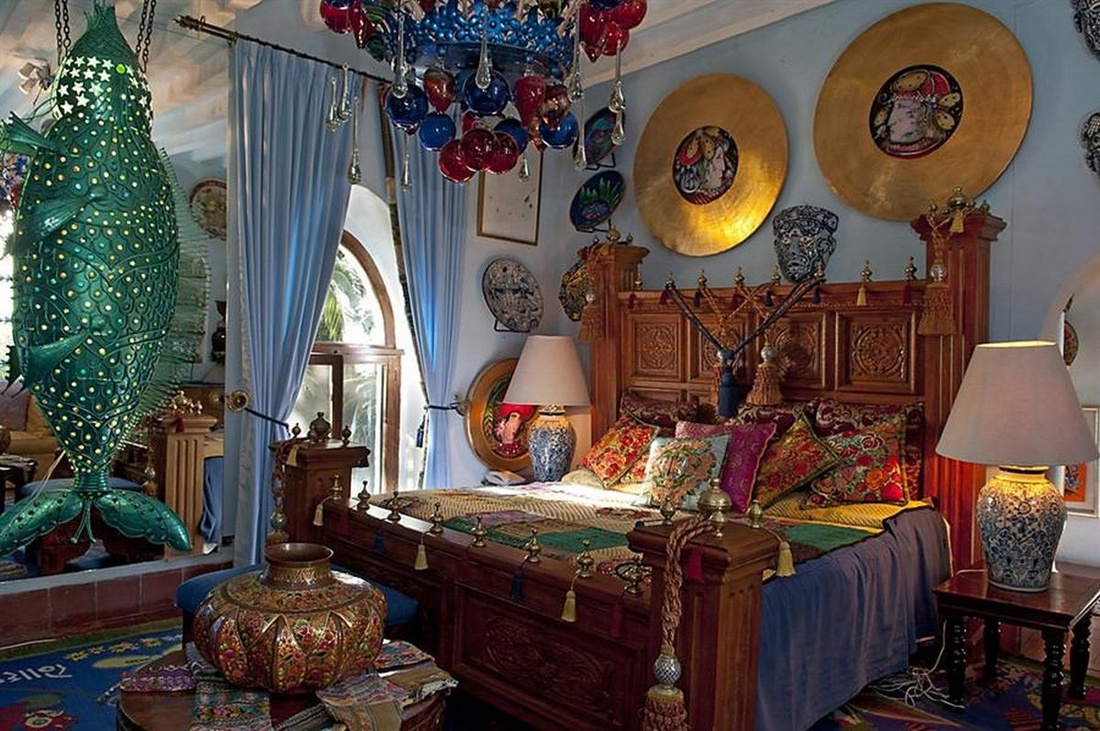
Toller Cranston's San Miguel home
Not Everyone Has A Phillippa - On Toller Cranston, His Estate, And The Sister Who Held It Together
"I got on a plane to San Miguel to go and get him out of a morgue. My only intention was to get him safely tucked away somehow." - Phillippa Baran, Sister of Toller Cranston
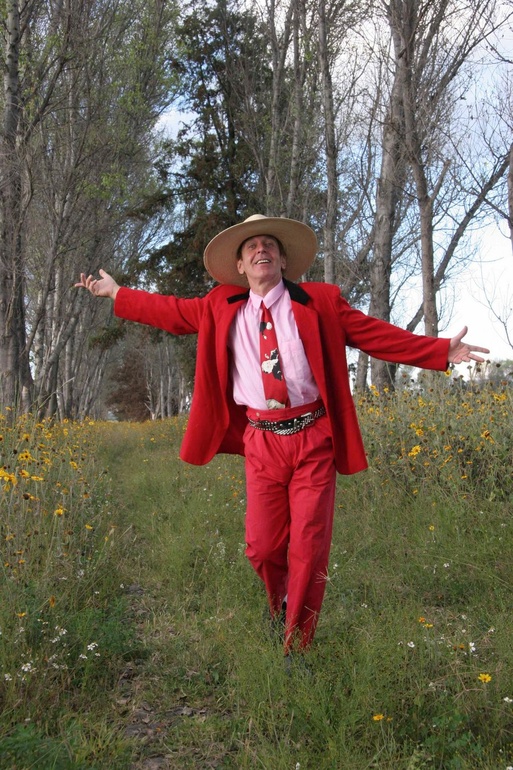
In 2015, groundbreaking Olympic figure skater and internationally acclaimed artist Toller Cranston died unexpectedly of a heart attack at age 65. His rambling San Miguel home and studio property were only one part of the tangle left for his sister Phillippa to sort out.
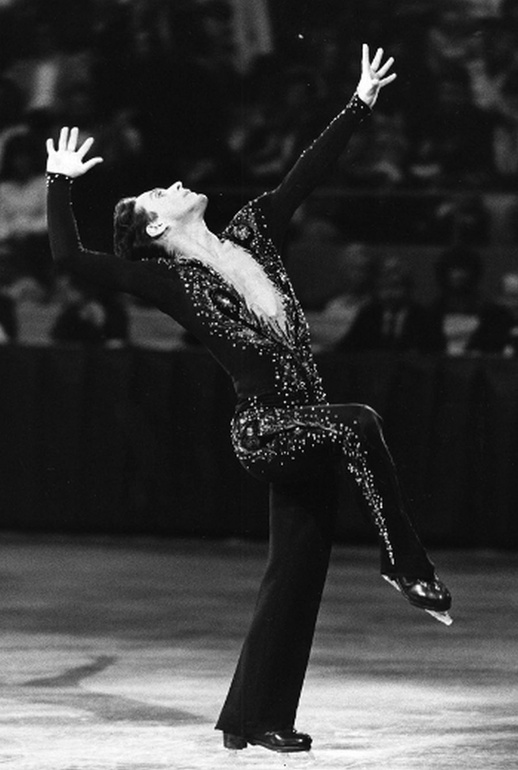
Toller Cranston
*
I had the privilege of interviewing Phillippa about her rather daunting experience. She explained, "The thing that was amazing was, right from the day he dropped dead, we began receiving hundreds of emails and notes. They didn’t say, 'He was a great skater, a great painter, and I loved him, and I loved his work.' It was, 'He made me brave, he made me strong. He made me realize I could be who I am, that I could live authentically.'"
The practical challenges she faced were staggering. He left behind an invalid handwritten will, two properties, more than 500 paintings and drawings, 18,000 inventoried objects, unfinished commissions, artwork scattered among galleries and collectors, all hamstrung by a frightening lack of paperwork.

Tollers Living Room in San Miguel Home
Toller's property had to be emptied in just forty-five days. Estate companies refused to take on something so large and complicated. Every piece of his art had to be measured, photographed, catalogued, valued, and traced. There were works on loan, commissions that had been paid for but never delivered, collectors making claims, and no inventory to determine what was actually out in the world. But what struck me most wasn't the logistics. It was the clarity of her purpose.
"I knew right from the beginning," she said, "that it was imperative to protect his legacy. I thought, this is really, really important work that I'm doing because I want people to remember the bravery, the courage… to live authentically," she revealed with an intensity, "I came to be in charge, but it was a task that I embraced. Oh, and I'm super proud of how it was done."
The work consumed years of her life. She and her husband advanced more than half a million dollars to keep the estate functioning until assets could be sold. Legal disputes dragged on for nearly a decade, delaying books, exhibitions, and even the ability to reproduce images of his artwork. Yet she says she doesn't regret a moment of it.

Phillippa Baran
"There were thousands of things... not counting the paintings," she told me. "There were chandeliers he had designed, gorgeous custom furniture, antiques, carpets, statuary... it was a spectacularly huge job."
Her experience also changed the way she thinks about artists' estates. "If a family doesn't have a me... or a you... or a Richard... unless there's somebody there to make sound decisions about how to deal with the artwork, it's just going to tank."
My dad had a me. As I've said before, I can't imagine what would have happened to my father's legacy without the obligation I felt to care for it.
Her advice to artists is simple but rarely executed. Keep records. Maintain an inventory and update it every couple of years. Document where every piece is located. Sit down with the person who may one day become your executor and explain your wishes while you still can. Otherwise, she warns, your years of work can quickly lose both financial value and historical context.
Phillippa Baran has authored two award-winning, best-selling books on Toller: Toller Cranston: Ice, Paint, Passion (2024) and Toller Cranston: Artistic Impressions (2025). In our interview, I learned that she is completing a third, currently titled EXECUTOR: Battle Scars and Wisdom — with the gritty subtitle: Lessons from the ten-year, soul-destroying, financially horrifying, and utterly uplifting precedent-setting battle of the Toller Cranston estate. You can find out more at www.tollerinternational.com.
Phillippa and the rest of us learned things the hard way, in real-time crisis, with no guidance. I wondered what these situations looked like from a professional's point of view.
Toller Cranston
***
The Estate of Things
San Miguel artist Shannon Reece, co-owner of ShanSales, has spent more than two decades helping people navigate these highly charged situations. She immediately confirmed what I'd been discovering. "The provenance is everything," she told me. "An artist's estate really needs someone who can identify the work, document it, establish authenticity, and preserve the story behind it. The stories sometimes sell the pieces more than the provenance."
Shannon reminded me that artists don't have to create some elaborate archive system. A simple video with your phone, walking through the collection, explaining when and where pieces came from, why they were important, and what they meant, can be invaluable to those left behind to deal with your stuff.
"I actually did that myself," she admitted with a laugh, "It's so weird that you reached out about this now!" Shannon revealed that just before we spoke, she recorded a simple phone video of her own collection, explaining each piece and how/why/where it came from.

Inventory your work!
The Art of Stewardship
Before beginning this research, I felt really alone in this process. But once I began talking to these fellow stewards, it was truly uplifting to hear how they managed it, through the minefields of grief and frustration. This work is so much larger than preserving someone's art collection. It means preserving context, stories, communities, even places. It's making sure that years after an artist is gone, someone can still walk into a living environment, stand before a painting, or sit quietly in a gallery and feel that artist's life and personality through their work.
Every creative hopes to leave behind something beautiful for the world to enjoy, but I suppose our conditioned fear of death means they seldom think about making a plan. Every caretaker I spoke to would probably say, "Get over it!" Ask someone you trust to help you leave a more manageable job for the invisible but dedicated guardians out there - ensuring that your lifetime of creation lives on.
See part one of this article
**************
Marni Hills is a QHHT Practitioner, writer, photographer, and lover of all things weird and unusual. She is an ancient astronaut theorist, dog foster, DJ, and is obsessed with travel, fashion, the Gaia Channel, never-before-seen footage, and mountaineering disasters. She made San Miguel her home in early 2022.
Marni's previous articles
**************
*****
Please contribute to Lokkal,
SMA's online collective:
 ***
***
Discover Lokkal: Mission

Visit SMA's Social Network
Contact / Contactar