 Español
September 27, 2026
by Charles Miller
Last week in this space I pointed a few jabs at my friends I will call John and Jane Doe. For the longest time they complained that their internet speed was too slow, but they would never listen to my suggestions with regards to what to do about it. When they finally did decide to listen, and agreed to purchase a new router, the results were immediate. They both agreed all of their internet usage appeared to be much faster than before. And they were confused to see that the speed of their internet actually measured a bit slower than it had measured just before the new router was installed.
So what was the real reason their internet had seemed to be so slow before, and why did it seem to be much faster with a new router even though the actual measured bandwidth was just a bit slower than before? First of all, bandwidth speeds rise and fall from test to test. That is just how it is. Second, the speed of the internet seemed to be much faster because all their internet connections were being routed more efficiently by the new router. It is a question of efficiency and not speed.
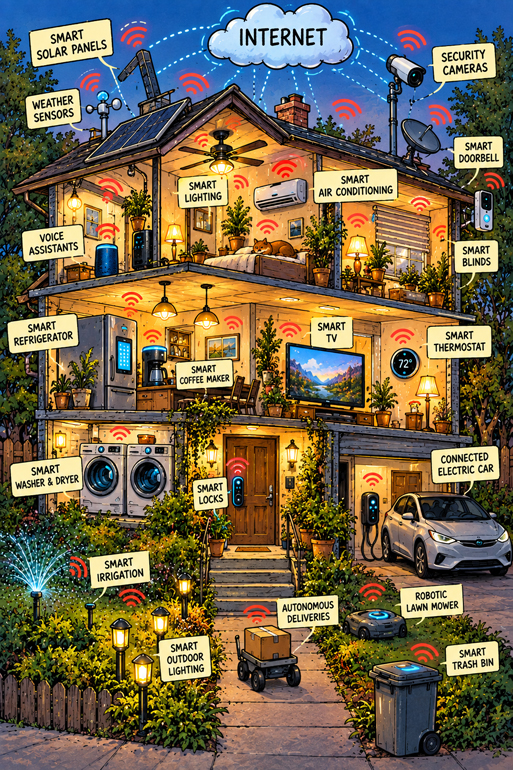
Remember that John and Jane have a large number of Internet of Things devices including multiple computers, smart phones, televisions, printers, lawn sprinklers, stoves, refrigerators, solar panels, security cameras, thermostats, door locks, medical devices, light bulbs, light bulbs, and more light bulbs. They were trying to connect everything through the modem/router provided by AT&T. The ISP was delivering more speed to John and Jane than they needed, but that speed was encountering a bottleneck inside their house when their low-end modem/router just could not handle the load.
Internet Service Providers (ISPs) frequently provide hardware that combines a modem and a router. To maintain company profit margins and avoid giving away expensive network hardware many users do not actually need, most ISPs provide the lowest-cost modem/routers they can source. Consequently, these units are typically built with minimal Rapid Access Memory (RAM) and an underpowered single-core Central Processing Unit (CPU). This low-performance network hardware is okay for "average" usage scenarios, assuming most customers will only browse the web or stream video from a single device. But increasingly this profile no longer fits the modern household.
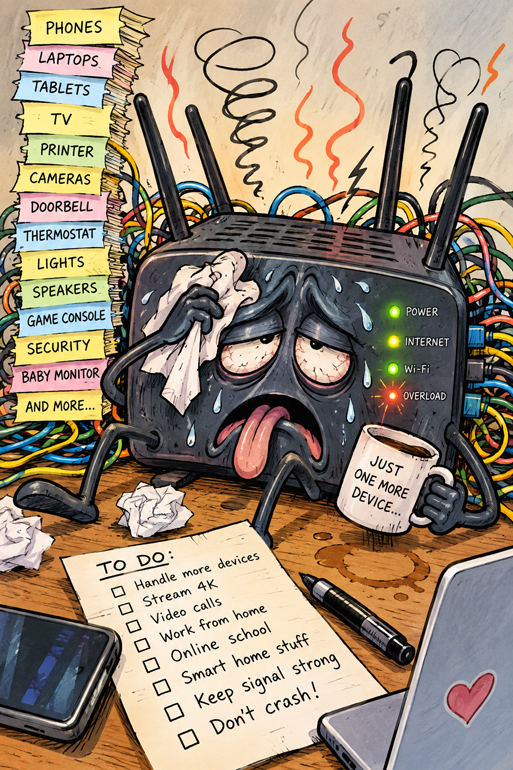
When the RAM of an under-powered router fills up, the device begins to swap data to slower storage or simply drops connections, leading to lag, packet loss, and frequent disconnections. Modern networking protocols can demands Quality of Service to prioritize gaming or video calls, complex firewall inspections, etc. Any overworked CPU will overheat, and overheated electronics slow down further exasperating the problem.
Putting it another way, you can have the fastest broadband internet in your neighborhood, but if you access it through a low-quality router that lacks the capacity to route incoming traffic to the correct devices fast enough, your internet speed seems to slow to a crawl. An inexpensive low-end router such as provided by the ISP does not have the capacity to efficiently manage hundreds of concurrent connections, maintain stable speeds during heavy loads, and handle advanced traffic management without overheating.
Installing the correct secondary router with significantly more RAM and a faster multi-core processor can solve these bottlenecks if the network design is properly executed by a knowledgeable network technician.. A more expensive router can do all of that, thus ensuring a stable, high-performance network capable of supporting all the dozens of devices John and Jane have in their modern digital household.
**************

Charles Miller is a freelance computer consultant with decades of IT experience and a Texan with a lifetime love for Mexico. The opinions expressed are his own. He may be contacted at 415-101-8528 or email FAQ8 (at) SMAguru.com.
**************
*****
Please contribute to Lokkal,
SMA's online collective:
 ***
***
Discover Lokkal: Mission

Visit SMA's Social Network
Contact / Contactar