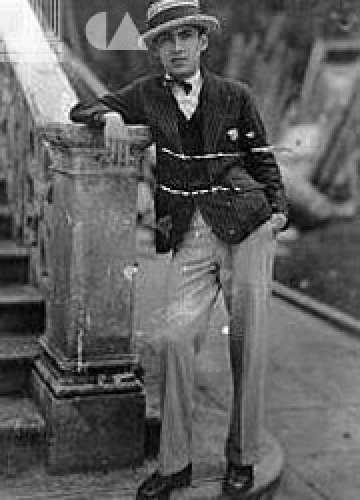
Arqueles Vela
Español
September 6, 2026
by Philip Gambone
On April 12, 1924, a group of young, avant-garde Mexican writers and artists threw a party in Mexico City's Café Europa. At the gleeful and irreverent soirée, they presented their new work to the public. Some recited poems, others displayed their paintings, masks, or photography. These break-away whiz kids were part of a new artistic movement called Stridentism. They were a raucous faction intent on shocking the middle class and raising high the banner of the modern. (See my "'Chopin to the Electric Chair!': Mexico's Stidentist Poets," Lokkal, April 19, 2026.)
The Café Europa, located on what is now the Avenida Álvaro Obregón, was the locus of the Stridentist movement, "our intellectual and sentimental laboratory," one member called it. In his study of their café culture, Luis Mario Schneider writes, "In addition to conversations and discussions between cups of coffee, alcohol and cigarettes, the fundamental projects for the conduct of the movement were carried out." These projects included exhibitions, the creation of a publishing house, and the printing of a Stridentist magazine.
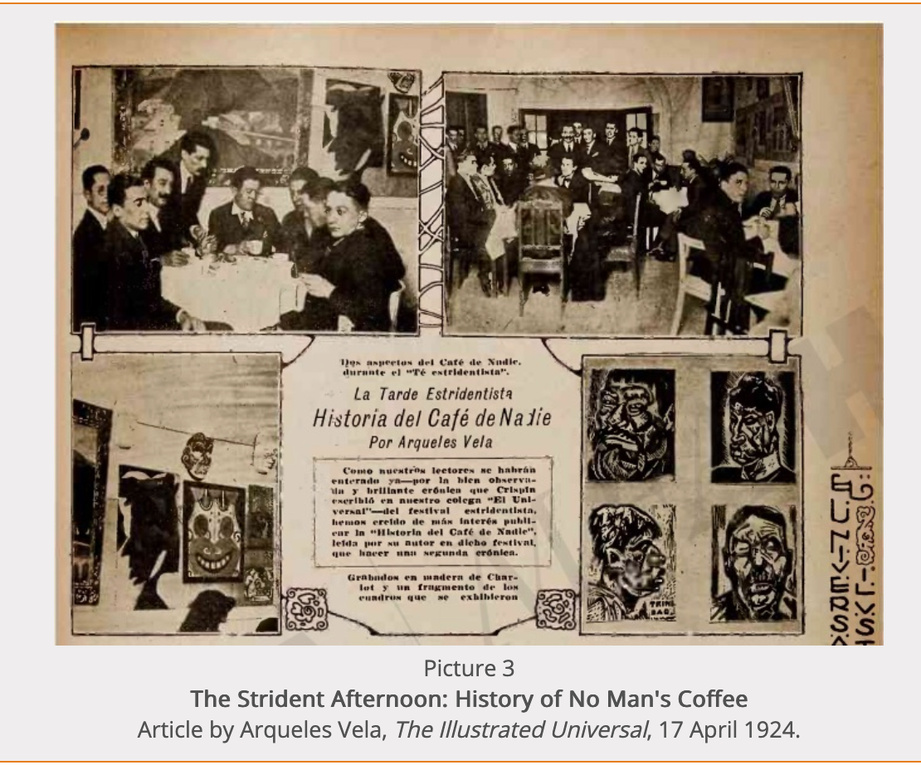
At the April 1924 gathering, billed as a "Tarde Estridentista," one writer in the group, Arqueles Vela, read excerpts from his short novel titled El Café de Nadie, a fictious café inspired by the Café de Europa. According to legend, another Stridentist had walked into the Europa one day, found no one and nothing but a pot of coffee, served himself a cup, drank it, and left a tip for the waitress he never once saw. Vela (1899-1977) picked up on this idea of a place of anonymity, where no one sees you, no one bothers you—nobody's café—and gave the Europa its new name. He presented the café, writes María del Carmen Domínguez Gutiérrez, as "a timeless bubble offering an escape from the perpetual motion—the 'ferocious disorder' of the Mexican city."
Arqueles Vela's novel opens as customers wander into the café from the teeming, sunlit avenue outside, entering "the subway of dreams." Here is a place where "every emotion, every feeling, becomes static and entrenches itself within this atmosphere of a ruined, abandoned city—a city ravaged by prehistoric catastrophes of casual patrons and revelers." The atmosphere is listless, impassive, spent—in a state of "lazy stretching." It is a place characterized by "webs of silence, words, and laughter not yet swept away by the feather duster of new conversations."
Even these brief quotations give a good sense of Vela's style—the surrealism, the word play, the use of foreign words, the delicious exaggeration. We have entered a world that deliberately scoffs at convention and at conventional storytelling. Everything is a bit off balance.
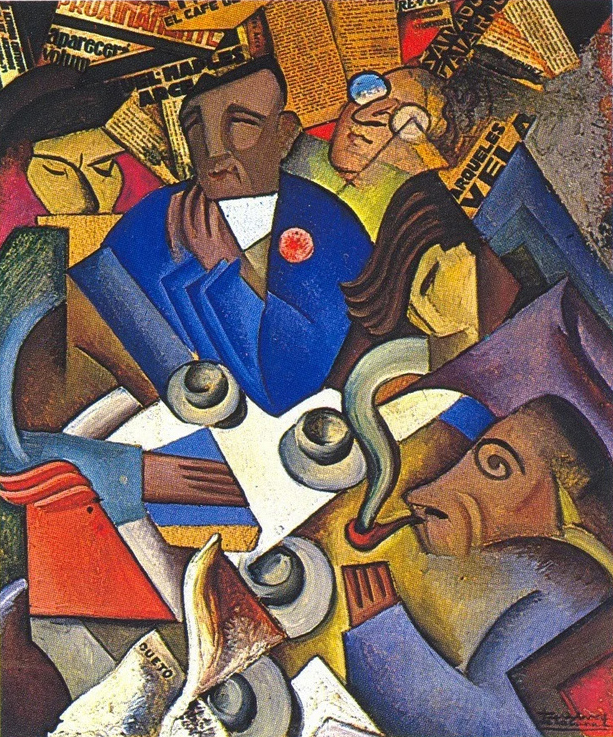
Café de Nadie, by Ramón Alva de la Canal, 1926
*
Two men, regulars at the café, enter and take a booth. One adjusts his suit and fastens his buttons, "convinced that without these rituals his ideas would escape him." The other "looks as though he has just fallen—possessing the vague instability of a vertical line that has yet to settle at its final resting point." He has the air "of a suit left forgotten on a coat rack." The two men let the hours drift by. They don't talk, don't argue, don't move. They're like cigarette ashes.
A woman enters. Her name is Mabelina, the only named character in the novella, a woman of many "poses collected like costumes in a museum." Her lively, mischievous eyes "flutter over the booth numbers, searching for the exact figure that will solve her sentimental equations." The booth she wants is occupied by the two men. Vela pours on the sultry, dreamlike prose: "Her cheeks flush slightly, then burn—ashamed to see themselves reflected in that sordid atmosphere of shouts, smoke, arguments, and flirtations; an atmosphere she had expected to intensify alongside the disarray of the night that was tumultuously deepening within her spirit." She hurries out, "avoiding the gaze that pursued her through a fog of incomprehension."
The lights in all the private booths are switched on. After the two men leave the Café, Mabelina returns and, adopting an air of indifference, enters the nearest booth, the one "furthest removed from her own life." She begins to reminisce about "him," a man who had not wanted "to get entangled in any incident, or in any task as complex and bothersome as making love to a woman." And yet, despite his reticence to make love, the man used to pour on the charm, speaking "from behind the sheer curtains of his sentimentality, as if in a dream: 'I find you at every crossroads of the heart—places situated beyond unreality, further away still.'" The brilliance of his "mental musings" would throw Mabelina into disarray and drown her in light, "as if she had been suddenly transported to one of those electrical appliance displays where every object swells with luminosity."
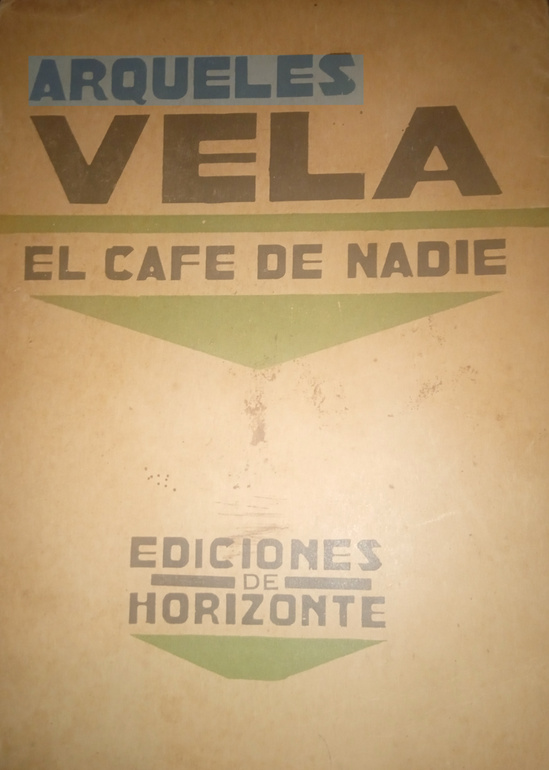
Café de Nadie (first edition)
*
She remembers how the two of them once took a taxi to the Café and how the man had confessed to being "an individual constantly renewing himself. An individual you will never be able to pin down. An individual you will constantly mistake for someone. Every day, the man you kiss in me is different." But now the man is there in the Café, and the two resume their coy flirtation. Mabelina confesses that, among all her paramours, he is her favorite. "The others are so indiscreet, so prying, and above all, so impertinent. You, on the other hand, try to sidestep what is said or asked of you; you try to lighten things up, throw people off the scent, and smooth things over—even if you end up tangling and unraveling it all later."
She tells him he was unlike her previous admirer, Androsio, who "with the air of a fashion designer or a window dresser," used to untie and retie the ribbon of her slippers, all the while extolling the color of her stockings and checking their quality. All Androsio wanted was for the two of them to be like "those hypothetical hotel guests returning from some city on a train that never arrives—passengers who are nothing more than tourists of love."
Some of the Estridentistas were homosexual, and here I detect Vela either making fun of the closeted and effeminate behavior of his gay compañeros—more passionate about women's fashion than about their bodies—or perhaps alluding to his own predilections. "You surprise me, excite me, and intrigue me," the man tells her, "because your legs look like they were taken from the women who advertise Holeproof stockings, and your breasts have the same luminosity, the same incandescence as the lamps adorning grand ballrooms—they seem made of the ice cream of voluptuousness." He, too, seems primarily interested in her because of her associations with fashion and fashionable society.

La señorita Etcétera
*
By now, dawn is breaking. The waiters clean up, moving chairs, which, in their "brazen embrace," refuse to let go of one another. They struggle to disentangle the chairs—and here is Vela at his most humorously campy—"much like madams grappling with girls who refuse to leave the arms of the man who orders nothing, who looks at none of the other women, who doesn't even buy cigarettes in that establishment, and yet is seen there every night, like a missionary." After sprucing up the booths—except the one occupied by the two regulars—the waiters, "survivors of the daily catastrophe," retreat to the corners where they wait, settling the matter of tips and gossiping about Mabelina and women in general.
There follows a list of names of the members of the Estridentista movement. Perhaps they have been Mabelina's lovers; perhaps she has been a muse to each of them. "With each of them, she had felt like a different woman—shaped by their psychology, their manners, their tastes, and their passions—and now she was barely a sketch of herself." As she recalls the emotions she used to enjoy with these café guests, "who had attended the conviviality of her life," she begins to lose all sense of herself. From feeling so much, she has become numb. She longs to rebuild herself "using those thousandths of a woman she had left behind in all those men—without them ever trading those fragments for the thousandth of a man she herself sought." If Vela has been campy, humorous, surreal, and theatrical in the earlier parts of his novella, now he shows himself to be an exquisite poet of female psychology, or at least of the psychology of this one woman, a Mexico City café habitué of the 1920s.
As the novella comes to an end, Mabelina awaits her final adventure. "One must spend, must squander life," she tells herself, "to outwit death. To thwart its purposes. May it find us exhausted, dead, useless, worthless. May it take nothing from us but the dregs, what we couldn't use, because it was unusable, disposable." Closing her handbag—"as if wishing to leave her thoughts behind inside it"—she crosses the Café, glancing back at her memories. The only light still on in the Café comes from the private booth occupied by the two regulars. Upon spotting it, Mabelina hesitates for a moment. Then she pushes open the café's door and walks toward the dawn on the city skyline.
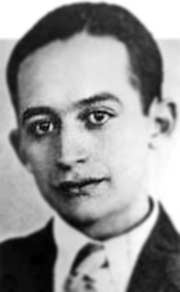
Arqueles Vela (1899-1977)
*
El Café de Nadie is considered Mexico's first "anti-novel," one that turned away from the traditional social-realist novels of the day and presented reality in a new—one might say "Cubist"—way. A host of scholars have weighed in on what Vela's intriguing novella means. In her book on the Latin American revolutionary novels of the 1920s, Elizabeth Coonrod Martínez writes that Vela was signaling that it was time for the Stridentist movement to enter a new era. "Vela wanted to demonstrate that artistic knowledge needs to move toward the sun or a new center of inspiration. To move there, however, one must leave everything behind and take great risk…. The artist does not look back, but perhaps hesitates for a moment (as Mabelina does at the door before exiting), moving, changing, evolving, like life and society."
Stephan González says that Vela's café is presented as the place where the danger of demonization lurks. It unmasks, he writes, "the myth of a civilization based on electricity, the foxtrot, the automobile, the Charleston, the telegraph, the speed of illuminated signs, the new sexual freedom, and casual, fleeting relationships."
For me, Vela's novella can also be enjoyed simply for its sheer verbal extravagance, its campy humor, and its portrait of one avant-garde hangout during Mexico's "Roaring Twenties." The Spanish version is easily found on line. A good English translation by Julianna Neuhouser is available in a set with two of Vela's other short, modernist fictions under the title Señorita Etcetera.
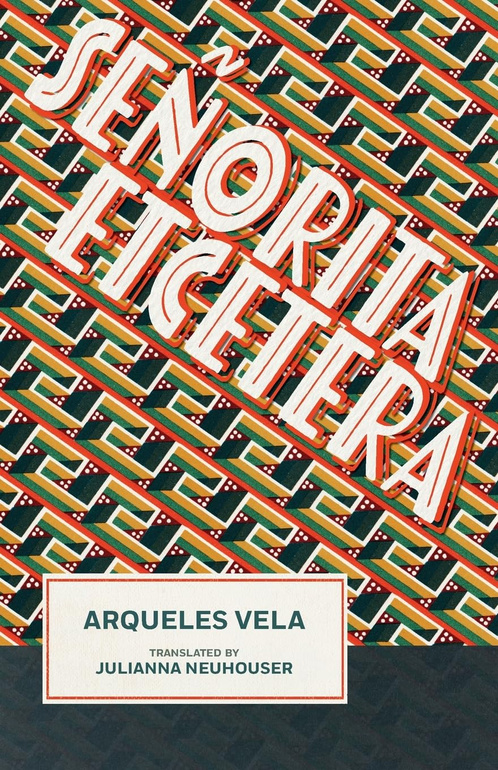
Señorita Etcetera
**************

Philip Gambone, a retired high school English teacher, also taught creative and expository writing at Harvard for twenty-eight years. For over a decade, his book reviews appeared regularly in The New York Times. Phil is the author of seven books. His memoir, As Far As I Can Tell: Finding My Father in World War II, was named one of the Best Books of 2020 by the Boston Globe. His new collection of short stories, Zigzag, was published last year by Rattling Good Yarns Press. His books are available through Amazon, Aurora Bookstore, and at "Tesoros," the bookshop at the Biblioteca.
The more than 100 articles about writers in Mexico which Phil has published in Lokkal are now available on his website:
www.philipgambone.com
**************
*****
Please contribute to Lokkal,
SMA's online collective:
 ***
***
Discover Lokkal: Mission

Visit SMA's Social Network
Contact / Contactar